This paper argues that user interfaces need to be explainable whether or not they contain artificial intelligence components. Even with the best design, complex applications often leave users confused; this is exacerbated on small touchscreens, where small slips can lead to markedly different outcomes and when notifications or intelligent agents may autonomously change the interface. This can be disorienting even for the most tech savvy user, but doubly so for those less confident or with motor-control issues. We are often left asking “what just happened?” or “how can I do this again?”. We need explainable user interfaces.
References
- Archer, J., Conway, R. and Schneider, F. (1984). User recovery and reversal in interactive systems. ACM TOPLAS, 6: 1-19.
- Berlage, T. (1994). A selective undo mechanism for graphical user interfaces based on command objects. ACM TOCHI, 1: 269-294.
- Blackwell, A., Britton, C., Cox, A., Green, T., Gurr, C., Kadoda, G., Kutar, M., Loomes, M., Nehaniv, C., Petre, M., Roast, C., Roe, C., Wong, A. and Young, R. (2001). Cognitive dimensions of notations: Design tools for cognitive technology. In Proc. CT 2001. Springer, 325–341.
- Chilton Computing (2022) PERQ History. https://www.chilton-computing.org.uk/acd/ sus/perq_history/ (last site build 9/10/2022, accessed 6/6/2025)
- Cook, W. (2007). AppleScript. In Proceedings of the third ACM SIGPLAN conference on History of programming languages (HOPL III). Association for Computing Machinery, New York, NY, USA, 1–1–1–21.
- Dix, A. (1992). Human issues in the use of pattern recognition techniques, in: Neural Networks and Pattern Recognition in Human Computer Interaction, Ellis Horwood, pp. 429–451. https://alandix.com/academic/papers/neuro92/.
- Dix, A., Finlay, J., Abowd, G. and Beale, R. (2004). Human-Computer Interaction, 3e. Prentice Hall. ISBN 0130461091. https://hcibook.com/e3/
- Dix, A. (2022). Follow your nose: history frames the future. Keynote at AVI 2022: Advanced Visual Interfaces, Rome, Italy, 6-10 June 2022. https://alandix.com/academic/talks/AVI2022-keynote/
- Dix, A. (2024). Just Counting – a tool ecosystem for personal numeric information. Proc. of AVI 2024, Article No. 11. doi:10.1145/3656650.3656658
- EU (2024). Council of the European Union. Position of the Council on General Data Protection Regulation. Technical Report. Council of the European Union, 8 April 2016. http://www.europarl.europa.eu/ sed/doc/news/document/CONS_CONS(2016)05418(REV1)_EN.docx/ accessed 01/12/2024.
- Fogarty, S. (2005). Binary Opposition. The Literary Encyclopedia. (First pub. Feb 2025) ISSN 1747-678x. https://litencyc.com/php/stopics.php ?rec=true&UID=122 (accessed 7/6/2025)
- Goodman N. (1976). Languages of Art, 2nd edn. Hackett, Indianapolis.
- Guidotti, R., Monreale, A., Ruggieri, S., Turini, F., Giannotti, F. and Pedreschi, D. (2018). A survey of methods for explaining black box models, ACM Computing Surveys 5:1–42.
- Hassija, V., Chamola, V., Mahapatra, A., Singal, A., Goel, D., Huang, K., Scardapane, S., Spinelli, I., Mahmud, M. and Hussain, A. (2024). Interpreting black-box models: a review on explainable artificial intelligence, Cognitive Computation 16:45–74. doi:s12559-023-10179-8.
- Kay, A. (1984). Computer Software. Scientific American 251, 3 (sept 1984), 52–59. Also published as Viewpoints Research Institute Technical Report TR-1984-001. https://web.archive.org/web/20171222015552/ http://www.vpri.org:80/html/writings.php.
- Kluyver, K. Ragan-Kelley, B., Pérez, F., Granger, B., Bussonnier, M., Frederic, J., Kelley, K., Hamrick, J. Grout, J., Corlay, S., Ivanpv, P., Avila, D., Abdali, S., Willing, C., and Jupyter Development Team. (2016). Jupyter Notebooks – a publishing format for reproducible computational workflows. In F. Loizides and B. Schmidt, editors, Positioning and Power in Academic Publishing: Players, Agents and Agendas. IOS Press, Amsterdam.
- Krasner, G. and S. T. Pope, S. (1988). A cookbook for using the model–view–controller user interface paradigm in Smalltalk-80. JOOP, 1(3).
- Meixner G, Paternó F, Vanderdonckt J (2011) Past, present, and future of model-based user interface development. i-com 10(3):2–11
- Norman, D. (1998). The Design of Everyday Things. Cambridge, MA: MIT Press.
- Pfaff, G. and ten Hagen, P. eds. (1985). Seeheim Workshop on User Interface Management Systems. Springer-Verlag, Berlin.
- Quinn, A., and Alvaro, P. (2025). Deterministic Record-and-Replay. Communications of the ACM, 68(5), 32-34.
- Reason J. (1990). Human Error. Cambridge University Press, Cambridge, UK.
- Victor, B. (2011). Explorable Explanations. http://worrydream.com/ExplorableExplanations/ (dated March 10, 2011, accessed 7/6/2025)

|

TANGO – it takes two to tango – a synergistic approach to human-machine decision making. An EU Horizon funded project
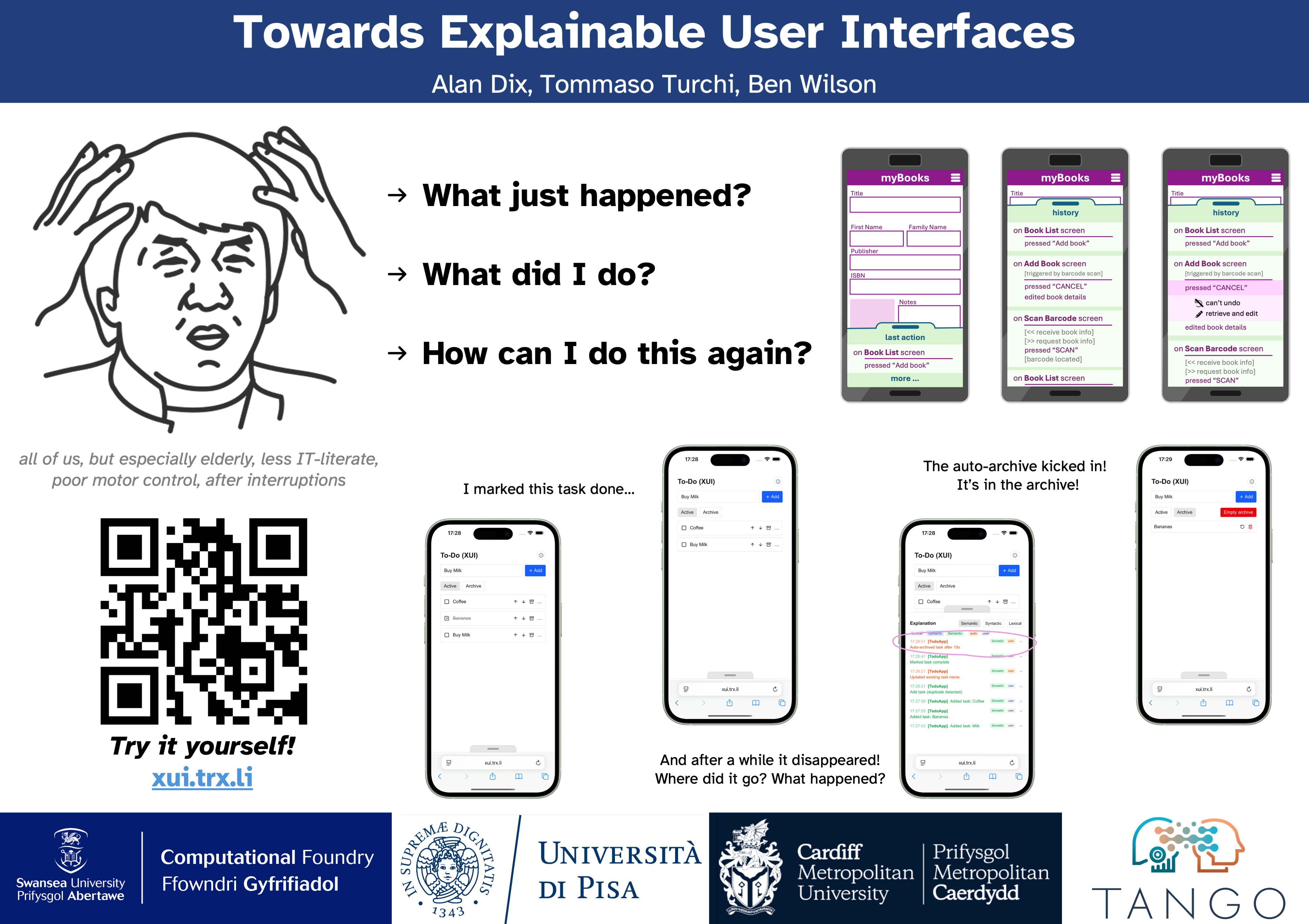
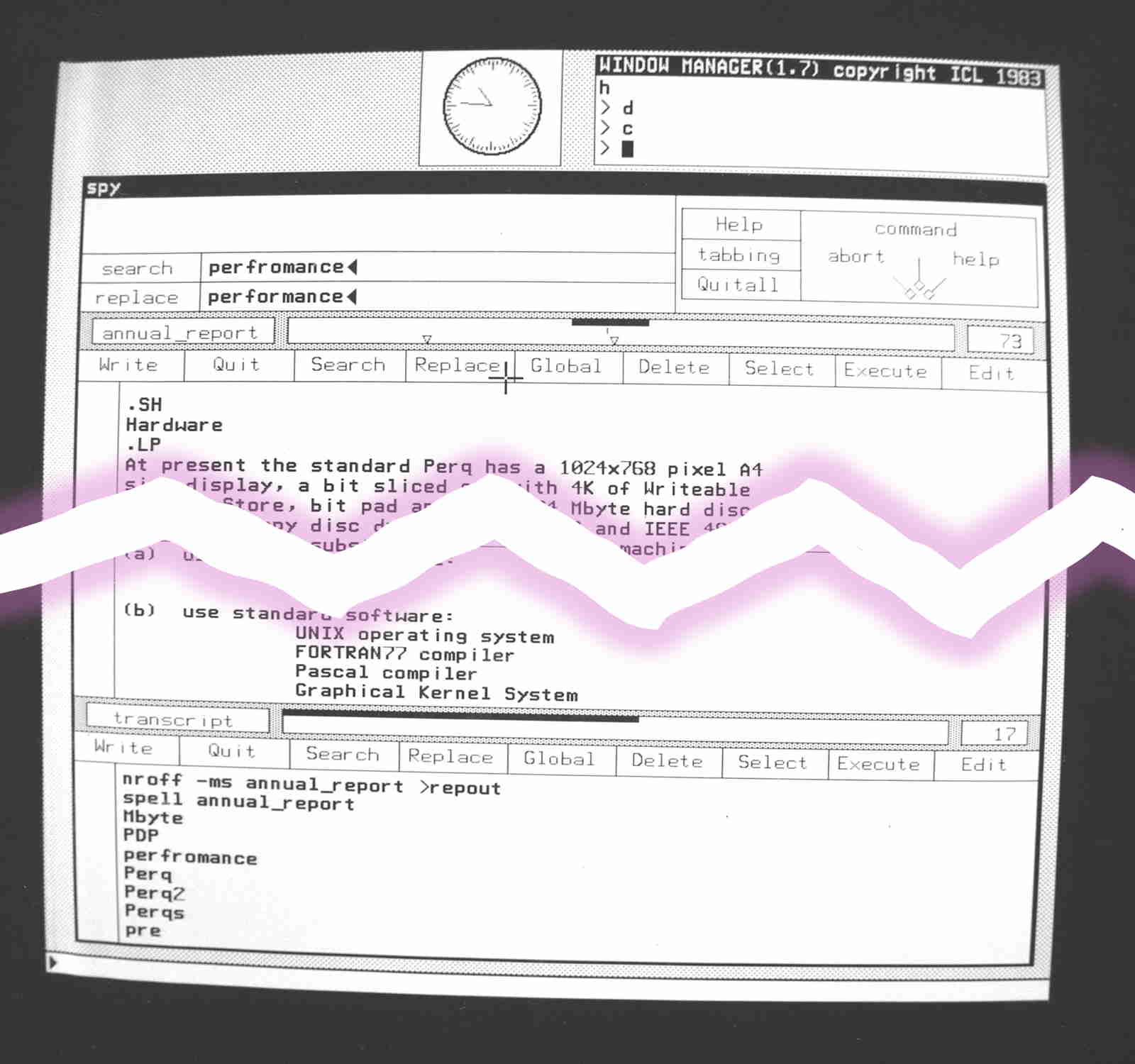
Figure 1. RAL's SPY Editor – Note UNIX shell in bottom pane. (Source: Chilton 2022, section 36; © UKRI Science and Technology Facilities Council, 1983)
[zoom image]
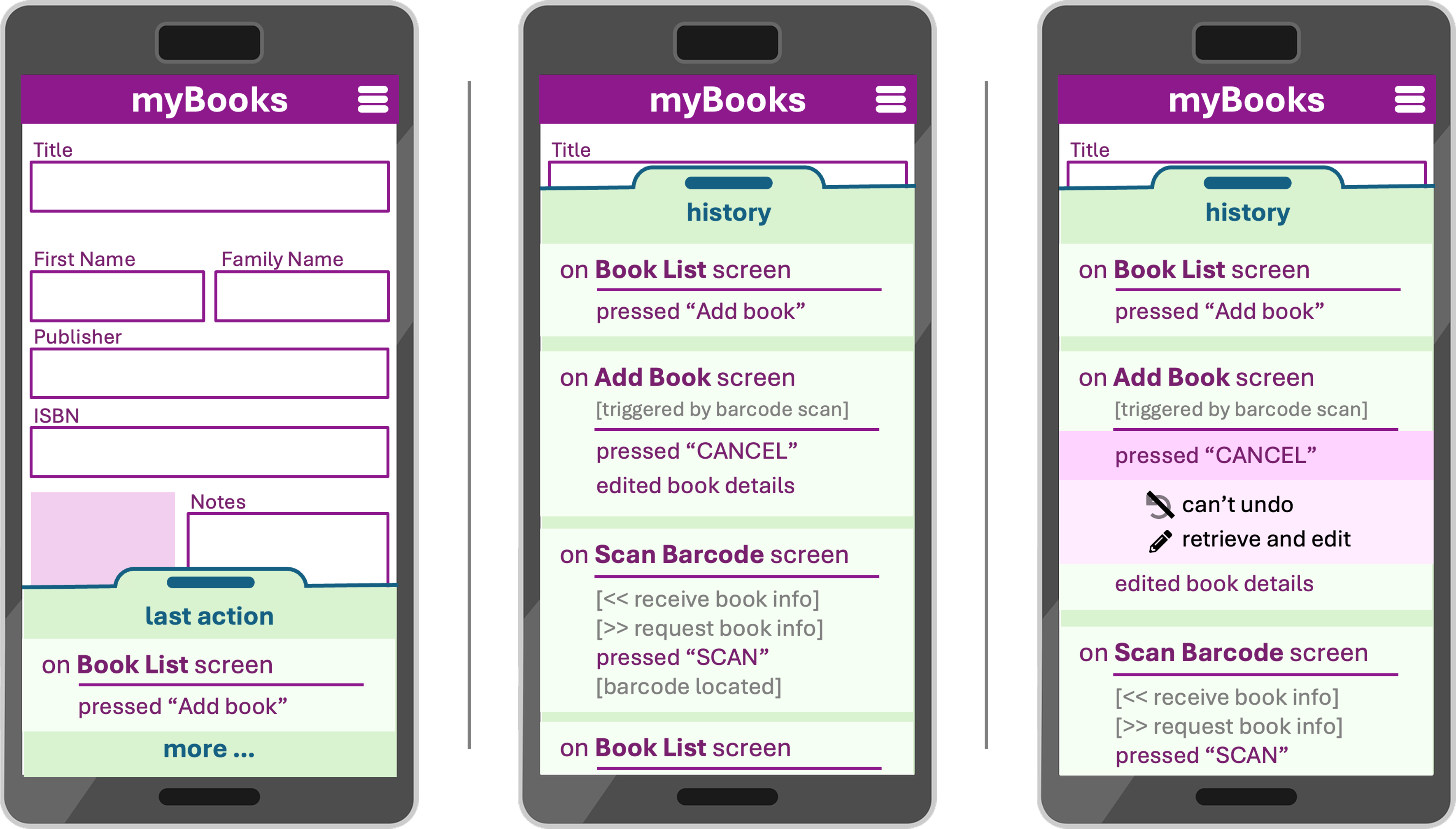
Figure 2. Application with history – envisionment.
[zoom image]
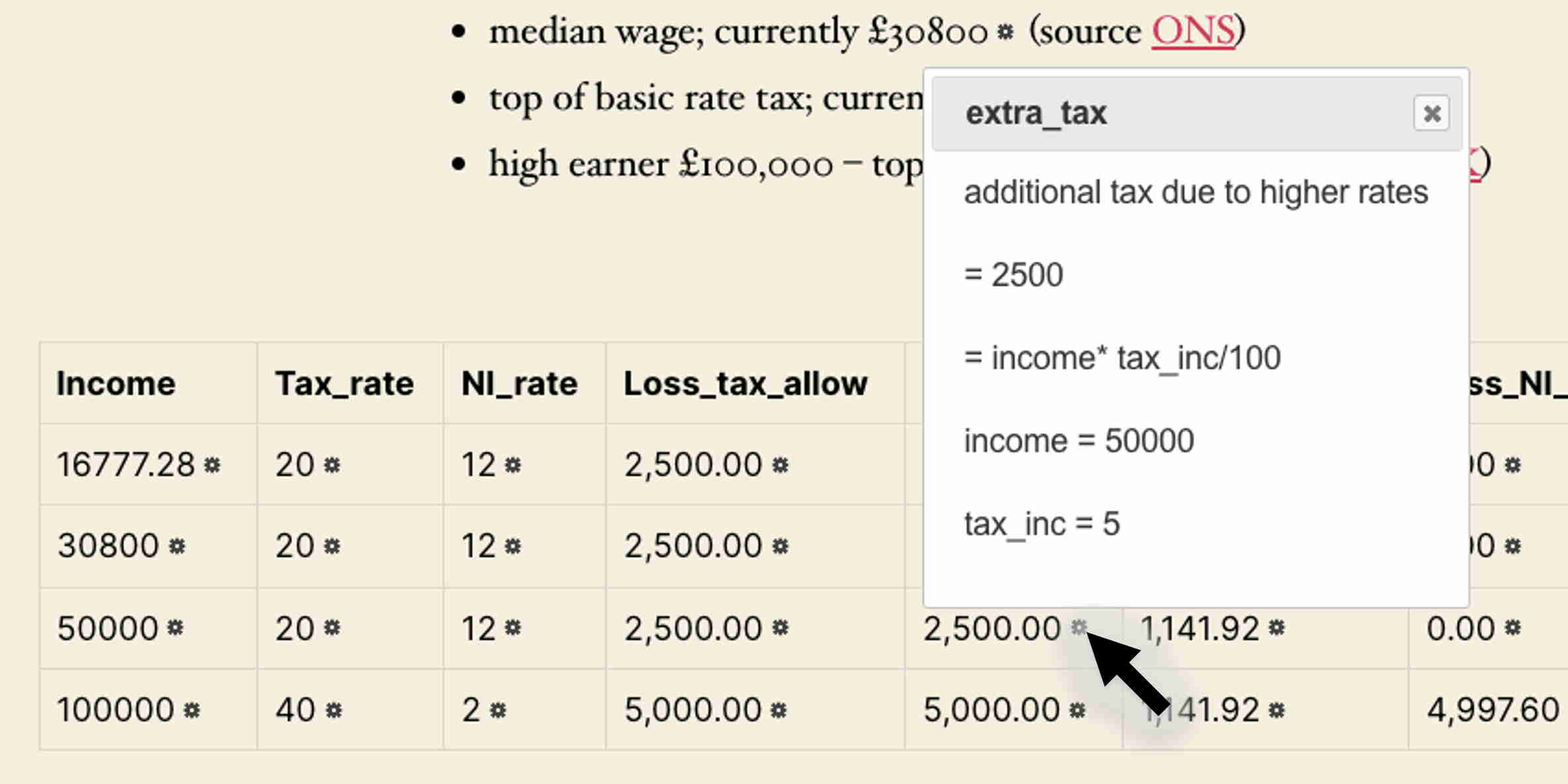
Figure 3. WS2 explains a value in relation to other data.
[zoom image]
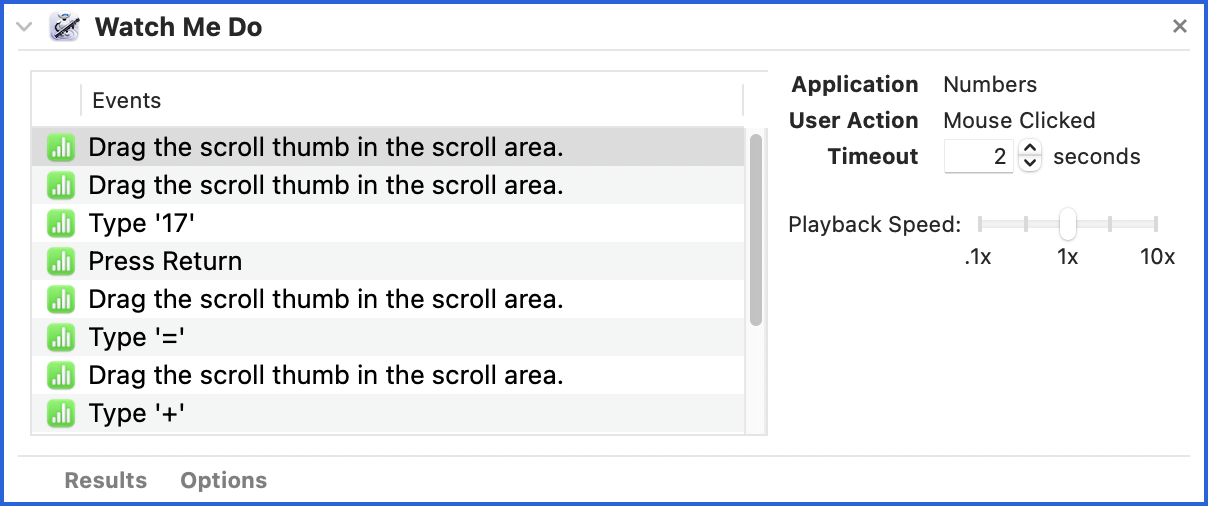
Figure 4. Apple Automator recording Numbers.
[zoom image]