
Glitches are short breaks in connectivity ranging from a few seconds to a minute. They are particuarly common in rural or other remote areas, but can also be experienced elsewhere. Glitches are too short to be regarded as a network disconnection, but far longer than normal jitter. For web pages this is experienced as a very long load time, for a video conversation a short freeze and for streaming media can exceed the buffering leading to either a short freeze or at worst needing to refresh the player. Furthermore, glitches can interact badly with low-level mechanisms, such as TCP slow start and DNS lookup.
When describing the quality of a network there are well known metrics: bandwidth (how much information can be passed per second), latency (the end-to-end delay) and jitter (how much the latency may vary from message to message). However, glitches do not have a standard metric and are thus often overlooked, despite being a critical problem for those in the margins.
Used in glossary entries: bandwidth, buffering, jitter, latency
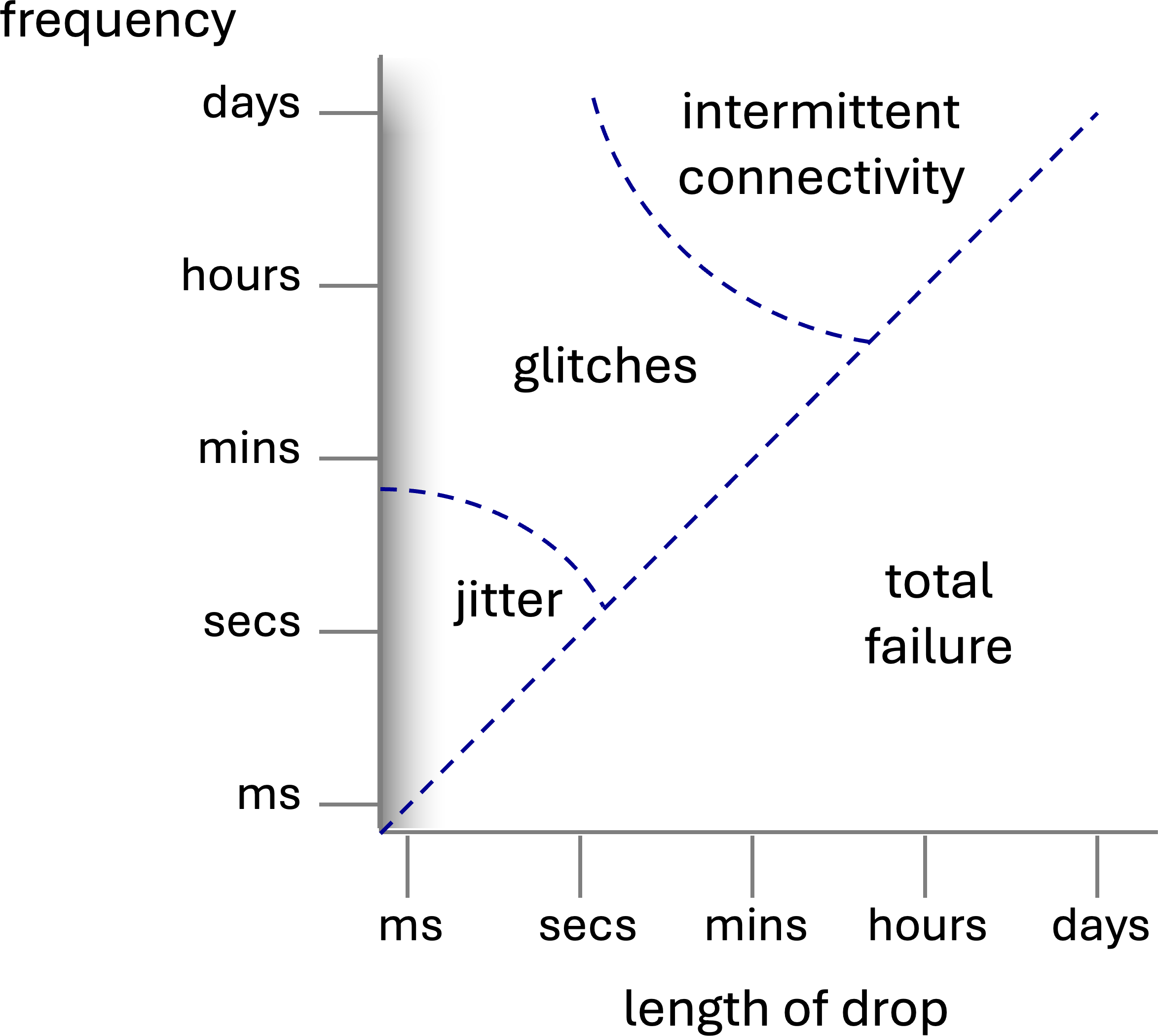
Different timescales of frequency of occurrence and length of delay/drop. Glitches sit between jitter and occasional disconnection. Figure 12.10 from Network-Based Interaction