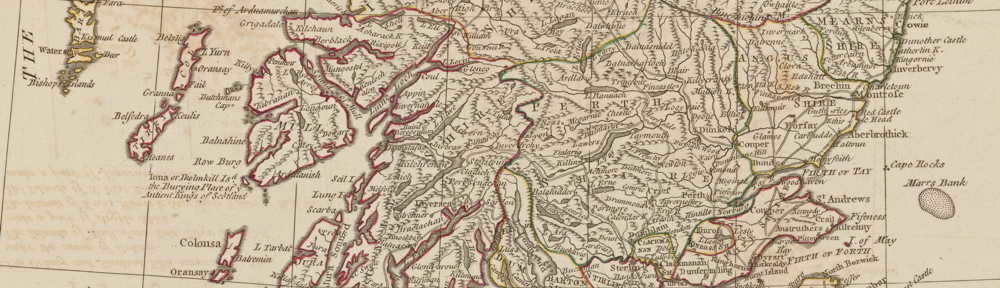
INVERNESS-SHIRE, county, comprehending part of mainland from head of Moray Firth south-westward to Deucale-donian Sea, all Skye group of Inner Hebrides, all Outer Hebrides southward from Lewis-proper, and the tiny distant isle-group of St. Kilda. The mainland part measures 94 miles in length, 56 miles in greatest breadth, and 4255 square miles in area ; is bisected lengthwise by the Great Glen ; and contains the western portion of Moray province, the sections of Aird, Strathglass, Glenurquhart, Glen-moriston, Glengarry, and Glenarchaig, and the districts of Badenoch, Lochaber, Moydart, Arasaig, Morar, Krioydart, and Glenelg. The north-eastern section for a few miles round Inverness onward to north-eastern extremity is low country, mostly fertile and ornate ; but nearly all the rest consists of lofty mountains, with intersections of straths or deep glens, and interspersions of wild moors. The mountains either include or adjoin the loftiest summits in Scotland, have many diversities of contour and arrangement, and exhibit in the aggregate great force of feature ; and the straths and glens, for the most part, abound in charms of wood, water, and cultivation. Chief fresh-water lakes are Ness, Oich, and Lochy in Great Glen ; Laggan and Treig in Lochaber ; Insch in Badenoch ; Clunie in Glenmoris-ton ; Quoich and Garry in Glengarry ; Ar-ch aig in Glenarchaig ; Monar, Banchran, Miulie, Molardich, Affrick, and Beneveian in Strathglass ; Morar between Morar and Arasaig, and Sliiel on boundary with Argyleshire. Chief rivers are the Spey in Badenoch, the Spean in Lochaber, the Ness and the Lochy in respectively the north-east and south-west of Great Glen, the Beauly and its head-streams in Strathglass, the upper parts of the Nairn and the Findhorn in the north-east, the Dulnain running through Duthil to the Spey, and the streams traversing the chief lateral glens. The chief sea-lochs are Hourn, between Glenelg and Knoydart; Nevis, between Knoydart and Arasaig; Aylort, between Arasaig and Moydart ; and Eil and Leven, on boundary with Argyleshire. Old red sandstone prevails in the north-eastern tract of low country, and is mostly covered with fertile soil ; but granite, trap, and metamorphic rocks prevail in the mountains and glens, and have small economical value. Agriculture is well practised in the low tracts ; sea-fishing is plied on the coasts ; and the rearing of bovine cattle and sheep is the chief occupation in the uplands. The principal islands are Skye, Raasay, Rum, Eigg, Harris, North Uist, Benbecula, South Uist, and Barra, and will be found noticed in their respective alphabetical places. Places notable in the history of the High-land clans, and antiquities of the ancient Caledonian times, are numerous. The only town with more than 14,000 inhabitants is Inverness ; the only other one with more than 1000 is Fort-William ; and the only villages with more than 300 inhabitants are Beauly, Campbelton, Portree, Kingussie, and Newtonmore. Real property in 1880-81, 342,948. Pop. in 1871, 87,531 ; in 1881, 90,414.