UK internet far from ubiquitous

On the last page of the Guardian on Saturday (13th Oct) in a sort of ‘interesting numbers’ section, they say that:

“30% of the UK population have no internet access at home”

I couldn’t find the exact source of this, however, another  guardian article “UK internet audience rises by 1.9 million over last year” dated Wednesday 30 June 2010 has a similar figure.  This says that Internet use  has grown to 38.8 million. The National Statistics office say the overall UK population is 61,792,000 with 1/5 under 16, so call that 2 in 16 under 10 or around 8 million. That gives an overall population of a little under 54 million over 10 years old, that is still only 70% actually using the web at all.

My guess is that some of the people with internet at home do not use it, and some of the ones without home connections use it using other means (mobile, use at school, cyber cafe’s), but by both measures we are hardly a society where the web is as ubiquitous as one might have imagined.

French subvert democatic process to pass draconian internet laws

Just saw on Rob @ dynamicorange, that the French have passed a law forcing ISPs to withdraw access based on accusations of IP infringement. Whether one agrees or disagrees  or even understands the issues involved, it appear this was forced through by a vote of 16 (out of 577) members of the French parliament at a time when the vote was not expected.  This reminds me of the notorious Shetland Times case back in the late 1990s, where the judgement  implied that simply, linking to another site infringed copyright and caused some sites to stop interlinking for fear of prosecution1, not to mention some early US patents that were granted because patent officers simply did not understand the technology and its implications2.

It would be nice to think that the UK had learnt from the Shetland case, but sadly not.  Earler this year the Government released its interim Digital Britain report. This starts well declaring “The success of our manufacturing and services industries will increasingly be defined by their ability to use and develop digital technologies“; however the sum total of its action plan to promote ‘Digital Content’ is to strengthen IP protection.  Whatever one’s views on copyright, file sharing etc., the fact that a digital economy is a global economy seems to have somehow been missed on the way; and this is the UK’s “action plan to secure the UK’s place at the forefront of innovation, investment and quality in the digital and communications industries3.

  1. See “Copyright battles: The Shetlands” @ Ariadne and “Scottish Court Orders Online Newspaper to Remove Links to Competitor’s Web Site” @ Harvard’s Berkman Center for Internet & Society.[back]
  2. and for that matter, more recent cases like the ‘wish list’ patent[back]
  3. UK Department for Culture, Media and Sport Press Release 106/08 “Digital Britain – the future of communications” 17th October 2008[back]

From raw experience to personal reflection

Just a week to go for deadline for this workshop on the Designing for Reflection on Experience that Corina and I are organising at CHI. Much of the time discussions of user experience are focused on trivia and even social networking often appears to stop at superficial levels.  While throwing a virtual banana at a friend may serve to maintain relationships and is perhaps less trivial than it at first appears; still there is little support for deeper reflection on life, with the possible exception of the many topic-focused chat groups.  However, in researching social networks we have found, amongst the flotsam, clear moments of poinency and conflict, traces of major life events … even divorce by Facebook. Too much navel gazing would not be a good thing, but some attention to expressing  deeper issues to others and to ourselves seems overdue.

escape from distraction

Last week I was away in Cornwall and lost (but later found) my phone, so was both without a phone and with no internet connection … and it was amazingly liberating. My life is driven by the never ending stream of incoming mails and while in principle I could ignore them, in fact I find myself constantly breaking off what I do and seeing what has come in.

This reminded me of a Times article Haliyana pointed out to be a couple of weeks ago “Stoooopid …. why the Google generation isn’t as smart as it thinks“. We make a virtue of the never ending stream of interruptions that assail us; “multi-tasking” we call it, but in fact they not only mean we are less focused, but are possibly loosing the ability to concentrate at all.

While reading the article itself I found myself fighting not to want to follow the numerous links to other stories that littered the Times online page … and I would like to tell you more about it, but I never managed to read to the end before succumbing to the next interruption.

Tags and Tagging: from semiology to scatology

I’ve just been at a two-day workshop on “Tags and Tagging” organised by the “Branded Meeting Places” project.

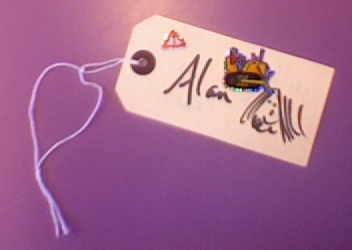
Tags are of course becoming ubiquitous in the digital world: Flickr photos, del.icio.us bookmarks; at the digital/physical boundary: RFID and barcodes; and in the physical world: supermarket price stickers, luggage labels and images of Paddington Bear or wartime evacuees each with a brown paper label round their necks. Indeed we started off the day being given just such brown paper tags to design labels for ourselves.

Alan's tag

As well as being labels so we know each other, they were also used as digital identifiers using a mobile-phone-based image-recognition system, which has been used in a number of projects by the project team at Edinburgh (see some student projects here). We could photograph each others tags with our own phones, MMS the picture to a special phone number, then a few moments later an SMS message would arrive with the other person’s profile.

Being focused on a single topic and even single word ‘tag’ soon everything begins to be seen through the lens of “tagging”, so that when we left the building and saw a traffic warden at work outside the building, instantly the thought came “tagging the car”!

Vocal Thumbs logoThe workshop covered loads of ground and included the design and then construction of a real application – part of the project’s methodology of research through design. However, two things that I want to write about. The first is the way the workshop made me think about the ontology or maybe semiology of tags and tagging, and the second is a particular tag (or maybe label, notice?) … on a toilet door … yes the good old British scatological obsession.

Continue reading

Usabilty and Web2.0

Nad did a brilliant guest lecture for our undergraduate HCI class at Lancaster on Monday. His slides and blog about the lecture are at Virtual Chaos. He touched on issues of democracy vs. authority of information, dynamic content vs. accessibility and of course increasing issues of privacy on social networking sites. He also had awesome slides to using loads of Flickr photos under creative commons … community content in action not just words! Of course also touched on Web3.0 and future convergence between emergent community phenomena and structured Semantic Web technologies.

digital culture

I was at futuresonic last Friday doing a panel keynote at the Social Technologies Summit. I talked about various things connected to imagination: bad ideas, regret modelling and firefly/fairylights technology. On the same panel was a guy from Satchi and Satchi who created television adds for T-mobile and a lady from Goldsmiths who described a project for Intel where they studied a London bus route. The chair Eric introduced the session with a little about blogging and other web-based technologies and in general we were immersed in the ways in which digital culture pervades the day to day world.
In my way home on the train I sat opposite a father and son who were playing hangman. The boy was about 6 or 7 and the father had to help him and sometimes correct him. Every so often I noticed the words they chose, but just before I got off the train there was obviously the father’s hardest challenge yet. I gradually noticed the hightened excitement in the voices … it was a word with ‘X’ and ‘Y’ in it.

As I stood to get up, the boy eventually got the last letters and completed the word …

F O X Y B I N G O . C O M