final solution

During the Holocaust the Nazi regime killed somewhere between 250,000 and 1,000,000 gypsies1, a greater proportion of the gypsy population than of the Jews.

While the Jewish holocaust brought widespread sympathy (even if muted by Israeli actions now-a-days) and a recognition of the evil of anti-Semitism.   However, prejudice and persecution of gypsies has if anything hardened.   Since the Second World War, nomadic life styles in the UK have been made all but illegal by the banning of camping on common land that was accepted (albeit often reluctantly) in previous centuries.  Legitimate camping has been made ever more difficult as gypsies are usually refused planning permission to buy their own land, and in recent years UK local authorities’ duty to provide at least some official camping places has been relaxed, meaning that in most parts of the country there is no legal place to stop.
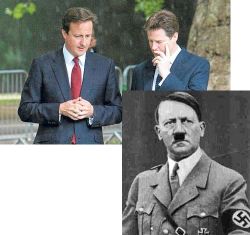
The front page of the Sunday Express reports the latest attempt to ‘crackdown’ on the ancient way of life of this people, turning what was until now civil prosecutions into criminal law.  I had thought the Cameron-Clegg coalition we had elected had been between Conservative and Liberal parties, but it seems more like the BNP.

Britain, and we are not alone, is still seeking to finish the work that Hitler started.

  1. Because gypsies were often off record, it is harder to obtain the exact number, hence the wide variation.  For more details, see  “Gypsies in the Holocaust” at the Jewish Virtual Library and Porajmos (the devouring) at Wikipedia[back]

and they said they would protect front line services

Just been at a public meeting about imminent cuts in the school here on Tiree. In a small school like this (120 pupils) losing several posts isn’t just a matter of shrinking slightly, but means that whole subjects, such as French, drop off the curriculum.

There are two issues here.  One is for the island and other small communities, as the funding formulae assume class sizes that are untenable in a small school; that is making sure the cuts that come, and we know they must, are applied fairly.

The second is  wider, remembering that all parties in the election promised to protect ‘front line services’; this is part of  a cut across all education provision in the region – everywhere there are less teachers … and this is before the harshest budget cuts begin.

update: (im)migration Holyrood vs Westminster

Since post last week on migration Holyrood vs Westminster, found link on the BBC website to the  the BBC News ‘Reality Check’ on immigration that showed net outflow of non-EU.  That is migration is out of the country not in!  Also Mark Easton’s blog @ the BBC, which gives more info.  Bottom line is that the outflow is even greater then the figure of 8000 given on BBC News.

migration Holyrood vs Westminster

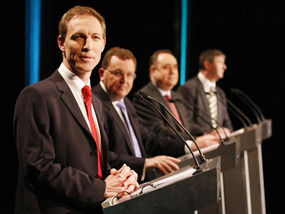
So refreshing watching the Scottish election debate last night.  The audience there saw immigration as  a positive thing, bringing fresh skills and wage earners (and tax payers) to the country.

This is in such sharp contrast to the UK general election leaders debates, where questions about immigration were  all of the “what are you going to do about …” kind and prompted the prospective prime ministers of all parties into a competition as to who could put the boot in most vigorously.  To be fair, the least anti-migrant was Nick Clegg including his memorable attempt to get David Cameron to admit that most migration was from EU countries and so not going to be affected by any of their policies.

After that UK debate the Telegraph challenged Nick Clegg’s claim that 80% of migration was non-EU.  However, BBC News 24 had a sort of ‘facts behind the claims’ slot and in their figures the net non-EU migration was actually negative; that is in the last year there were more non-EU people leaving the country than entering.  Unfortunately BBC News don’t have this information on their web site to link to 🙁  My guess is the difference in the figures depends on whether you take into account student visas where there will be a very large influx and outflux each year, and whether you simply look at  total immigration in a year or net migration.  Certainly the BBC News figures suggested that all the major parties were overestimating the ‘problem’.

The great thing in the Scottish debate was that this was not viewed as a ‘problem’ at all.

warming to Gordon

Yesterday, my postal vote went off and lacking a Plaid Cymru candidate far from my homeland I made do with the best of the rest. This is perhaps the most exciting election in the UK for many years as it seems likely that one result will be a change in the voting system, so that in future elections I will not feel I need to vote ‘tactically’, but more for the people, parties and policies that I most deeply support.

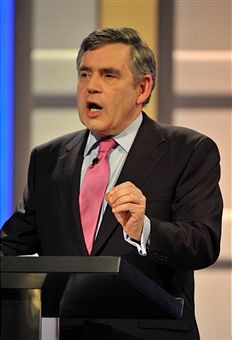
While this did not take me to the Labour fold at this election, one of the most surprising things about the general election campaign has been that throughout it, not withstanding gaffs along the way, I have found myself warming to Gordon Brown

Continue reading

Apple’s Model-View-Controller is Seeheim

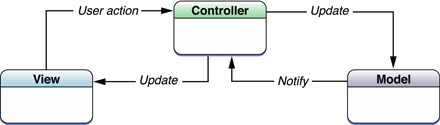
Just reading the iPhone Cocoa developer docs and its description of Model-View-Controller. However, if you look at the diagram rather than the model component directly notifying the view of changes as in classic MVC, in Cocoa the controller acts as mediator, more like the Dialogue component in the Seeheim architecture1 or the Control component in PAC.

MVC from Mac Cocoa development docs

The docs describing the Cocoa MVC design pattern in more detail in fact do a detailed comparison with the Smalltalk MVC, but do not refer to Seeheim or PAC, I guess because they are less well known now-a-days.  Only a few weeks ago when discussing architecture with my students, I described Seeheim as being more a conceptual architecture and not used in actual implementations now.  I will have to update my lectures – Seeheim lives!

  1. Shocked to find no real web documentation for Seeheim, not even on Wikipedia; looks like CS memory is short.  However, it is described in chapter 8 of the HCI book and in the chapter 8 slides[back]

Justice and mercy: al-Megrahi

I’ve been away most of the last two weeks with just a few days at home in between.  However, just before I was first away I heard the Scottish Justice Secretary Kenny MacAskill announce the release of al-Megrahi.  The decision was clearly hard and arbitrating the balance between justice and compassion is an unenviable task.

Whether the final decision was right or wrong, hearing MacAskill’s explanation of his decisions made me proud to be living in Scotland. Rather than bowing to the clear political pressure he was under, instead he kept his focus on what justice means in a land where compassion is at the heart of who we are.  In a world often ravaged by war and terror, suffering under human cruelty, and governed by the twins of aggression and revenge, MacAskill put himself under a  higher order and demonstrated the clear difference between a country still under the influence of its Christian past and those, from all sides, who besmirch the names of their own countries and religions by terror and violence.

Since then the grubby world of UK deals over oil and US deals over billions of dollars of compensation payments have both been aired, but it appears that MacAskill’s decision stood against pressure from all sides.

It was perhaps inevitable that the release would provoke some controversy, but disappointing nonetheless; one always hopes that integrity will triumph over knee-jerk reactions.  However, it has been especially galling to hear US voices raised in protest, a country which for so many years acted as safe haven for IRA fund raising; bankrolling the London bombings of the 1970s and beyond.  While Gaddafi supplied the weapons, the US public supplied the dollars1.  I was only young at the time, but these were vicious attacks in crowded tube trains and on the streets of London and elsewhere, designed specifically to cause maximum death and injury; and all the while, in the US, the IRA were allowed to operate freely due to political support in high places.

Obama came to power with the promise of a new attitude and a principled approach to politics, so it is doubly disappointing that he has failed this early test of principle over public opinion.  If the current White House staff cannot accept the independence of the Scottish justice system over politics, what hope in other parts of the world.

  1. Of course, while the Libyan involvement in the Lockerbie bombing and al-Megrahi’s guilt have been a matter of debate, the involvement of Libya in IRA terrorism was indisputable.   Since those days the IRA have become part of the Northern Ireland political process and Libya itself has been welcomed into the allied camp of the ‘war on terror’.  Whether in India, Israel or Ireland, yesterday’s terrorists become today’s politicians.  This makes the focus on al-Megrahi seem even more like that of a scapegoat.[back]

On the edge: universities bureacratised to death?

Just took a quick peek at the new JISC report “Edgeless University: why higher education must embrace technology” prompted by a blog about it by Sarah Bartlett at Talis.

The report is set in the context of both an increasing number of overseas students, attracted by the UK’s educational reputation, and also the desire for widening access to universities.  I am not convinced by the idea that technology is necessarily the way to go for either of these goals as it is just so much harder and more expensive to produce good quality learning materials without massive economies of scale (as the OU has).  Also the report seems to mix up open access to research outputs and open access to learning.

However, it was not these issues, that caught my eye, but a quote by Thomas Kealey vice-chancellor of the University of Buckingham,  the UKs only private university.  For three years Buckingham has come top of UK student satisfaction surveys, and Kealey says:

This is the third year that we’ve come top because we are the only university in Britain that focuses on the student rather than on government or regulatory targets. (Edgeless University, p. 21)

Of course, those in the relevant departments of government would say that the regulations and targets are inteded to deliver education quality, but as so often this centralising of control, (started paradoxically in the UK during the Thatcher years), serves instead to constrain real quality that comes from people not rules.

In 1992 we saw the merging of the polytechnic and university sectors in the UK.  As well as diffferences in level of education, the former were tradtionally under the auspices of local goverment, whereas the latter were independent educational isntitutions. Those in the ex-polytechnic sector hoped to emulate the levels of attaiment and ethos of the older universities.  Instead, in recent years the whole sector seems to have been dragged down into a bureacratic mire where paper trails take precidence over students and scholarship.

Obviously private institutions, as  Kealey suggests, can escape this, but I hope that current and future government can have the foresight and humility to let go some of this centralised control, or risk destroying the very system it wishes to grow.

Sinking beneath the waves

Thanks to Pete Bagnall @ surfaceeffect for pointing out an article in George Monbiot’s Environment blog in the Guardian “Climate change displacement has begun – but hardly anyone has noticed“.  Evidently the whole population of the Carteret Islands (Google map, Wikipedia) near Papua New Guinea have had to abandon the islands due to rising sea levels.

The inundation beguns.

French subvert democatic process to pass draconian internet laws

Just saw on Rob @ dynamicorange, that the French have passed a law forcing ISPs to withdraw access based on accusations of IP infringement. Whether one agrees or disagrees  or even understands the issues involved, it appear this was forced through by a vote of 16 (out of 577) members of the French parliament at a time when the vote was not expected.  This reminds me of the notorious Shetland Times case back in the late 1990s, where the judgement  implied that simply, linking to another site infringed copyright and caused some sites to stop interlinking for fear of prosecution1, not to mention some early US patents that were granted because patent officers simply did not understand the technology and its implications2.

It would be nice to think that the UK had learnt from the Shetland case, but sadly not.  Earler this year the Government released its interim Digital Britain report. This starts well declaring “The success of our manufacturing and services industries will increasingly be defined by their ability to use and develop digital technologies“; however the sum total of its action plan to promote ‘Digital Content’ is to strengthen IP protection.  Whatever one’s views on copyright, file sharing etc., the fact that a digital economy is a global economy seems to have somehow been missed on the way; and this is the UK’s “action plan to secure the UK’s place at the forefront of innovation, investment and quality in the digital and communications industries3.

  1. See “Copyright battles: The Shetlands” @ Ariadne and “Scottish Court Orders Online Newspaper to Remove Links to Competitor’s Web Site” @ Harvard’s Berkman Center for Internet & Society.[back]
  2. and for that matter, more recent cases like the ‘wish list’ patent[back]
  3. UK Department for Culture, Media and Sport Press Release 106/08 “Digital Britain – the future of communications” 17th October 2008[back]