What is Computing? The centrality of systemics

Recently I was in a meeting where the issue of ‘core’ computer science came up. One person listed a few areas, but then this was challenged by another member of the group who said (to be fair, partly in jest), that core computer science should certainly include computer architecture, but not the ‘human stuff’.

I felt a little like a teenager complete with T-shirt and iPod dropped into Jurassic Park arguments that I thought had been put to bed in the 1980s suddenly resurfacing – how do you explain this white thing that makes sounds from its earphones to a caveman wearing skins?

However, I also felt a certain sympathy as I often wonder about computer science as a whole; indeed it has its own arguments in the 1960s and ’70s as to whether it was a ‘discipline’ as opposed to just an application domain for maths or electronics, or just a tool for business. Maybe one of the clinchers was the theoretical foundations of computing in the work of Church and Turing … but strangely enough at Lancaster the closest to this, the course on algorithmic complexity, is taught by a HCI person!

One of my worries in computing is that these theoretical foundations are still weak, there is black hole in the theoretical centre of computer science (( This demands a discussion of its own, but the basic problem is that while Church and Turing gave us understanding of disembodied computation, we still do not have clear understanding of generic computation when embodied in devices in general only particular architectures. )). However, these theoretical issues were certainly not what was bothering my colleague. To answer his challenge and my own worries about the discipline we really need to know – what is computing?

Continue reading →

HCI and CSCW – is your usability too small

Recently heard some group feedback on our HCI textbook. Nearly all said that they did NOT want any CSCW. I was appalled as considering any sort of user interaction without its surrounding social and organisational settings seems as fundamentally misbegotten as considering a system without its users.

Has the usability world gone mad or is it just that our conception of HCI has become too narrow?

Continue reading →

puzzle with pictures

As it was new Years Day and it was too wet to go shift earth in the garden I thought I’d play a bit with Professor Alan’s puzzle square. I’ve had a ‘make your own’ version for years, but you had to chop an image into bits give them special names, etc. Now it works much more easily with any image (try it yourself). This are a couple I made with my own photos:

needs Javascript   needs Javascript

The key is that it is I am now using the CSS clip property which allows you to show selected parts of an image (or in fact any HTML element). This was made a little more complicated due to the fact that the W3C pages for clip give running examples for every other kind of visual effect … but not clip! Googling was a nightmare as it turns up page after page in forums saying “I can’t get clip to work”!

Happily I found seifi.org (a blog that looks like a really great web resource) and a post on Creating Thumbnails Using the CSS Clip Property. This was full of meticulously laid out examples … Mojo Seifi, you are a star!

Continue reading →

robot friends

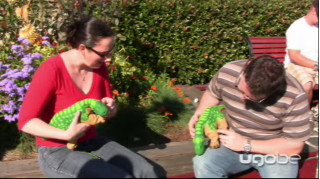
Last night we watched Jurassic Park 3 and today found you can have a little dinosaur all of your own!

Pleo Dinosaur Sony have robot dogs, Phillips robot cats (albeit stuck sitting in one place) but Ugobe have little robot dinosaurs called Pleo. In the videos they do move like little baby creatures and the lady in the shopping mall coos over one as she strokes it.

Central to Pleo seems to be:

  1. Designing Sociable Robotsembodiment – they feel through 40 sensors and move in their environment
  2. emotion – they have a relatively complex model of basic drives rather like Cynthia Breazwal describes in her book “Designing Sociable Robots“.

This seems to pay off in people’s reactions, both on Pleo’s own videos (well they would!), but also in owner’s plogs (sic) … one owner says:

“she acts just like a cat concerning keyboards.. just crawl on the darn thing while I’m typing! I know Penny,. you’re so cute it doesn’t matter what you do. But you should have a little sensor strip in your butt to spank when you’re bad ((This could get us into the territory of agent abuse!)) or to pat gently to urge you to go explore. Go to sleep my little love” ArcticLotus

people play wht Pleo
Pleos making friends :-/

For researchers there is an open architecture so it should be possible to play oops experiment with them 🙂 The API doesn’t seem to be published yet, so wait until you get your cheque books out!

people play wht Pleo

I just wanted to print a file

I just wanted to print a file, now it is an hour and a half later and I still have nothing … this is where all our time goes gently coaxing our computers in the hope they may do what we ask.

Such a simple thing to want to do … and so much pain on the process, and so many simple things that application designers could do it make it better.

Continue reading →

Christmas lights and crackers

FireFly in at CityLabThe lights are on in Lancaster City Centre. After three years FireFly has its first real public outing. You can see them now and for the next few months in Dalton Square in the centre of Lancaster.

The initial idea for FireFly came after a meeting where we had been discussing various forms of public displays. For some reason, a thought struck – those tiny lights Individual lightsthat you see in trees outside hotels and in city centres throughout the year; what if you could turn those into a display?

That was in early 2004 and now after several years of Joe Finney’s ingenuity and Angie Chandler’s hard work, they are here. Behind each of the three thousand lights in the CityLab display is a microprocessor as fast as my first PC! If you are near Lancaster in the next few months do go see them, they are just by the City Hall, under the beady eye of Queen Victoria’s statue.

facebookIn another bit of Christmas technology, this year I ported crackers to facebook. The good old virtual crackers are still there, but now you can also send facebook crackers 🙂 Mostly this was a straight port, but there are interesting differences because of the way facebook works as a platform. I’ve been watching the stats I collect and it is interesting to see that whilst around 2/3 of email crackers are opened only about 1 in 5 are opened in facebook. I guess with so much food being thrown and the like, facebook users are far more used to ignoring things :-/

Links: Lights in City Lab | Crackers on Facebook | Email Crackers

Physicality and Middle Ages Tech Support

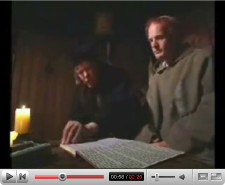
Ansgarr needing help to use a bookOn the forum of our MRes course at Lancaster one of the students posted a link to Middle Ages Tech Support on YouTube. It shows Ansgarr a Mediaeval monk struggling with his first book.

I first saw this video when I was giving a talk at University of Peloponnese in Tripolis. Georgios ((one of my hosts there as part of the TIM project)) showed the video before I started, just because he thought it was fun. I was talking a little bit about physicality and the video brought up some really interesting issues relating to this and usability. Although it is a comic video we can unpack it and ask which of the problems that Ansgarr has as he changes technology from scroll to book would actually happen and which are more our own anachronistic view of the past.

Continue reading →

Usabilty and Web2.0

Nad did a brilliant guest lecture for our undergraduate HCI class at Lancaster on Monday. His slides and blog about the lecture are at Virtual Chaos. He touched on issues of democracy vs. authority of information, dynamic content vs. accessibility and of course increasing issues of privacy on social networking sites. He also had awesome slides to using loads of Flickr photos under creative commons … community content in action not just words! Of course also touched on Web3.0 and future convergence between emergent community phenomena and structured Semantic Web technologies.

Iraqi bloggers

By chance I just came across this BBC New article “Iraqi bloggers at home and abroad“. Short poignant snippets from active bloggers from Iraq: Mohamed a dentist form Baghdad, Sunshine a 15 year-old girl in Mosul, Najma an engineering student at Mosul university and Riverbend who recently left Iraq to become a refugee in Syria. In each case I was amazed not just by the stories, but by their hope and spirit amongst appalling conditions. I loved the names of the blogs of Sunshine and Najma: “Days of My Life” and “A Star form Mosul”, and was humbled by Riverbend’s description of her new neighbours: one a Christian family escaping persecution in Kurdistan and another a Kurd family driven from Baghdad and yet showing kindness in trouble and poverty – a toothless boy bringing cake.