fading news – disks astray and children named

This is now old news (it takes me a long time to get to the blog!), but anyone in the UK will know the story of the missing child benefit disks – 25 million records containing parents and children’s names addresses, dates of birth, bank account and national insurance details … an identity fraudsters’ gold mine. This has caused worries of millions of parents and embarrassment for Alistair Darling in Parliament. The BBC has a timeline of the events and Computer Weekly has (very) slightly more techie focused account.

Anyway a week ago last Thursday (22nd Nov) I did a short radio interview on Radio Cumbria, which forced me to consider the issue in a little more detail. I think they expected more a security angle, but obviously this is very much a human story also.

Despite the gravity of the event I was shocked but not surprised. In the end if you put people in a severely time pressured, cost-controlled context mistakes will inevitable happen.

So what went wrong? …

Continue reading →

digging ourselves back from the Semantic Web mire

Discussions on the Talis Platform Advisory Group prompted me to look at some of the APIs of new Semantic-Web-like services such as Freebase ((listen to Talis’ pod cast interview with Jamie Taylor Freebase’s ‘Minister of Information’ (sic).)).

Freebase is interesting as its underlying representation is graph/relationship based like RDF, but its Metaweb Query Language (MQL) uses JSON which is a more programming-like whole and parts representation with arrays and slots. Facebook’s new Data Store API also has objects and associations, but does not use RDF or other obvious web technologies.

So the question is – if the closest things to Semantic Web apps on the internet don’t use SemWeb techology like RDF, SPARQL etc. … are these SemWeb techologies fit for purpose or indeed useful at all?

I think the answer is that (i) partly they are not fit for purpose – caught in a backwater by their history, but (ii) that is like all things and they are what we have got, and (iii) we can use some of the tools of computing to make them work …

Continue reading →

matterealities and the physical embodiment of code

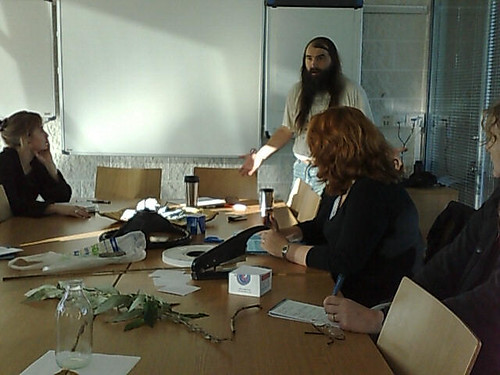
Last Tuesday morning I had the pleasure of entertaining a group of attendees to the Matterealities workshop @ lancaster. Hans and I had organised a series of demos in the dept. during the morning (physiological gaming, Firefly (intelligent fairylights), VoodooIO, something to do with keyboards) … but as computer scientists are nocturnal the demos did not start until 10am, and so I got to talk with them for around an hour beforehand :-/

The people there included someone who studied people coding about DNA, someone interested in text, anthropologosts, artists and an ex-AI man. We talked about embodied computation ((I just found notes I’d made for web page in embodied computation 5 years ago … so have put the notes online)), the human body as part of computation, the physical nature of code, the role of the social and physical environment in computation … and briefly over lunch I even strayed onto the modeling of regret … but actually a little off topic.
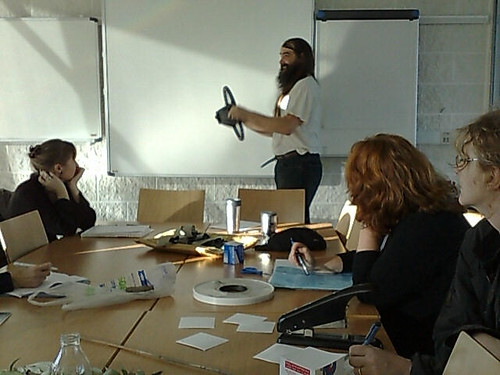
Alan driving

physicality – Played a little with sticks and stones while talking about properties of physical objects: locality of effect, simplicity of state, proportionality and continuity of effect ((see preface to Physicality 2006 proceedings)).

physical interaction – Also talked about the DEPtH project and previous work with Masitah on natural interaction. Based on the piccie I may have acted out driving when talking about natural inverse actions

ubiquity of computation – I asked the question I often do “How many computers do you have in your house” … one person admitted to over 10 … and she meant real computers ((I just found an online survey on How many computers in your house)). However, as soon as you count the computer in the TV and HiFi, the washing machine and microwave, central heating and sewing machine the count gets bigger and bigger. Then there is the number you carry with you: mobile phone, camera, USB memory stick, car keys (security codes), chips on credit cards.
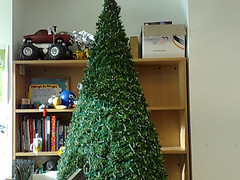
FireFly on a Christmas treeHowever at the Firefly demo later in the morning they got to see what may be the greatest concentration of computers in the UK … and all on a Christmas Tree. Behind each tiny light (over 1000 of them) is a tiny computer, each as powerful as the first PC I owned allowing them to act together as a single three dimensional display.

embodiment of computation – Real computation always happens in the physical world: electrons zipping across circuit boards and transistors routing signals in silicon. For computation to happen the code (the instruction of what needs to happen) and the data (what it needs to happen with and to) need to be physically together.

The Turing Machine, Alan Turing’s thought experiment, is a lovely example of this. Traditionally the tape in the Turing machine is thought of as being dragged across a read-write head on the little machine itself.

However … if you were really to build one … the tape would get harder and harder to move as you used longer and longer tapes. In fact it makes much more sense to think of the little machine as moving over the tape … the Turing machine is really a touring machine (ouch!). Whichever way it goes, the machine that knows what to do and the tape that it must do it to are brought physically together ((Yep I know that Universal Turing machine has the code on the tape, but there the ‘instructions’ to be executed are basically temporarily encoded into the UTM’s state while it zips off to the data part of the tape.)).

This is also of crucial importance in real computers and one of the major limits on fast computers is the length of the copper tracks on circuit boards – the data must come to the processor, and the longer the track the longer it takes … 10 cm of PCB is a long distance for an electron in a hurry.
Alanbrain as a computer – We talked about the way each age reinvents humanity in terms of its own technology: Pygmalion in stone, clockwork figures, pneumatic theories of the nervous system, steam robots, electricity in Shelley’s Frankenstein and now seeing all life through the lens of computation.

This withstanding … I did sort of mention the weird fact (or is it a factoid) that the human brain has similar memory capacity to the web ((A. Dix (2005). the brain and the web – a quick backup in case of accidents. Interfaces, 65, pp. 6-7. Winter 2005.
http://www.hcibook.com/alan/papers/brain-and-web-2005/)) … this is always a good point to start discussion 😉

While on the topic I did just sort of mention the socio-organisational Church-Turing hyphothesis … but that is another story

more … I recall counting the number of pairs of people and the number of seat orderings to see quadratic (n squared) and exponential effects, the importance of interpretation, why computers are more than and less than numbers, the Java Virtual Machine, and more, more, more, … it was very full hour
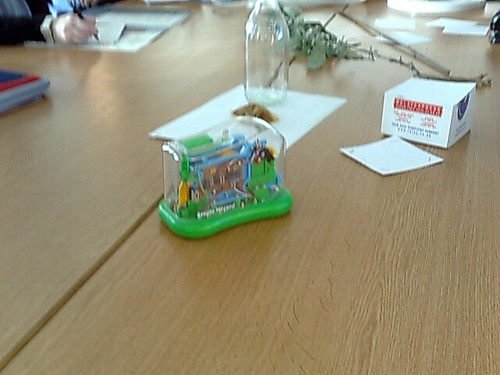
AlanLcoblo - artefactsAlan

mathematics goes reality TV!

In 1978 I was on the British team for the 20th International Mathematical Olympiad (recollections of the trip). It was in Romania and the event was prime time news … and I was one of a group interviewed for the news of the event. the following year the 21st IMO was held in London and there was no press coverage that I found whatsoever. OK mathematics is hardly a spectator sport, but the complete British lack of interest in anything remotely intellectual was disturbing.

But now … nearly 30 years later … perhaps things are changing. On Sunday BBC2 are showing a 90min documentary about the olympiad team. Maybe maths will get sexy!

Beautiful Young Minds (( unfortunately the BBC’s own page on this disappeared at the end of the week – why do they do this! – but there are many descriptions and reviews of it on the web including one at plus.maths.org ))
BBC2 Sun 14 Oct, 9:00 pm – 10:30 pm 90mins
Beautiful Young Minds tells the story of some of the brightest mathematical brains of a generation. Each year, exceptionally gifted teenagers from over 90 countries compete for medals at the International Mathematical Olympiad. The film follows a group of brilliant teenagers as they battle it out to become the chosen six selected to represent the UK.

real personal information management

Some of my research is in an area that is called ‘personal information management’ or PIM. PIM is about all the bits of information people store electronically: files on the computer desktop, web bookmark, calendars and address books and increasingly photos, movies and more.

However, physical information management can be just as fascinating … and a lot more creative.

Continue reading →

Local images – mixing memories and maps

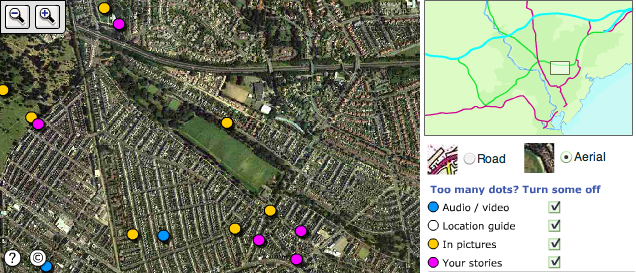
I just came across a really nice part of the BBC web site for Cardiff called Streets of Cardiff. It allows anyone to upload (moderated, this is the BBC!) stories, pictures, or videos about different areas and these are presented as points on a map. Below is the Roath Park and Penylan page … where I grew up:

Roath Park map @ BBC
[ screen shot ] [ BBC web page ]
Given it is the BBC no google mashup, but a little flash app! But a very nice bit of webbery, community content etc. … pity they don’t have it for everywhere. For years now I have kept thinking it would be really nice to have a coherent location-based portal of everywhere and even got a domain for it! Whilst google maps and related things are getting close to that dream, still it is hard to find things by location … maybe one day …

This also reminded me of some pictures of Roath Park I took a short while back for a keynote I gave a few years ago “Paths and Patches – patterns of geonosy and gnosis“, so I have just added them as a Roath Park flickr set.
… and now I really must get back to work.

Torchlight Carnival

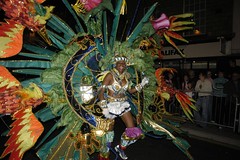
Last night was at the Kendal Torchlight Carnival [web site, flickr]. Floats, shire horses, caribean-style dancers, old steam vehicles and a vintage fire engine to die for … how cool to drive to work in that!

dancer at Kendal Torchlight I remembered summer holidays as a child, where the seaside villages and those nearby would often have street processions, a different village each week, carefully timed for tourist season. I even recall one on the Isle of White the year of the Isle of Wight Festival … but no I was a little too small to go to that!

Like, I would guess, most of the seaside processions, Kendal Torchlight is not an ancient festival, but only goes back less than 40 years, and apart from a fun fair does not include much beyond the procession itself. However, it was a slightly eerie feeling walking down towards the town through street empty of traffic and so quiet with families buggies and old ladies with fold-up chars all going in the same direction, almost like one of those zombie-style sci-fi films where everyone is drawn towards some unseen force.

I don’t go to football matches or other sports, so it was unusual that sense of all streaming together towards an event, the shared anticipation waiting together lined along the roadside and experiencing the lights, sounds and movements with so many at the same time (especially the enthusiastic lady next to us who cheered waved and shouted at every passing lorry and dancer). In a world dominated by the individual, from on-demand TV to corner yogurt pots, things that bring us together, whether ancient or modern, seem no bad thing.

after the ball is over …

Last week’s HCI2007 conference and the Physicality workshop now all finished (except sorting out the the final finances for HCI … but I’ll forget that for now!)

Being part of the organisation of things you always see so many things that are not as planned (like going wrong), but for the delegates it all seems a well-oiled machine. In this as in many other domains, the mark of a rubust system is not whether or not it fails, but how it copes with failure. This is the heart of my principles for appropriate intelligence when designing ‘intelligent’ user interfaces and also ‘fail fast programming’ ((I must make web pages for this some day … but see debugging notes I did for a software engineering course a few years ago)) when designing and debugging critical computer systems.

Great to see so many old friends … and meet new people … and after able to show Nad ((see his blog on arriving at the conference and his Flickr photos of the Lake District)) the glories of the Lake District.

windermere lake district mountains lake district in winter

face to face with myself – Nad’s blog on Live Search

Nad has been blogging about Live Search‘s new features for searching for images of different kinds (see Finding Faces with Live Search). he used me as an example and it was weird both the images it found of me, but also the occasional images that also showed up that were not of me, including a golden Budda (!). There is something quite poignant about the near random associations that come with the ‘mistakes’ on the search. One image was of a national guardsman about to leave for Iraq. the link was tenuous, his name was Alan and he was at Fort Dix, but seeing the photos of his children and his going away cake (stars and stripes and plastic tanks), gave me a very odd feeling of connection to someone far away and in so different circumstances.

Google’s Vint Cerf avoiding responsibility

Yesterday morning I was on my way into Lancaster and listening to the Today programme. Google’s ‘internet evangelist’ Vint Cerf was being interviewed by John Humphrys and the topic was ‘should the internet be regulated like other media’. ((“The 0810 Interview: Godfather of the Internet”, BBC4, Today Programme, Wednesday, 29th August 2007))

Not surprisingly Vint Cerf thought not, but I was surprised how well he avoided actually saying so. John Humphrys is experienced and politicians fear him in these early morning interviews, but to be honest he was completely outclassed by Vint Cerf who sidestepped, avoided and generally never addressed the question.

Web 2.0 was the heart of the issue. With end-user content now dominating the internet do service providers such as YouTube (of course owned by Google) have any responsibility for the kinds of material hosted?

This was in the context of videos of ‘happy slappers’ and other violent attacks being posted, but more generally that whereas TV in many countries is limited in the kinds of material it can show, particularly early in the evening when children are more likely to be watching, is limited by a mixture of voluntary and satutory codes. Why not the internet?

Vint Cerf repeatedly re-iterated the same message “Google is law abiding” if content is not legal it is removed. Implicitly the message was “if it is not illegal it is OK”, but as I said he carefully avoided saying so.

The closest point to actually addressing the question was when John Humphrys suggested that technologies could be misused like research for atomic power being used for nuclear weapons (strange I thought it went the other way round?). Vent Cerf’s response was, the standard neutrality of technology stance, that the makers of roads were not responsible for car deaths, strip development … the same argument used by arms dealers, manufacturers of gas guzzling cars, and scientists in every repressive regime in recent history.

According to Cerf if you are a worried parent you need to buy good filtering software; the solution is at the edges of the net … and of course does not involve the likes of Google … who it appears from the context is at the centre?
Now there are very good arguments against regulation both ethical (freedom of expression) and practical (volume of material, international access). The disappointing, and worrying, aspect of this interview was that Google’s key public face was unwilling or unable to constructively enter the debate at all.