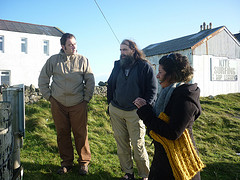
First version of Tiree Mobile Archive app goes live at Wave Classic

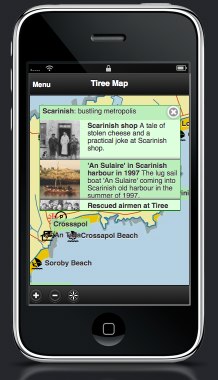
The first release version of the Tiree Mobile Archive app (see “Tiree Going Mobile“) is seeing real use this coming week at the Tiree Wave Classic. As well as historical information, and parts customised for the wind-surfers, it already embodies some interesting design features including the use of a local map  There’s a lot of work to do before the full launch next March, but it is an important step.

The mini-site for this Wave Classic version has a simulator, so you can see what it is like online, or download to your mobile … although GPS tracking only works when you are on Tiree ;-)

Currently it still has only a small proportion of the archive material from An Iodhlann so still to come are some of the issues of volume that will surely emerge as more of the data comes into the app.

Of course those coming for the Wave Classic will be more interested in the sea than local history, so we have deliberately included features relevant to them, Twitter and news feeds from the Wave Classic site and also pertinent tourist info (beaches, campsites and places to eat … and drink!).  This will still be true for the final version of the app when it is released in the sprint — visitors come for a variety of reasons, so we need to offer a broad experience, without overlapping too much with a more tourism focused app that is due to be created for the island in another project.

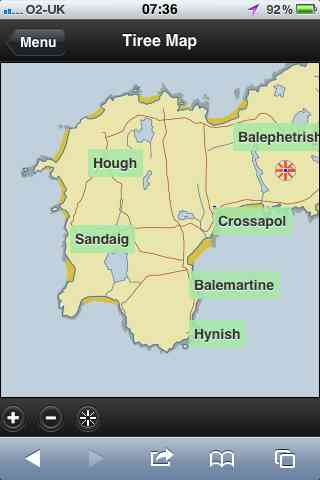
One crucial feature of the app is the use of local maps.  The booklet for the wave classic (below left) uses the Discover Tiree tourist map, designed by Colin Woodcock and used on the island community website and various island information leaflets.  The online map (below right) uses the same base layer.  The map deliberately uses this rather than the OS or Google maps (although final version will swop to OS for most detailed views) as this wll be familiar as they move between paper leaflets and the interactive map.


In “from place to PLACE“, a collection developed as part of Common Ground‘s ‘Parish Maps‘ project in the 1990s, Barbara Bender writes about the way:

“Post-Renaissance maps cover the surface of the world with an homogeneous Cartesian grip”

Local maps have their own logic not driven by satellite imagery, or military cartography1; they emphasise certain features, de-emphasise others, and are driven spatially less by the compass and ruler and more by the way things feel ‘on the ground’.  These issues of space and mapping have been an interest for many years2, so both here and in my walk around Wales next year I will be aiming to ‘reclaim the local map within technological space’.

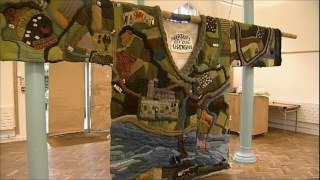
In fact, the Discover Tiree map, while stylised and deliberately not including roads that are not suitable for tourists, is very close to a ‘standard map’ in shape, albeit at a slightly different angle to OS maps as it is oriented3 to true North whereas OS maps are oriented to ‘Grid North’ (the problems of representing a round earth on flat sheets!).  In the future I’d like us to be able to deal with more interpretative maps, such as the mural map found on the outside of MacLeod’s shop. Or even the map of Cardigan knitted onto a Cardigan knitted as part of the 900 year anniversary of the town.


Technically this is put together as an HTML5 site to be cross-platform,, but … well let’s say some tweaks needed4.  Later on we’ll look to wrapping this in PhoneGap or one of the other HTML5-to-native frameworks, but for the time being once you have bookmarked to the home page on iOS looks pretty much like an app – on Android a little less so, but still easy access … and crucially works off-line — Tiree not known for high availability of mobile signal!


  1. The ‘ordnance‘ in ‘Ordnance Survey‘ was originally about things that go bang! [back]
  2. For example, see “Welsh Mathematician walks in Cyberspace” and  “Paths and Patches - patterns of geognosy and gnosis”. [back]
  3. A lovely word, originally means to face East as early Mappa Mundi were all arranged with the East at the top. [back]
  4. There’s a story, going cross browser on mobile platform reminds me so much of desktop web design 10 years ago, on the whole iOS Safari behave pretty much like desktop ones, but Android is a law unto itself!. [back]

Walking Wales

As some of you already know, next year I will be walking all around Wales: from May to July covering just over 1000 miles in total.

Earlier this year the Welsh Government announced the opening of the Wales Coastal Path a new long distance footpath around the whole coast of Wales. There were several existing long distance paths covering parts of the coastline, as well as numerous stretches of public footpaths at or near the coast. However, these have now been linked, mapped and waymarked creating for the first time, a continuous single route. In addition, the existing Offa’s Dyke long distance path cuts very closely along the Welsh–English border, so that it is possible to make a complete circuit of Wales on the two paths combined.

As soon as I heard the announcement, I knew it was something I had to do, and gradually, as I discussed it with more and more people, the idea has become solid.

This will not be the first complete periplus along these paths; this summer there have been at least two sponsored walkers taking on the route. However, I will be doing the walk with a technology focus, which will, I believe, be unique.

The walk has four main aspects:

personal — I am Welsh, was born and brought up in Cardiff, but have not lived in Wales for over 30 years. The walk will be a form of homecoming, reconnecting with the land and its people that I have been away from for so long. The act of encircling can symbolically ‘encompass’ a thing, as if knowing the periphery one knows the whole. Of course life is not like this, the edge is just that, not the core, not the heart. As a long term ex-pat, a foreigner in my own land, maybe all I can hope to do is scratch the surface, nibble at the edges. However, also I always feel most comfortable as an outsider, as one at the margins, so in some ways I am going to the places where I most feel at home. I will blog, audio blog, tweet and generally share this experience to the extent the tenuous mobile signal allows, but also looking forward to periods of solitude between sea and mountain.

practical — As I walk I will be looking at the IT experience of the walker and also discuss with local communities the IT needs and problems for those at the edges, at the margins. Not least will be issues due to the paucity of network access both patchy mobile signal whilst walking and low-capacity ‘broadband’ at the limits of wind-beaten copper telephone wires — none of the mega-capacity fibre optic of the cities. This will not simply be fact-finding, but actively building prototypes and solutions, both myself (in evenings and ‘days off’) and with others who are part of the project remotely or joining me for legs of the journey1. Geolocation and mobile based applications will be a core part of this, particularly for the walkers experience, but local community needs likely to be far more diverse.

philosophical — Mixed with personal reflections will be an exploration of the meanings of place, of path, of walking, of nomadicity and of locality. Aristotle’s school of philosophy was called the Peripatetic School because discussion took place while walking; over two thousand years later Wordsworth’s poetry was nearly all composed while walking; and for time immemorial routes of pilgrimage have been a focus of both spiritual service and personal enlightenment. This will build on some of my own previous writings in particular past keynotes2 on human understanding of space, and also wider literature such as Rebecca Solnit’s wonderful “Wanderlust“.  This reflection will inform the personal blogging, and after I finish I will edit this into a book or account of the journey.

research3 — the practical outcomes will intersect with various personal research interests including social empowerment, interaction design and algorithmics4.  For the walker’s experience, I will be effectively doing a form of action research!.  This will certainly include how to incorporate local maps (such as tourists town plans) effectively into more large-scale experiences, how ‘crowdsourced’ route knowledge can augment more formal digital and paper resources, data synchonisation to deal with disconnection, and data integration between diverse sources.  In addition I am offering myself as a living lab so that others can use my trip as a place to try out their own sensors and instrumentation5, information systems, content authoring, ethnographic practices, community workshops, etc.  This may involve simply asking me to use things, coming for a single meeting or day, or joining me for parts of the walk.

If any of this interests you, do get in touch.  As well as research collaborations (living lab or supporting direct IT goals) any help in managing logistics, PR, or finding sources of funding/sponsorship for basic costs, most welcome.

I’ll get a dedicated website, Facebook page, twitter account, and charity sponsorship set up soon … watch this space!


  1. Coding whilst walking is something I have thought about (but not done!) for many years, but definitely inspired more recently by Nick the amazing cycling programmer who came to the Spring Tiree Tech Wave. [back]
  2. Welsh Mathematician Walks in Cyberspace“, and “Paths and Patches: patterns of geognosy and gnosis“. [back]
  3. I tried to think of a word beginning with ‘p’ for research, but failed! [back]
  4. As I tagged this post I found I was using nearly all my my most common tags — I hadn’t realised quite how much this project cuts across so many areas of interest. [back]
  5. But with the “no blood rule”: if I get sensor sores, the sensors go in the bin ;-) [back]

September beckons: calls for Physicality and Alt-HCI

I’m co-chairing a couple of events, both with calls due in mid June: Physicality 2012, and Alt-HCI.   Both are associated with HCI 2012  in Birmingham in September, so you don’t have to chose!

Physicality 2012 – 4th International Workshop on Physicality

(Sept.11, co-located with HCI 2012)

Long awaited, the 4th in the Physicality workshop series exploring design challenges, theories and experiences in developing new forms of interactions that exploit human physical interaction with digital technology.

Position papers and research papers due 18th June.

see:

Alt-HCI

(track of HCI 2012, 12-15 Sept 2012)

A chance to present and engage with work that pushes the boundaries of HCI.  Do you investigate methods for inducing negative user experience, or for not getting things done (or is that Facebook?).  Maybe you would like to argue for the importance of Taylorism within HCI, or explore user interfaces for the neonate.

Papers due 15th June with an open review process in the weeks following.

see: HCI 2012 call for participation  (also HCI short papers and work-in-progress due 15th June: )

One week to the next Tech Wave

Just a week to go now before the next Tiree Tech Wave starts, although the first person is coming on Sunday and one person is going to hang on for a while after getting some surfing in.

Still plenty of room for anyone who decides to come at the last minute.

Things have been a little hectic, as having to do more of the local organisation this time, so running round the island a bit, but really looking forward to when people get here :-)  Last two times I’ve felt a bit of tension leading up to the event as I feel responsible.  It is difficult planning an event and not having a schedule “person A giving talk at 9:30, person B at 10:45″; strangely much harder having nothing, simply trusting that good things will happen.  Hopefully this time I now have had enough experience to know that if I just hang back and resist the urge to ‘do something’, then people will start to talk together, work together, make together — I just need to have the confidence to do nothing1.

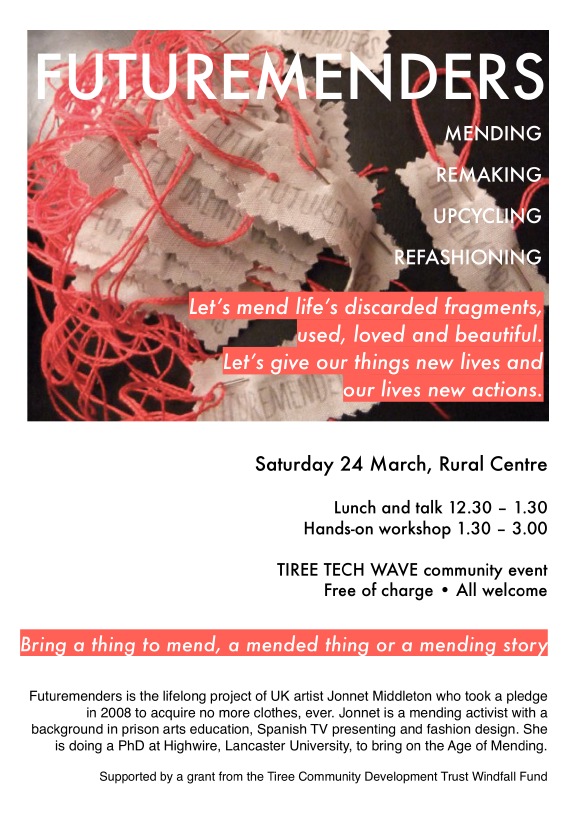
At previous TTW we have had open evenings when people from the local community have come in to see what is being done.  This time, as well as having a general welcome to people to come and see,  Jonnet from HighWire at Lancaster is going to run a community workshop on mending based on her personal and PhD work on ‘Futuremenders‘. Central to this is Jonnet’s pledge to not acquire any more clothes, ever, but instead to mend and remake. This picks up on textile themes on the island especially the ‘Rags to Riches Eco-Chic‘ fashion award and community tapestry group, but also Tech Wave themes of making, repurposing and generally taking things to pieces.   Jonnet’s work is not techno-fashion (no electroluminescent skirts, or LEDs stitched into your wooly hat), but does use social connections both physical and through the web to create mass participation, including mass panda knitting and an attempt on the world mass darning record.

For the past few weeks I have had an unusual (although I hope to become usual) period of relative stability on the island after a previous period of 8 months almost constantly on the move.  This has included some data hacking and learning HTML5 for mobile devices (hence some hacker-ish blog posts recently) I hope to finish off one mini-project during the TTW that will be particularly pertinent the weekend the clocks ‘go forward’ an hour for British Summer Time.  Will blog if I do.

I hit the road last November almost immediately the Tech Wave finished, so never got time to tidy things up.  So, before this one starts, I really should try to write a up a couple of activities from last time as I’m sure there will plenty more this time round…


  1. Strange I always give people the same advice we they take on management roles, “the brave manager does nothing”.  How rare that is.  In a university, new Vice Chancellor starts and feels he/she has to change things — new faculty structure, new committees. “In the long run, will be better”, everyone says, but I’ve always found such re-organisation is itself re-organised before we ever get to t “the long run”. [back]

After the Tech Wave is over

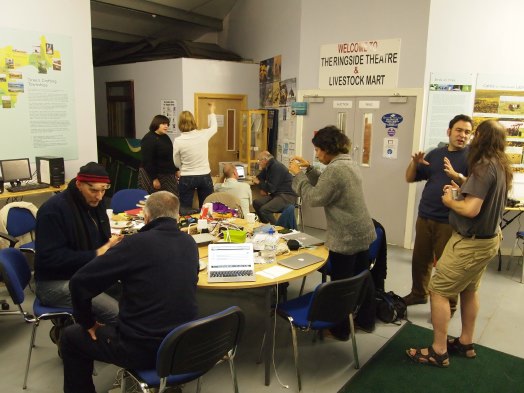
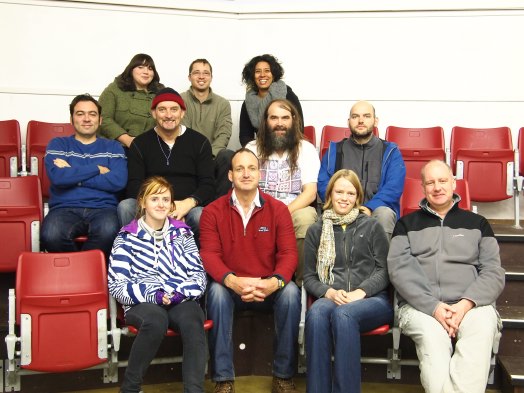
The Second Tiree Tech Wave is over.   Yesterday the last participants left by ferry and plane and after a final few hours tidying, the Rural Centre, which the day before had been a tangle of wire and felt, books and papers, cups and biscuit packets, is now as it had been before.  And as I left, the last boxes under my arm, it was strangely silent with only the memory of voices and laughter in my mind.

So is it as if it had never been?  I there anything left behind?  There are a few sheets of Magic Whiteboard on the walls, that I left so that those visiting the Rural Centre in the coming weeks can see something of what we were doing, and there are used teabags and fish-and-chip boxes in the bin, but few traces.

We trod lightly, like the agriculture of the island, where Corncrake and orchid live alongside sheep and cattle.

Some may have heard me talk about the way design is like a Spaghetti Western. In the beginning of the film Clint Eastwood walks into the town, and at the end walks away.  He does not stay, happily ever after, with a girl on his arm, but leaves almost as if nothing had ever happened.

But while he, like the designer, ultimately leaves, things are not the same.  The Carson brothers who had the town in fear for years lie dead in their ranch at the edge of town, the sharp tang of gunfire still in the air and the buzz of flies slowly growing over the elsewise silent bodies.  The crooked major, who had been in the pocket of the Carson brothers, is strapped over a mule heading across the desert towards Mexico, and not a few wooden rails and water buts need to be repaired.  The job of the designer is not to stay, but to leave, but leave change: intervention more than invention.

But the deepest changes are not those visible in the bullet-pocked saloon door, but in the people.  The drunk who used to sit all day at the bar, has discovered that he is not just a drunk, but he is a man, and the barmaid, who used to stand behind the bar has discovered that she is not just a barmaid, but she is a woman.

This is true of the artefacts we create and leave behind as designers, but much more so of the events, which come and go through our lives.  It is not so much the material traces they leave in the environment, but the changes in ourselves.

I know that, as the plane and ferry left with those last participants, a little of myself left with them, and I know many, probably all, felt a little of themselves left behind on Tiree.  This is partly abut the island itself; indeed I know one participant was already planning a family holiday here and another was looking at Tiree houses for sale on RightMove!  But it was also the intensity of five, sometimes relaxed, sometimes frenetic, days together.

So what did we do?

There was no programme of twenty minute talks, no keynotes or demo, indeed no plan nor schedule at all, unusual in our diary-obsessed, deadline-driven world.

Well, we talked.  Not at a podium with microphone and Powerpoint slides, but while sitting around tables, while walking on the beach, and while standing looking up at Tilly, the community wind turbine, the deep sound of her swinging blades resonating in our bones.  And we continued to talk as the sun fell and the overwhelmingly many stars came out , we talked while eating, while drinking and while playing (not so expertly) darts.

We met people from the island those who came to the open evening on Saturday, or popped in during the days, and some at the Harvest Service on Sunday.  We met Mark who told us about the future plans for Tiree Broadband, Jane at PaperWorks who made everything happen, Fiona and others at the Lodge who provided our meals, and many more. Indeed, many thanks to all those on the island who in various ways helped or made those at TTW feel welcome.

We also wrote.  We wrote on sheets of paper, notes and diagrams, and filled in TAPT forms for Clare who was attempting unpack our experiences of peace and calmness in the hope of designing computer systems that aid rather than assault our solitude.  Three large Magic Whiteboard sheets were entitled “I make because …”, “I make with …”, “I make …” and were filled with comments.  And, in these days of measurable objectives, I know that at least a grant proposal, book chapter and paper were written during the long weekend; and the comments on the whiteboards and experiences of the event will be used to create a methodological reflection of the role of making in research which we’ll put into Interfaces and the TTW web site.

We moved.  Walking, throwing darts, washing dishes, and I think all heavily gesturing with our hands while taking.  And became more aware of those movements during Layda’s warm-up improvisation exercises when we mirrored one another’s movements, before using our bodies in RePlay to investigate issues of creativity and act out the internal architecture of Magnus’ planned digital literature system.

We directly encountered the chill of wind and warmth of sunshine, the cattle and sheep, often on the roads as well as in the fields.  We saw on maps the pattern of settlement on the island and on display boards the wools from different breeds on the island. Some of us went to the local historical centre, An Iodhlann [[ http://www.aniodhlann.org.uk/ ]], to see artefacts, documents and displays of the island in times past, from breadbasket of the west of Scotland to wartime airbase.

We slept.  I in my own bed, some in the Lodge, some in the B&B round the corner, Matjaz and Klem in a camper van and Magnus – brave heart – in a tent amongst the sand dunes.  Occasionally some took a break and dozed in the chairs at the Rural Centre or even nodded off over a good dinner (was that me?).

We showed things we had brought with us, including Magnus’ tangle of wires and circuit boards that almost worked, myself a small pack of FireFly units (enough to play with I hope in a future Tech Wave), Layda’s various pieces she had made in previous tech-arts workshops, Steve’s musical instrument combining Android phone and cardboard foil tube, and Alessio’s impressively modified table lamp.

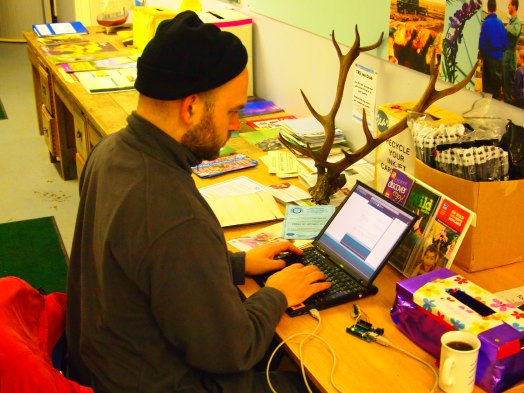
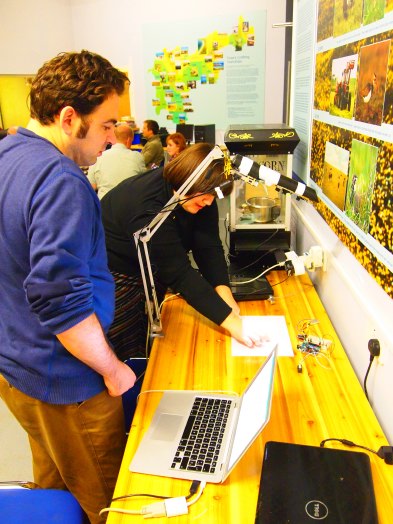
And we made.  We do after all describe this as a making event!  Helen and Claire explored the limits of ZigBee wireless signals.  Several people contributed to an audio experience using proximity sensors and Arduino boards, and Steve’s CogWork Chip: Lego and electronics, maybe the world’s first mechanical random-signal generator.  Descriptions of many of these and other aspects of the event will appear in due course on the TTW site and participants’ blogs.


But it was a remark that Graham made as he was waiting in the ferry queue that is most telling.  It was not the doing that was central, the making, even the talking, but the fact that he didn’t have to do anything at all.  It was the lack of a plan that made space to fill with doing, or not to do so.

Is that the heart?  We need time and space for non-doing, or maybe even un-doing, unwinding tangles of self as well as wire.

There will be another Tiree Tech Wave in March/April, do come to share in some more not doing then.

Who was there:

  • Alessio Malizia – across the seas from Madrid, blurring the boundaries between information, light and space
  • Helen  Pritchard – artist, student of innovation and interested in cows
  • Claire  Andrews – roller girl and researching the design of assistive products
  • Clare  Hooper – investigating creativity, innovation and a sprinkling of SemWeb
  • Magnus  Lawrie – artist, tent-dweller and researcher of digital humanities
  • Steve Gill – designer, daredevil and (when he can get me to make time) co-authoring book on physicality TouchIT
  • Graham Dean – ex-computer science lecturer, ex-businessman, and current student and auto-ethnographer of maker-culture
  • Steve Foreshaw - builder, artist, magician and explorer of alien artefacts
  • Matjaz Kljun – researcher of personal information and olive oil maker
  • Layda Gongora – artist, curator, studying improvisation, meditation and wild hair
  • Alan Dix – me

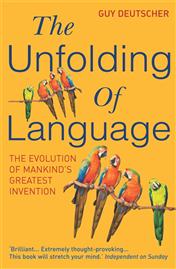
book: The Unfolding of Language, Deutscher

I have previously read Guy Deutscher‘s “Through the Language Glass“, and have now, topsy turvy, read his earlier book “The Unfolding of Language“.  Both are about language, “The Unfolding of Language” about the development of the complexity of language that we see today from simpler origins, and “Through the Language Glass” about the interaction between language and thought.  Both are full of sometimes witty and always fascinating examples drawn from languages around the world, from the Matses in the Amazon to Ancient Sumarian.

I recall my own interest in the origins of language began young, as a seven year old over breakfast one day, asking whether ‘night, was a contraction of ‘no light’.  While this was an etymological red herring, it is very much the kind of change that Deutscher documents in detail showing the way a word accretes beginnings and ending through juxtaposition of simpler words followed by erosion of hard to pronounce sounds.

One of my favourites examples was the French “aujourd’hui”.  The word ‘hui, was Old French for ‘today’, but was originally Latin “hoc die”, “(on) this day”. Because ‘hui’ is not very emphatic it became “au jour d’hui”, “on the day of this day” , which contracted to the current ‘aujourd’hui’. Except now to add emphasis some French speakers are starting to say “au jour aujourd’hui”, “on the day on the day of this day”!  This reminds me of Longsleddale in the Lake District (inspiration for Postman Pat‘s Greendale),  a contraction of “long sled dale”, which literally means “long valley valley” from Old English “slaed” meaning “valley” … although I once even saw something suggesting that ‘long’ itself in the name was also “valley” in a different language!

Deutscher gives many more prosaic examples where words meaning ‘I’, ‘you’, ‘she’ get accreted to verbs to create the verb endings found in languages such as French, and how prepositions (themselves metaphorically derived from words like ‘back’) were merged with nouns to create the complex case endings of Latin.

However, the most complex edifice, which Deutscher returns to repeatedly, is that of the Semitic languages with a template system of vowels around three-consonant roots, where the vowel templates change the meaning of the root.  To illustrate he uses the (fictional!) root ‘sng’ meaning ‘to snog’ and discusses how first simple templates such as ‘snug’ (“I snogged”) and then more complex constructions such as ‘hitsunnag’ (“he was made to snog himself”) all arose from simple processes of combination, shortening and generalisation.

“The Unfolding of Language” begins with the 19th century observation that all languages seem to be in a process of degeneration where more complex  forms such as the Latin case system or early English verb endings are progressively simplified and reduced. The linguists of the day saw all languages in a state of continuous decay from an early linguistic Golden Age. Indeed one linguist, August Schleicher, suggested that there was a process where language develops until it is complex enough to get things done, and only then recorded history starts, after which the effort spent on language is instead spent in making history.

As with geology, or biological evolution, the modern linguist rejects this staged view of the past, looking towards the Law of Uniformitarianism, things are as they have always been, so one can work out what must have happened in the pre-recorded past by what is happening now.  However, whilst generally finding this convincing, throughout the book I had a niggling feeling that there is a difference.  By definition, those languages for which we have written records are those of large developed civilisations, who moreover are based on writing. Furthermore I am aware that for biological evolution small isolated groups (e.g. on islands or cut off in valleys) are particularly important for introducing novelty into larger populations, and I assume the same would be true of languages, but somewhat stultified by mass communication.

Deutscher does deal with this briefly, but right at the very end in a short epilogue.  I feel there is a whole additional story about the interaction between culture and the grammatical development of language.  I recall in school a teacher explained how in Latin the feminine words tended to belong to the early period linked to agriculture and the land, masculine words for later interests in war and conquest, and neuter for the still later phase of civic and political development. There were many exceptions, but even this modicum of order helped me to make sense of what otherwise seemed an arbitrary distinction.

The epilogue also mentions that the sole exception to the ‘decline’ in linguistic complexity is Arabic with its complex template system, still preserved today.

While reading the chapters about the three letter roots, I was struck by the fact that both Hebrew an Arabic are written as consonants only with vowels interpolated by diacritical marks or simply remembered convention (although Deutscher does not mention this himself). I had always assumed that this was like English where t’s pssble t rd txt wth n vwls t ll. However, the vowels are far more critical for Semitic languages where the vowel-less words could make the difference between “he did it” and “it will be done to him”.  Did this difference in writing stem from the root+template system, or vice versa, or maybe they simply mutually reinforced each other?

The other factor regarding Arabic’s remarkable complexity must surely be the Quran. Whereas the Bible was read for a over a millennium in Latin, a non-spoken language, and later translated focused on the meaning; in contrast there is a great emphasis on the precise form of the Quran together with continuous lengthy recitation.  As the King James Bible has been argued to have been a significant influence on modern English since the 17th century, it seems likely the Quran has been a factor in preserving Arabic for the last 1500 years.

Early in “The Unfolding of Language” Deutscher dismisses attempts to look at the even earlier prehistoric roots of language as there is no direct evidence. I assume that this would include Mithin’s “The Singing Neanderthals“, which I posted about recently. There is of course a lot of truth in this criticism; certainly Mithin’s account included a lot of guesswork, albeit founded on paleontological evidence.  However, Deutscher’s own arguments include extrapolating to recent prehistory. These extrapolations are based on early written languages and subsequent recorded developments, but also include guesswork between the hard evidence, as does the whole family-tree of languages.  Deutscher was originally a Cambridge mathematician, like me, so, perhaps unsurprisingly, I found his style of argument convincing. However, given the foundations on Uniformitarianism, which, as noted above, is at best partial when moving from history to pre-history, there seems more of  a continuum rather than sharp distinction between the levels of interpretation and extrapolation in this book and Mithin’s.

Deutscher’s account seeks to fill in the gap between the deep prehistoric origins of protolanguage (what Deutscher’s calls ‘me Tarzan’ language) and its subsequent development in the era of media-society (starting 5000BC with extensive Sumerian writing). Rather than seeing these separately, I feel there is a rich account building across various authors, which will, in time, yield a more complete view of our current language and its past.

book: The Singing Neanderthals, Mithin

One of my birthday presents was Steven Mithin’s “The Singing Neanderthals” and, having been on holiday, I have already read it! I read Mithin’s “The Prehistory of the Mind” some years ago and have referred to it repeatedly over the years1, so was excited to receive this book, and it has not disappointed. I like his broad approach taking evidence from a variety of sources, as well as his own discipline of prehistory; in times when everyone claims to be cross-disciplinary, Mithin truly is.

“The Singing Neanderthal”, as its title suggests, is about the role of music in the evolutionary development of the modern human. We all seem to be born with an element of music in our heart, and Mithin seeks to understand why this is so, and how music is related to, and part of the development of, language. Mithin argues that elements of music developed in various later hominids as a form of primitive communication2, but separated from language in homo sapiens when music became specialised to the communication of emotion and language to more precise actions and concepts.

The book ‘explains’ various known musical facts, including the universality of music across cultures and the fact that most of us do not have perfect pitch … even though young babies do (p77). The hard facts of how things were for humans or related species tens or hundreds of thousands of years ago are sparse, so there is inevitably an element of speculation in Mithin’s theories, but he shows how many, otherwise disparate pieces of evidence from palaeontology, psychology and musicology make sense given the centrality of music.

Whether or not you accept Mithin’s thesis, the first part of the book provides a wide ranging review of current knowledge about the human psychology of music. Coincidentally, while reading the book, there was an article in the Independent reporting on evidence for the importance of music therapy in dealing with depression and aiding the rehabilitation of stroke victims3, reinforcing messages from Mithin’s review.

The topic of “The Singing Neanderthal” is particularly close to my own heart as my first personal forays into evolutionary psychology (long before I knew the term, or discovered Cosmides and Tooby’s work), was in attempting to make sense of human limits to delays and rhythm.

Those who have been to my lectures on time since the mid 1990s will recall being asked to first clap in time and then swing their legs ever faster … sometimes until they fall over! The reason for this is to demonstrate the fact that we cannot keep beats much slower than one per second4, and then explain this in terms of our need for a mental ‘beat keeper’ for walking and running. The leg shaking is to show how our legs, as a simple pendulum, have a natural frequency of around 1Hz, hence determining our slowest walk and hence need for rhythm.

Mithin likewise points to walking and running as crucial in the development of rhythm, in particular the additional demands of bipedal motion (p150). Rhythm, he argues, is not just about music, but also a shared skill needed for turn-taking in conversation (p17), and for emotional bonding.

In just the last few weeks, at the HCI conference in Newcastle, I learnt that entrainment, when we keep time with others, is a rare skill amongst animals, almost uniquely human. Mithin also notes this (p206), with exceptions, in particular one species of frog, where the males gather in groups to sing/croak in synchrony. One suggested reason for this is that the louder sound can attract females from a larger distance. This cooperative behaviour of course acts against each frog’s own interest to ‘get the girl’ so they also seek to out-perform each other when a female frog arrives. Mithin imagines that similar pressures may have sparked early hominid music making. As well as the fact that synchrony makes the frogs louder and so easy to hear, I wonder whether the discerning female frogs also realise that if they go to a frog choir they get to chose amongst them, whereas if they follow a single frog croak they get stuck with the frog they find; a form of frog speed dating?

Mithin also suggests that the human ability to synchronise rhythm is about ‘boundary loss’ seeing oneself less as an individual and more as part of a group, important for early humans about to engage in risky collaborative hunting expeditions. He cites evidence of this from the psychology of music, anthropology, and it is part of many people’s personal experience, for example, in a football crowd, or Last Night at the Proms.

This reminds me of the experiments where a rubber hand is touched in time with touching a person’s real hand; after a while the subject starts to feel as if the rubber hand is his or her own hand. Effectively our brain assumes that this thing that correlates with feeling must be part of oneself5. Maybe a similar thing happens in choral singing, I voluntarily make a sound and simultaneously everyone makes the sound, so it is as if the whole choir is an extension of my own body?

Part of the neurological evidence for the importance of group music making concerns the production of oxytocin. In experiments on female prairie voles that have had oxytocin production inhibited, they engage in sex as freely as normal voles, but fail to pair bond (p217). The implication is that oxytocin’s role in bonding applies equally to social groups. While this explains a mechanism by which collaborative rhythmic activities create ‘boundary loss’, it doesn’t explain why oxytocin is created through rhythmic activity in the first place. I wonder if this is perhaps to do with bipedalism and the need for synchronised movement during face-to-face copulation, which would explain why humans can do synchronised rhythms whereas apes cannot. That is, rhythmic movement and oxytocin production become associated for sexual reasons and then this generalises to the social domain. Think again of that chanting football crowd?

I should note that Mithin also discusses at length the use of music in bonding with infants, as anyone who has sung to a baby knows, so this offers an alternative route to rhythm & bonding … but not one that is particular to humans, so I will stick with my hypothesis ;-)

Sexual selection is a strong theme in the book, the kind of runaway selection that leads to the peacock tail. Changing lifestyles of early humans, in particular longer periods looking after immature young, led to a greater degree of female control in the selection of partners. As human size came close to the physical limits of the environment (p185), Mithin suggests that other qualities had to be used by females to choose their mate, notably male singing and dance – prehistoric Saturday Night Fever.

As one evidence for female mate choice, Mithin points to the overly symmetric nature of hand axes and imagines hopeful males demonstrating their dexterity by knapping ever more perfect axes in front of admiring females (p188). However, this brings to mind Calvin’s “Ascent of Mind“, which argues that these symmetric, ovoid axes were used like a discus, thrown into the midst of a herd of prey to bring one down. The two theories for axe shape are not incompatible. Calvin suggests that the complex physical coordination required by axe throwing would have driven general brain development. In fact these forms of coordination, are not so far from those needed for musical movement, and indeed expert flint knapping, so maybe it was this skills that were demonstrated by the shaping of axes beyond that immediately necessary for purpose.

Mithin’s description of the musical nature of mother-child interactions also brought to mind Broomhall’s “Eternal Child“. Broomhall ‘s central thesis is that humans are effectively in a sort of arrested development with many features, not least our near nakedness, characteristic of infants. Although it was not one of the points Broomhall makes, his arguments made sense to me in terms of the mental flexibility that characterises childhood, and the way this is necessary for advanced human innovation; I am always encouraging students to think in a more childlike way. If Broomhall’s theories were correct, then this would help explain how some of the music making more characteristic of mother-infant interactions become generalised to adult social interactions.

I do notice an element of mutual debunking amongst those writing about richer cognitive aspects of early human and hominid development. I guess a common trait in disciplines when evidence is thin, and theories have to fill a lot of blanks. So maybe Mithin, Calvin and Broomhall would not welcome me bringing their respective contributions together! However, as in other areas where data is necessarily scant (such as sub-atomic physics), one does feel a developing level of methodological rigour, and the fact that these quite different theoretical approaches have points of connection, does suggest that a deeper understanding of early human cognition, while not yet definitive, is developing.

In summary, and as part of this wider unfolding story, “The Singing Neanderthal” is an engaging and entertaining book to read whether you are interested in the psychological and social impact of music itself, or the development of the human mind.

… and I have another of Mithin’s books in the birthday pile, so looking forward to that too!


  1. See particularly my essay on the role of imagination in bringing together our different forms of ‘specialised intelligence’. “The Prehistory of the Mind” highlighted the importance of this ‘cognitive fluidity’, linking social, natural and technological thought, but lays this largely in the realm of language. I would suggest that imagination also has this role, creating a sort of ‘virtual world’ on which different specialised cognitive modules can act (see “imagination and rationality“). [back]
  2. He calls this musical communication system Hmmmm in its early form – Holistic, Multiple-Modal, Manipulative and Musical, p138 – and later Hmmmmm – Holistic, Multiple-Modal, Manipulative, Musical and Mimetic, p221. [back]
  3. NHS urged to pay for music therapy to cure depression“, Nina Lakhani, The Independent, Monday, 1 August 2011 [back]
  4. Professional conductors say 40 beats per minute is the slowest reliable beat without counting between beats. [back]
  5. See also my previous essay on “driving as a cyborg experience“. [back]

Struggling with Heidegger

Heidegger and hammers have been part of HCI’s conceptualisation from pretty much as long as I can recall.  Although maybe I first heard the words at some sort of day workshop in the late 1980s as the hammer example as used in HCI annoyed me even then, so let’s start with hammers.

hammers

I should explain that problems with the hammer example are not my current struggles with Heidegger!  For the hammer it is just that Heidegger’s ‘ready at hand’ is often confused with ‘walk up and use’.  In  Heidegger ready-at-hand refers to the way one is focused on the nail, or wood to be joined, not the hammer itself:

“The work to be produced is the “towards which” of such things as the hammer, the plane, and the needle” (Being and Time1, p.70/99)

To be ‘ready to hand’ like this typically requires familiarity with the equipment (another big Heidegger word!), and is very different from the way a cash machine or tourist information systems should be in some ways accessible independent of prior knowledge (or at least only generic knowledge and skills).

My especial annoyance with the hammer example stems from the fact that my father was a carpenter and I reckon it took me around 10 years to learn how to use a hammer properly2!  Even holding it properly is not obvious, look at the picture.

There is a hand sized depression in the middle.  If you have read Norman’s POET you will think, “ah yes perceptual affordance’, and grasp it like this:

But no that is not the way to hold it!  If try to use it like this you end up using the strength of your arm to knock in the nail and not the weight of the hammer.

Give it to a child, surely the ultimate test of ‘walk up and use’, and they often grasp the head like this.

In fact this is quite sensible for a child as a ‘proper’ grip would put too much strain on their wrist.  Recall  Gibson’s definition of affordance was relational3, about the ecological fit between the object and the potential actions, and the actions depends on who is doing the acting.  For a small child with weaker arms the hammer probably only affords use at all with this grip.

In fact the ‘proper’ grip is to hold it quite near the end where you can use the maximum swing of the hammer to make most use of the weight of the hammer and its angular momentum:

Anyway, I think maybe Heidegger knew this even if many who quote him don’t!

Heidegger

OK, so its alright me complaining about other people mis-using Heidegger, but I am in the middle of writing one of the chapters for TouchIT and so need to make sure I don’t get it wrong myself … and there my struggles begin.  I need to write about ready-to-hand and present-to-hand.   I thought I understood them, but always it has been from secondary sources and as I sat with Being and Time in one hand, my Oxford Companion to Philosophy in another and various other books in my teeth … I began to doubt.

First of all what I thought the distinction was:

  • ready at hand — when you are using the tool and it is invisible to you, you just focus on the work to be done with it
  • present at hand — when there is some sort of breakdown, the hammer head is loose or you don’t have the right tool to hand and so start to focus on the tools themsleves rather than on the job at hand

Scanning the internet this is certainly what others think, for example blog posts at 251 philosophy and Matt Webb at Berg4.  Koschmann, Kuutti and Hickman produced an excellent comparison of breakdown in Heidegger, Leont’ev and Dewey5, and from this it looks as though the above distinction maybe comes Dreyfus summary of Heidegger — but again I don’t have a copy of Dreyfus’ “Being-in-the-World“, so not certain.

Now this is an important distinction, and one that Heidegger certainly makes.  The first part is very clearly what Heidegger means by ready-to-hand:

“The peculiarity of what is proximally to hand is that, in its readiness-to-hand, it must, as it were, withdraw … that with which we concern ourselves primarily is the work …” (B&T, p.69/99)

The second point Heidegger also makes at length distinguishing at least three kinds of breakdown situation.  It just seems a lot less clear whether ‘present-at-hand’ is really the right term for it.  Certainly the ‘present-at-hand’ quality of an artefact becomes foregrounded during breakdown:

“Pure presence at hand announces itself in such equipment, but only to withdraw to the readiness-in-hand with which one concerns oneself — that is to say, of the sort of thing we find when we put it back into repair.” (B&T, p.73/103)

But the preceeding sentance says

“it shows itself as an equipmental Thing which looks so and so, and which, in its readiness-to-hand as looking that way, has constantly been present-at-hand too.” (B&T, p.73/103)

That is present-at-hand is not so much in contrast to ready-at-hand, but in a sense ‘there all along’; the difference is that during breakdown the presence-at-hand becomes foregrounded. Indeed when ‘present-at-hand’ is first introduced Heidegger appears to be using it as a binary distinction between Dasein, (human) entities that exist and ponder their existence, and other entities such as a table, rock or tree (p. 42/67).  The contrast is not so much between ready-to-hand and present-to-hand, but between ready-to-hand and ‘just present-at-hand’ (p.71/101) or ‘Being-just-present-at-hand-and-no-more’ (p.73/103). For Heidegger to seems not so much that ‘ready-to-hand’ stands in in opposition to ‘present-to-hand’; it is just more significant.

To put this in context, traditional philosophy had focused exclusively on the more categorically defined aspects of things as they are in the world (‘existentia’/present-at-hand), whilst ignoring the primary way they are encountered by us (Dasein, real knowing existence) as ready-to-hand, invisible in their purposefulness.  Heidegger seeks to redress this.

“If we look at Things just ‘theoretically’, we can get along without understanding readiness-to-hand.” (B&T p.69/98)

Heidegger wants to avoid the speculation of previous science and philosophy. Although it is not a Heidegger word, I use ‘speculation’ here with all of its connotations, pondering at a distance, but without commitment, or like spectators at a sports stadium looking in at something distant and other.  In contrast, ready-to-hand suggests commitment, being actively ‘in the world’ and even when Heidegger talks about those moments when an entity ceases to be ready-to-hand and is seen as present-to-hand, he uses the term circumspection — a casting of the eye around, so that the Dasein, the person, is in the centre.

So present-at-hand is simply the mode of being of the entities that are not Dasein (aware of their own existence), but our primary mode of experience of them and thus in a sense the essence of their real existence is when they are ready-to-hand.  I note Roderick Munday’s useful “Glossary of Terms in Being and Time” highlights just this broader sense of present-at-hand.

Maybe the confusion arises because Heidegger’s concern is phenomenological and so when an artefact is ready-to-hand and its presence-to-hand ‘withdraws’, in a sense it is no longer present-to-hand as this is no longer a phenomenon; and yet he also seems to hold a foot in realism and so in another sense it is still present-to-hand.  In discussing this tension between realism and idealism in Heidegger, Stepanich6 distinguishes present-at-hand and ready-to-hand, from presence-to-hand and readiness-to-hand — however no-one else does this so maybe that is a little too subtle!

To end this section (almost) with Heidegger’s words, a key statement, often quoted, seems to say precisely what I have argued above, or maybe precisely the opposite:

“Yet only by reason of something present-at-hand ‘is there’ anything ready-to-hand.  Does it follow, however, granting this thesis for the nonce, that readiness-to-hand is ontologically founded upon presence-at-hand?” (B&T, p.71/101)

What sort of philosopher makes a key point through a rhetorical question?

So, for TouchIT, maybe my safest course is to follow the example of the Oxford Companion to Philosophy, which describes ready-to-hand, but circumspectly never mentions present-to-hand at all?

and anyway what’s wrong with …

On a last note there is another confusion, or maybe mistaken attitude, that seems to be common when referring to ready-to-hand.  Heidegger’s concern was in ontology, understanding the nature of being, and so he asserted the ontological primacy of the ready-to-hand, especially in light of the previous dominant concerns of philosophy.  However, in HCI, where we are interested not in the philosophical question, but the pragmatic one of utility, usability, and experience, Heidegger is often misapplied as a kind of fetishism of engagement, as if everything should be ready-to-hand all the time.

Of course for many purposes this is correct, as I type I do not want to be aware of the keys I press, not even of the pages of the book that I turn.

Yet there is also a merit in breaking this engagement, to encourage reflection and indeed the circumspection that Heidegger discusses.  Indeed Gaver et al.’s focus on ambiguity in design7 is often just to encourage that reflection and questioning, bringing things to the foreground that were once background.

Furthermore as HCI practitioners and academics we need to both take seriously the ready-to-hand-ness of effective design, but also (just as Heidegger is doing) actually look at the ready-to-hand-ness of things seeing them and their use not taking them for granted.  I constantly strive to find ways to become aware of the mundane, and offer students tools for estrangement to look at the world askance8.

“To lay bare what is  just present-at-hand and no more, cognition must first penetrate beyond what is ready-to-hand in our concern.” (B&T, p.71/101)

This ability to step out and be aware of what we are doing is precisely the quality that Schon recognises as being critical for the ‘Reflective Practioner‘.  Indeed, my practical advice on using the hammer in the footnotes below comes precisely through reflection on hammering, and breakdowns in hammering, not through the times when the hammer was ready-to-hand..

Heidegger is indeed right that our primary existence is being in the world, not abstractly viewing it from afar.  And yet, sometimes also, just as Heidegger himself did as he pondered and wrote about these issues, one of our crowning glories as human beings is precisely that we are able also in a sense to step outside ourselves and look in wonder.


  1. In common with much of the literature the page references to Being and Time are all of the form p.70/99 where the first number refers to the page numbers in the original German (which I have not read!) and the second number to the page in Macquarrie and Robinson’s translation of Being and Time published by Blackwell. [back]
  2. Practical hammering – a few tips: The key thing is to focus on making sure the face of the hammer is perpendicular to the nail, if there is a slight angle the nail will bend.  For thin oval wire nails, if one does bend do not knock the nail back upright, most likely it will simply bend again and just snap.  Instead, simply hit the head of the nail while still bent, but keeping the hammer face perpendicular to the nail not the hole.  So long as the nail has cut any depth of hole it will simply follow its own path and straighten of its own accord. [back]
  3. James Gibson. The Ecological Approach to Visual Perception [back]
  4. Matt Webb’s post appears to be quoting Paul Dourish’ “Where the Action Is”, but I must have lent my copy to someone, so not sure of this is really what Paul thinks. [back]
  5. Koschmann, T., Kuutti, K. & Hickman, L. (1998). The Concept of Breakdown in Heidegger, Leont’ev, and Dewey and Its Implications for Education. Mind, Culture, and Activity, 5(1), 25-41. doi:10.1207/s15327884mca0501_3 [back]
  6. Lambert Stepanich. “Heidegger: Between Idealism and Realism“, The Harvard Review of Philosophy, Vol 1. Spring 1991. [back]
  7. Bill Gaver, Jacob Beaver, and Steve Benford, 2003. Ambiguity as a resource for design. CHI ’03. [back]
  8. see previous posts on “mirrors and estrangement” and “the ordinary and the normal“ [back]

Names, URIs and why the web discards 50 years of computing experience

Names and naming have always been a big issue both in computer science and philosophy, and a topic I have posted on before (see “names – a file by any other name“).

In computer science, and in particular programming languages, a whole vocabulary has arisen to talk about names: scope, binding, referential transparency. As in philosophy, it is typically the association between a name and its ‘meaning’ that is of interest. Names and words, whether in programming languages or day-to-day language, are, what philosophers call, ‘intentional‘: they refer to something else. In computer science the ‘something else’ is typically some data or code or a placeholder/variable containing data or code, and the key question of semantics or ‘meaning’ is about how to identify which variable, function or piece of data a name refers to in a particular context at a particular time.

The emphasis in computing has tended to be about:

(a) Making sure names have unambiguous meaning when looking locally inside code. Concerns such as referential transparency, avoiding dynamic binding and the deprecation of global variables are about this.

(b) Putting boundaries on where names can be seen/understood, both as a means to ensure (a) and also as part of encapsulation of semantics in object-based languages and abstract data types.

However, there has always been a tension between clarity of intention (in both the normal and philosophical sense) and abstraction/reuse. If names are totally unambiguous then it becomes impossible to say general things. Without a level of controlled ambiguity in language a legal statement such as “if a driver exceeds the speed limit they will be fined” would need to be stated separately for every citizen. Similarly in computing when we write:

function f(x) { return (x+1)*(x-1); }

The meaning of x is different when we use it in ‘f(2)’ or ‘f(3)’ and must be so to allow ‘f’ to be used generically. Crucially there is no internal ambiguity, the two ‘x’s refer to the same thing in a particular invocation of ‘f’, but the precise meaning of ‘x’ for each invocation is achieved by external binding (the argument list ‘(2)’).

Come the web and URLs and URIs.

Fiona@lovefibre was recently making a test copy of a website built using WordPress. In a pure html website, this is easy (so long as you have used relative or site-relative links within the site), you just copy the files and put them in the new location and they work :-) Occasionally a more dynamic site does need to know its global name (URL), for example if you want to send a link in an email, but this can usually be achieved using configuration file. For example, there is a development version of Snip!t at cardiff.snip!t.org (rather then www.snipit.org), and there is just one configuration file that needs to be changed between this test site and the live one.

Similarly in a pristine WordPress install there is just such a configuration file and one or two database entries. However, as soon as it has been used to create a site, the database content becomes filled with URLs. Some are in clear locations, but many are embedded within HTML fields or serialised plugin options. Copying and moving the database requires a series of SQL updates with string replacements matching the old site name and replacing it with the new — both tedious and needing extreme care not to corrupt the database in the process.

Is this just a case of WordPress being poorly engineered?

In fact I feel more a problem endemic in the web and driven largely by the URL.

Recently I was experimenting with Firefox extensions. Being a good 21st century programmer I simply found an existing extension that was roughly similar to what I was after and started to alter it. First of course I changed its name and then found I needed to make changes through pretty much every file in the extension as the knowledge of the extension name seemed to permeate to the lowest level of the code. To be fair XUL has mechanisms to achieve a level of encapsulation introducing local URIs through the ‘chrome:’ naming scheme and having been through the process once. I maybe understand a bit better how to design extensions to make them less reliant on the external name, and also which names need to be changed and which are more like the ‘x’ in the ‘f(x)’ example. However, despite this, the experience was so different to the levels of encapsulation I have learnt to take for granted in traditional programming.

Much of the trouble resides with the URL. Going back to the two issues of naming, the URL focuses strongly on (a) making the name unambiguous by having a single universal namespace;  URLs are a bit like saying “let’s not just refer to ‘Alan’, but ‘the person with UK National Insurance Number XXXX’ so we know precisely who we are talking about”. Of course this focus on uniqueness of naming has a consequential impact on generality and abstraction. There are many visitors on Tiree over the summer and maybe one day I meet one at the shop and then a few days later pass the same person out walking; I don’t need to know the persons NI number or URL in order to say it was the same person.

Back to Snip!t, over the summer I spent some time working on the XML-based extension mechanism. As soon as these became even slightly complex I found URLs sneaking in, just like the WordPress database :-( The use of namespaces in the XML file can reduce this by at least limiting full URLs to the XML header, but, still, embedded in every XML file are un-abstracted references … and my pride in keeping the test site and live site near identical was severely dented1.

In the years when the web was coming into being the Hypertext community had been reflecting on more than 30 years of practical experience, embodied particularly in the Dexter Model2. The Dexter model and some systems, such as Wendy Hall’s Microcosm3, incorporated external linkage; that is, the body of content had marked hot spots, but the association of these hot spots to other resources was in a separate external layer.

Sadly HTML opted for internal links in anchor and image tags in order to make html files self-contained, a pattern replicated across web technologies such as XML and RDF. At a practical level this is (i) why it is hard to have a single anchor link to multiple things, as was common in early Hypertext systems such as Intermedia, and (ii), as Fiona found, a real pain for maintenance!


  1. I actually resolved this by a nasty ‘hack’ of having internal functions alias the full site name when encountered and treating them as if they refer to the test site — very cludgy! [back]
  2. Halasz, F. and Schwartz, M. 1994. The Dexter hypertext reference model. Commun. ACM 37, 2 (Feb. 1994), 30-39. DOI= http://doi.acm.org/10.1145/175235.175237 [back]
  3. Hall, W., Davis, H., and Hutchings, G. 1996 Rethinking Hypermedia: the Microcosm Approach. Kluwer Academic Publishers. [back]

data types and interpretation in RDF

After following a link from one of Nad’s tweets, read Jeni Tennison’s “SPARQL & Visualisation Frustrations: RDF Datatyping“.  Jeni had been having problems processing RDF of MP’s expense claims, because the amounts were plain RDF strings rather than as typed numbers.  She  suggests some best practice rules for data types in RDF based on the underlying philosophy of RDF that it should be self-describing:

  • if the literal is XML, it should be an XML literal
  • if the literal is in a particular language (such as a description or a name), it should be a plain literal with that language
  • otherwise it should be given an appropriate datatype

These seem pretty sensible for simple data types.

In work on the TIM project with colleagues in Athens and Rome, we too had issues with representing data types in ontologies, but more to do with the status of a data type.  Is a date a single thing “2009-08-03T10:23+01:00″, or is it a compound [[date year="2009" month="8" ...]]?

I just took a quick peek at how Dublin Core handles dates and see that the closest to standard references1 still include dates as ‘bare’ strings with implied semantics only, although one of the most recent docs does say:

It is recommended that RDF applications use explicit rdf:type triples …”

and David MComb’s “An OWL version of the Dublin Core” gives an alternative OWL ontology for DC that does include an explicit type for dc:date:

<owl:DatatypeProperty rdf:about="#date">
  <rdfs:domain rdf:resource="#Document"/>
  <rdfs:range rdf:resource="http://www.w3.org/2001/XMLSchema#dateTime"/>
</owl:DatatypeProperty>

Our solution to the compound types has been to have “value classes” which do not represent ‘things’ in the world, similar to the way the RDF for vcard represents  complex elements such as names using blank nodes:

<vCard:N rdf:parseType="Resource">
  <vCard:Family> Crystal </vCard:Family>
  <vCard:Given> Corky </vCard:Given>
  ...
</vCard:N>

From2

This is fine, and we can have rules for parsing and formatting dates as compound objects to and from, say, W3C datetime strings.  However, this conflicts with the desire to have self-describing RDF as these formatting and parsing rules have to be available to any application or be present as reasoning rules in RDF stores.  If Jeni had been trying to use RDF data coded like this she would be cursing us!

This tension between representations of things (dates, names) and more semantic descriptions is also evident in other areas.  Looking again at Dublin Core the metamodal allows a property such as “subject”  to have a complex object with a URI and possibly several string values.

Very semantic, but hardly mashes well with sources that just say <dc:subject>Biology</dc:subject>.  Again a reasoning store could infer one from the other, but we still have issues about where the knowledge for such transformations resides.

Part of the problem is that the ‘self-describing’ nature of RDF is a bit illusary.   In (Piercian) semiotics the interpretant of a sign is crucial, representations are interpreted by an agent in a particular context assuming a particular language, etc.  We do not expect human language to be ‘sef describing’ in the sense of being totally acontextual.  Similarly in philosophy words and ideas are treated as intentional, in the (not standard English) sense that they refer out to something else; however, the binding of the idea to the thing it refers to is not part of the word, but separate from it.  Effectively the desire to be self-describing runs the risk of ignoring this distinction3.

Leigh Dodds commented on Jeni’s post to explain that the reason the expense amounts were not numbers was that some were published in non-standard ways such as “12345 (2004)”.  As an example this captures succinctly the perpetual problem between representation and abstracted meaning.  If a journal article was printed in the “Autumn 2007″ issue of  quarterly magazine, do we express this as <dc:date>2007</dc:date> or <dc:date>2007-10-01</dc:date>  attempting to give an approximation or inference from the actual represented date.

This makes one wonder whether what is really needed here is a meta-description of the RDF source (not simply the OWL as one wants to talk about the use of dc:date or whatever in a particular context) that can say things like “mainly numbers, but also occasionally non-strandard forms”, or “amounts sometimes refer to different years”.  Of course to be machine mashable there would need to be an ontology for such annotation …


  1. see “Expressing Simple Dublin Core in RDF/XML“, “Expressing Dublin Core metadata using HTML/XHTML meta and link elements” and Stanford DC OWL [back]
  2. Renato Iannella, Representing vCard Objects in RDF/XML, W3C Note, 22 February 2001. [back]
  3. Doing a quick web seek, these issues are discussed in several places, for example: Glaser, H., Lewy, T., Millard, I. and Dowling, B. (2007) On Coreference and the Semantic Web, (Technical Report, Electronics & Computer Science, University of Southampton) and Legg, C. (2007). Peirce, meaning and the semantic web (Paper presented at Applying Peirce Conference, University of Helsinki, Finland, June 2007). [back]