Alt-HCI open reviews – please join in

Papers are online for the Alt-HCI trcak of British HCI conference in September.

These are papers that are trying in various ways to push the limits of HCI, and we would like as many people as possible to join in discussion around them … and this discussion will be part of process for deciding which papers are presented at the conference, and possibly how long we give them!

Here are the papers  — please visit the site, comment, discuss, Tweet/Facebook about them.

paper #154 — How good is this conference? Evaluating conference reviewing and selectivity
        do conference reviews get it right? is it possible to measure this?

paper #165 — Hackinars: tinkering with academic practice
        doing vs talking – would you swop seminars for hack days?

paper #170 — Deriving Global Navigation from Taxonomic Lexical Relations
        website design – can you find perfect words and structure for everyone?

paper #181 — User Experience Study of Multiple Photo Streams Visualization
        lots of photos, devices, people – how to see them all?

paper #186 — You Only Live Twice or The Years We Wasted Caring about Shoulder-Surfing
        are people peeking at your passwords? what’s the real security problem?

paper #191 — Constructing the Cool Wall: A Tool to Explore Teen Meanings of Cool
        do you want to make thing teens think cool?  find out how!

paper #201 — A computer for the mature: what might it look like, and can we get there from here?
        over 50s have 80% of wealth, do you design well for them?

paper #222 — Remediation of the wearable space at the intersection of wearable technologies and interactive architecture
        wearable technology meets interactive architecture

paper #223 — Designing Blended Spaces
        where real and digital worlds collide

The value of networks: mining and building

The value of networks or graphs underlies many of the internet (and for that read global corporate) giants.  Two of the biggest: Google and Facebook harness this in very different ways — mining and building.

Years ago, when I was part of the dot.com startup aQtive, we found there was no effective understanding of internet marketing, and so had to create our own.  Part of this we called ‘market ecology‘.  This basically involved mapping out the relationships of influence between different kinds of people within some domain, and then designing families of products that exploited that structure.

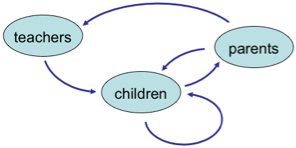
The networks we were looking at were about human relationships: for example teachers who teach children, who have other children as friends and siblings, and who go home to parents.  Effectively we were into (too) early social networking1!

The first element of this was about mining — exploiting the existing network of relationships.

However in our early white papers on the topic, we also noted that the power of internet products was that it was also possible to create new relationships, for example, adding ‘share’ links.  That is building the graph.

The two are not distinct, if one is not able to exploit new relationships within a product it will die, and the mining of existing networks can establish new links (e.g. Twitter suggesting who to follow).  Furthermore, creating of links is rarely ex nihilo, an email ‘share’ link uses an existing relationships (contact in address book), but brings it into a potentially different domain (e.g. bookmarking a web page).

It is interesting to see Google and Facebook against this backdrop.  Their core strengths are in different domains (web information and social relationships), but moreover they focus differently on mining and building.

Google is, par excellence, about mining graphs (the web).  While it has been augmented and modified over the years, the link structure used in PageRank is what made Google great.  Google also mine tacit relationships, for example the use of word collocation to understand concepts and relationships, so in a sense build from what they mine.

Facebook’s power, in contrast, is in the way it is building the social graph as hundreds of millions of people tell it about their own social relationships.  As noted, this is not ex nihilo, the social relationships exist in the real word, but Facebook captures them digitally.  Of course, then Facebook mines this graph in order to derive revenue form advertisements, and (although people debate this) attempt to improve the user experience by ranking posts.

Perhaps the greatest power comes in marrying the two.   Amazon does this to great effect within the world of books and products.

As well as a long-standing academic interest, these issues are particularly germane to my research at Talis where the Education Graph is a core element.  However, they apply equally whether the core network is kite surfers, chess or bio-technology.

Between the two it is probably building that is ultimately most critical.  When one has a graph or network it is possible to find ways to exploit it, but without the network there is nothing to mine. Page and Brin knew this in the early days of their pre-Google project at Stanford, and a major effort was focused on simply gathering the crawl of the web on which they built their algorithms2.  Now Google is aware that, in principle, others can exploit the open resources on which much of its business depends; its strength lies in its intellectual capital. In contrast, with a few geographical exceptions, Facebook is the social graph, far more defensible as Google has discovered as it struggles with Google Plus.


  1. See our retrospective about vfridge  at  last year’s HCI conference and our original web sharer vision. [back]
  2. See the description of this in “In The Plex: How Google Thinks, Works and Shapes Our Lives“. [back]

Phoenix rises – vfridge online again

vfridge is back!

I mentioned ‘Project Phoenix’ in my last previous post, and this was it – getting vfridge up and running again.

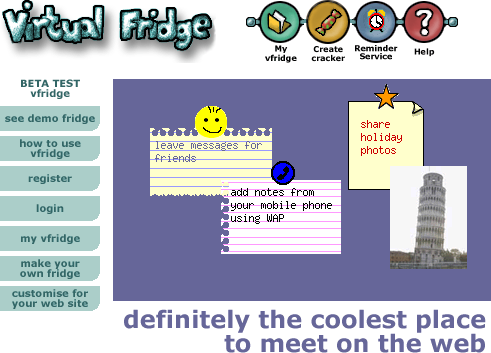
Ten years ago I was part of a dot.com company aQtive1 with Russell Beale, Andy Wood and others.  Just before it folded in the aftermath of the dot.com crash, aQtive spawned a small spin-off vfridge.com.  The virtual fridge was a social networking web site before the term existed, and while vfridge the company went the way of most dot.coms, for some time after I kept the vfridge web site running on Fiona’s servers until it gradually ‘decayed’ partly due to Javascript/DOM changes and partly due to Java’s interactions with mysql becoming unstable (note very, very old Java code!).  But it is now back online :-)

The core idea of vfridge is placing small notes, photos and ‘magnets’ in a shareable web area that can be moved around and arranged like you might with notes held by magnets to a fridge door.
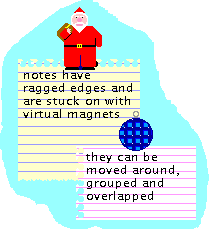
Underlying vfridge was what we called the websharer vision, which looked towards a web of user-generated content.  Now this is passé, but at the time  was directly counter to accepted wisdom and looking back seem prescient – remember this was written in 1999:

Although everyone isn’t a web developer, it is likely that soon everyone will become an Internet communicator — email, PC-voice-comms, bulletin boards, etc. For some this will be via a PC, for others using a web-phone, set-top box or Internet-enabled games console.

The web/Internet is not just a medium for publishing, but a potential shared place.

Everyone may be a web sharer — not a publisher of formal public ‘content’, but personal or semi-private sharing of informal ‘bits and pieces’ with family, friends, local community and virtual communities such as fan clubs.

This is not just a future for the cognoscenti, but for anyone who chats in the pub or wants to show granny in Scunthorpe the baby’s first photos.

Just over a year ago I thought it would be good to write a retrospective about vfridge in the light of the social networking revolution.  We did a poster “Designing a virtual fridge” about vfridge years ago at a Computers and Fun workshop, but have never written at length abut its design and development.  In particular it would be good to analyse the reasons, technical, social and commercial, why it did not ‘take off’ the time.  However, it is hard to do write about it without good screen shots, and could I find any? (Although now I have)  So I thought it would be good to revive it and now you can try it out again. I started with a few days effort last year at Christmas and Easter time (leisure activity), but now over the last week have at last used the fact that I have half my time unpaid and so free for my own activities … and it is done :-)

The original vfridge was implemented using Java Servlets, but I have rebuilt it in PHP.  While the original development took over a year (starting down in Coornwall while on holiday watching the solar eclipse), this re-build took about 10 days effort, although of course with no design decisions needed.  The reason it took so much development back then is one of the things I want to consider when I write the retrospective.

As far as possible the actual behaviour and design is exactly as it was back in 2000 … and yes it does feel clunky, with lots of refreshing (remember no AJAX or web2.0 in those days) and of course loads of frames!  In fact there is a little cleverness that allowed some client-end processing pre-AJAX2.    Also the new implementation uses the same templates as the original one, although the expansion engine had to be rewritten in PHP.  In fact this template engine was one of our most re-used bits of Java code, although now of course many alternatives.  Maybe I will return to a discussion of that in another post.

I have even resurrected the old mobile interface.  Yes there were WAP phones even in 2000, albeit with tiny green and black screens.  I still recall the excitement I felt the first time I entered a note on the phone and saw it appear on a web page :-)   However, this was one place I had to extensively edit the page templates as nothing seems to process WML anymore, so the WML had to be converted to plain-text-ish HTML, as close as possible to those old phones!  Looks rather odd on the iPhone :-/

So, if you were one of those who had an account back in 2000 (Panos Markopoulos used it to share his baby photos :-) ), then everything is still there just as you left it!

If not, then you can register now and play.


  1. The old aQtive website is still viewable at aqtive.org, but don’t try to install onCue, it was developed in the days of Windows NT. [back]
  2. One trick used the fact that you can get Javascript to pre-load images.  When the front-end Javascript code wanted to send information back to the server it preloaded an image URL that was really just to activate a back-end script.  The frames  used a change-propagation system, so that only those frames that were dependent on particular user actions were refreshed.  All of this is preserved in the current system, peek at the Javascript on the pages.    Maybe I’ll write about the details of these another time. [back]

Italian conferences: PPD10, AVI2010 and Search Computing

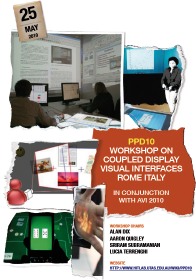
I got back from trip to Rome and Milan last Tuesday, this included the PPD10 workshop that Aaron, Lucia, Sri and I had organised, and the AVI 2008 conference, both in University of Rome “La Sapienza”, and a day workshop on Search Computing at Milan Polytechnic.

PPD10

The PPD10 workshop on Coupled Display Visual Interfaces1 followed on from a previous event, PPD08 at AVI 2008 and also a workshop on “Designing And Evaluating Mobile Phone-Based Interaction With Public Displays” at CHI2008.  The linking of public and private displays is something I’ve been interested in for some years and it was exciting to see some of the kinds of scenarios discussed at Lancaster as potential futures some years ago now being implemented over a range of technologies.  Many of the key issues and problems proposed then are still to be resolved and new ones arising, but certainly it seems the technology is ‘coming of age’.  As well as much work filling in the space of interactions, there were also papers that pushed some of the existing dimensions/classifications, in particular, Rasmus Gude’s paper on “Digital Hospitality” stretched the public/private dimension by considering the appropriation of technology in the home by house guests.  The full proceedings are available at the PPD10 website.

AVI 2010

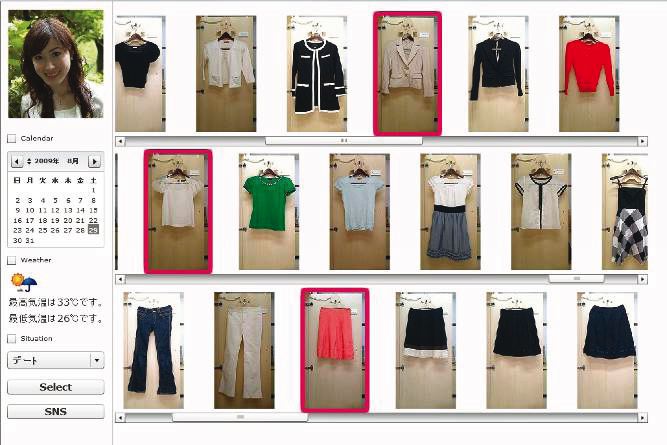
AVI is always a joy, and AVI 2010 no exception; a biennial, single-track conference with high-quality papers (20% accept rate this year), and always in lovely places in Italy with good food and good company!  I first went to AVI in 1996 when it was in Gubbio to give a keynote “Closing the Loop: modelling action, perception and information“, and have gone every time since — I always say that Stefano Levialdi is a bit like a drug pusher, the first experience for free and ever after you are hooked! The high spot this year was undoubtedly Hitomi Tsujita‘s “Complete fashion coordinator2, a system for using social networking to help choose clothes to wear — partly just fun with a wonderful video, but also a very thoughtful mix of physical and digital technology.


images from Complete Fashion Coordinator

The keynotes were all great, Daniel Keim gave a really lucid state of the art in Visual Analytics (more later) and Patrick Lynch a fresh view of visual understanding based on many years experience and highlighting particularly on some of the more immediate ‘gut’ reactions we have to interfaces.  Daniel Wigdor gave an almost blow-by-blow account of work at Microsoft on developing interaction methods for next-generation touch-based user interfaces.  His paper is a great methodological exemplar for researchers combining very practical considerations, more principled design space analysis and targeted experimentation.

Looking more at the detail of Daniel’s work at Microsoft, it is interesting that he has a harder job than Apple’s interaction developers.  While Apple can design the hardware and interaction together, MS as system providers need to deal with very diverse hardware, leading to a ‘least common denominator’ approach at the level of quite basic touch interactions.  For walk-up-and use systems such as Microsoft Surface in bar tables, this means that users have a consistent experience across devices.  However, I did wonder whether this approach which is basically the presentation/lexical level of Seeheim was best, or whether it would be better to settle at some higher-level primitives more at the Seeheim dialog level, thinking particularly of the way the iPhone turns pull down menus form web pages into spinning selectors.  For devices that people own it maybe that these more device specific variants of common logical interactions allow a richer user experience.

The complete AVI 2010 proceedings (in colour or B&W) can be found at the conference website.

The very last session of AVI was a panel I chaired on “Visual Analytics: people at the heart of data” with Daniel Keim, Margit Pohl, Bob Spence and Enrico Bertini (in the order they sat at the table!).  The panel was prompted largely because the EU VisMaster Coordinated Action is producing a roadmap document looking at future challenges for visual analytics research in Europe and elsewhere.  I had been worried that it could be a bit dead at 5pm on the last day of the conference, but it was a lively discussion … and Bob served well as the enthusiastic but also slightly sceptical outsider to VisMaster!

As I write this, there is still time (just, literally weeks!) for final input into the VisMaster roadmap and if you would like a draft I’ll be happy to send you a PDF and even happier if you give some feedback :-)

Search Computing

I was invited to go to this one-day workshop and had the joy to travel up on the train from Rome with Stu Card and his daughter Gwyneth.

The search computing workshop was organised by the SeCo project. This is a large single-site project (around 25 people for 5 years) funded as one of the EU’s ‘IDEAS Advanced Grants’ supporting ‘investigation-driven frontier research’.  Really good to see the EU funding work at the bleeding edge as so many national and European projects end up being ‘safe’.

The term search computing was entirely new to me, although instantly brought several concepts to mind.  In fact the principle focus of SeCo is the bringing together of information in deep web resources including combining result rankings; in database terms a form of distributed join over heterogeneous data sources.

The work had many personal connections including work on concept classification using ODP data dating back to aQtive days as well as onCue itself and Snip!t.  It also has similarities with linked data in the semantic web word, however with crucial differences.  SeCo’s service approach uses meta-descriptions of the services to add semantics, whereas linked data in principle includes a degree of semantics in the RDF data.  Also the ‘join’ on services is on values and so uses a degree of run-time identity matching (Stu Card’s example was how to know that LA=’Los Angeles’), whereas linked data relies on URIs so (again in principle) matching has already been done during data preparation.  My feeling is that the linking of the two paradigms would be very powerful, and even for certain kinds of raw data, such as tables, external semantics seems sensible.

One of the real opportunities for both is to harness user interaction with data as an extra source of semantics.  For example, for the identity matching issue, if a user is linking two data sources and notices that ‘LA’ and ‘Los Angeles’ are not identified, this can be added as part of the interaction to serve the user’s own purposes at that time, but by so doing adding a special case that can be used for the benefit of future users.

While SeCo is predominantly focused on the search federation, the broader issue of using search as part of algorithmics is also fascinating.  Traditional algorithmics assumes that knowledge is basically in code or rules and is applied to data.  In contrast we are seeing the rise of web algorithmics where knowledge is garnered from vast volumes of data.  For example, Gianluca Demartini at the workshop mentioned that his group had used the Google suggest API to extend keywords and I’ve seen the same trick used previously3.  To some extent this is like classic techniques of information retrieval, but whereas IR is principally focused on a closed document set, here the document set is being used to establish knowledge that can be used elsewhere.  In work I’ve been involved with, both the concept classification and folksonomy mining with Alessio apply this same broad principle.

The slides from the workshop are appearing (but not all there yet!) at the workshop web page on the SeCo site.


  1. yes I know this doesn’t give ‘PPD’ this stands for “public and private displays” [back]
  2. Hitomi Tsujita, Koji Tsukada, Keisuke Kambara, Itiro Siio, Complete Fashion Coordinator: A support system for capturing and selecting daily clothes with social network, Proceedings of the Working Conference on Advanced Visual Interfaces (AVI2010), pp.127–132. [back]
  3. The Yahoo! Related Suggestions API offers a similar service. [back]

From raw experience to personal reflection

Just a week to go for deadline for this workshop on the Designing for Reflection on Experience that Corina and I are organising at CHI. Much of the time discussions of user experience are focused on trivia and even social networking often appears to stop at superficial levels.  While throwing a virtual banana at a friend may serve to maintain relationships and is perhaps less trivial than it at first appears; still there is little support for deeper reflection on life, with the possible exception of the many topic-focused chat groups.  However, in researching social networks we have found, amongst the flotsam, clear moments of poinency and conflict, traces of major life events … even divorce by Facebook. Too much navel gazing would not be a good thing, but some attention to expressing  deeper issues to others and to ourselves seems overdue.

HCI and CSCW – is your usability too small

Recently heard some group feedback on our HCI textbook. Nearly all said that they did NOT want any CSCW. I was appalled as considering any sort of user interaction without its surrounding social and organisational settings seems as fundamentally misbegotten as considering a system without its users.

Has the usability world gone mad or is it just that our conception of HCI has become too narrow?

Continue reading

Usabilty and Web2.0

Nad did a brilliant guest lecture for our undergraduate HCI class at Lancaster on Monday. His slides and blog about the lecture are at Virtual Chaos. He touched on issues of democracy vs. authority of information, dynamic content vs. accessibility and of course increasing issues of privacy on social networking sites. He also had awesome slides to using loads of Flickr photos under creative commons … community content in action not just words! Of course also touched on Web3.0 and future convergence between emergent community phenomena and structured Semantic Web technologies.