Network externalities, the way one person’s use of AI and digital tech changes its value for others, creates positive feedback loops, leading to runaway growth and emergent monopolies, the nemesis of free markets.
This is the fourth of a series of blogs based on my keynote “The abomination of AI” at ICoSCI 2026. Each has an accompanying segment of the video and slides from the talk as well as detailed notes and references. Section numbers refer to the full report which will be released in the final blog. The slide thumbnails in the text correspond to the slides in the navigation panel below. The presentation can be played below, or opened full screen. The full length video, complete slides and further information can be found at: https://alandix.com/academic/talks/ICOSCI-2026-abomination-of-AI/
Previously …
§1. Every industry is driven by profits and power, but there is something about the nature of AI itself, which interacts with the nature of market forces in the world that is problematic and is different from other technologies.
§2. Can any technology be neutral? AI can be used for good purposes, such as advances in healthcare. It can also have bad outcomes such as bias in the criminal justice system or online exploitative pornography. Perhaps most often it is creating the frivolous or even ugly.
§3. The obvious impact of AI is in the things it does directly. Some technologies also change the very nature of society, affecting even those who do not use them. Cars are an obvious example. AI is also such a technology.
§4. Doomsayers worry about the point when AI becomes sentient, outgrowing its creators. The real danger is more insidious: the massive financial and human impacts of AI seem almost obscene.
5 Why is this happening?
Why is this happening? Well, we know the world is unequal, we know that the way free markets work mean that big companies often get economies of scale and get larger. Is it just a natural thing that the same is happening with AI?
The answer is ‘no’, this is clear from the way AI stocks have performed in ways unlike any previous (legitimate) business. There are elements of the normal operation of markets, but there are particular properties of digital technology in general and AI in particular that break aspects of market economics and lead to emergent monopolies.
These are due to positive feedback loops. If you are from an engineering background you’ll know about these, but for those who aren’t we’ll take a little segue to look at positive feedback loops in general and then come back to how that applies in the economic sense.
5.1 Understanding feedback loops
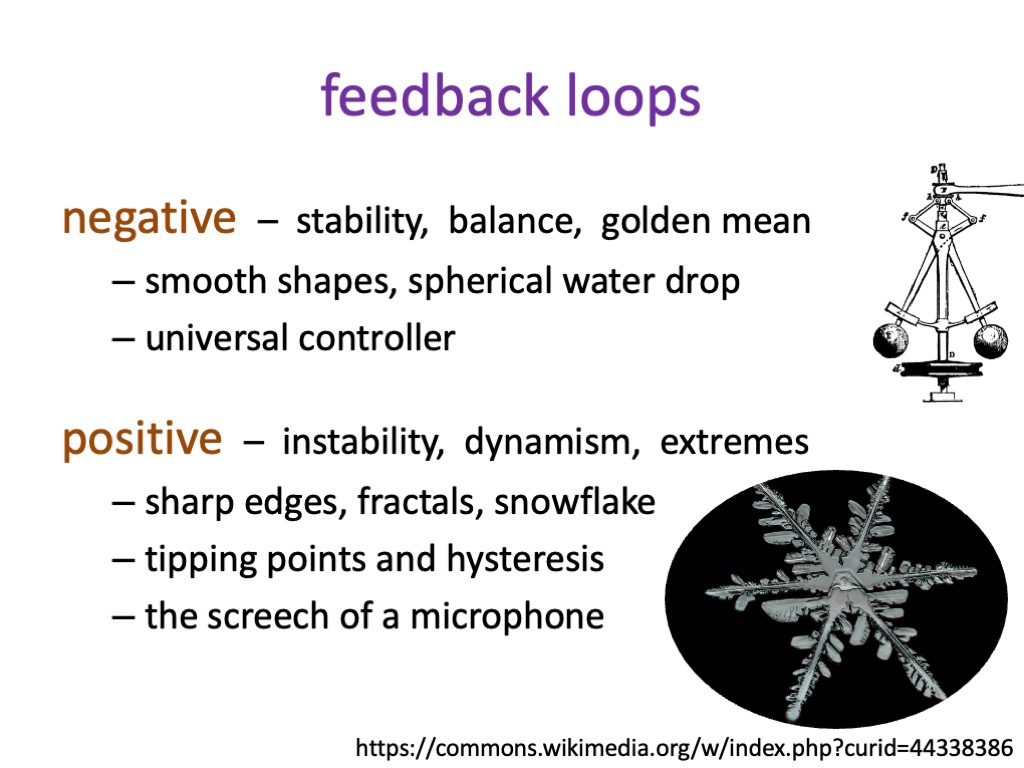
Image: By Charles Schmitt – Own work, CC BY-SA 4.0, https://commons.wikimedia.org/w/index.php?curid=44338386
Feedback loops are everywhere. The term simply means a process where the output in some way influences the future input.
One type is called a negative feedback loop, where a change in the input creates an effect that counters the change. This can be engineered. The classic example of this is the universal controller for a steam engine which keeps the engine running at a set speed. It consists of a set of steel balls on arms that spin as the engine spins. The spinning of the arms means the steel balls rise due to centrifugal force, which then opens a valve reducing the pressure of the steam and hence the speed of the engine. If the engine turns too slowly the balls fall, shutting the valve, increasing the steam pressure and hence the speed of the engine. Notice that this negative feedback effect leads to stability and balance,
In geometric shapes, smoothness is often an indication of negative feedback effect. A water drop is a smooth sphere because any small disturbance on the surface is counteracted by the surface tension, so any little dents fill back in again very rapidly. once again the negative feedback loop creates a stable balance.
Positive feedback effects are when the output that is produced reinforces the original change. Think about a microphone being put near a speaker and the screech you get – that is a classic positive feedback effect – instability and extremes. In physical structures positive feedback effects often lead to sharp edges, like a snowflake. As the snowflake forms any sharp point attracts more ice formation and therefore grows.
Positive feedback often leads to tipping points where you get sudden changes and hysteresis where you have changes, which are hard to reverse. Many climate change issues are of this kind.
This sounds as though positive feedback is a bad idea, but positive feedback can be really powerful. Snowflakes are beautiful and they happen because of this! In our bodies our immune system has some positive feedback cycles so that our bodies can react very rapidly. Positive feedback often leads to exponential growth, and here the immune system can ramp up very quickly to fight infections. However, useful positive feedback is usually wrapped around with controls incorporating negative feedback, which prevents the overall system becoming too extreme.
So it is not the positive feedbacks are bad per se and negative ones good. However, it often feels as though they should be labelled the other way round, as positive feedback on its own tends to have these runaway effects and nobody wants a screeching microphone!
5.2 Network effects / externalities
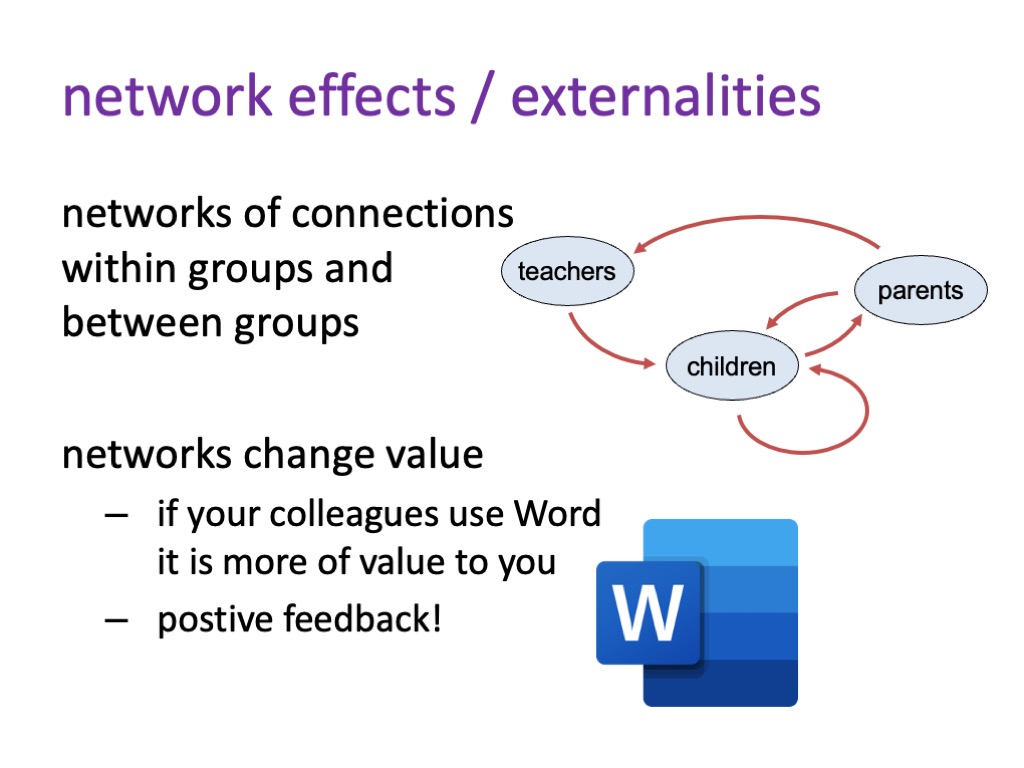
Image: https://en.m.wikipedia.org/wiki/File:Microsoft_Office_Word_%282019%E2%80%93present%29.svg
Human society has many networks, some mediated by technology, some by our normal human relationships, such as networks of people that know one another, or business contacts. Some of these networks are within a single group, others span several groups or kinds of people, for example the way teachers are connected with the children they teach, who in turn have parents, who may themselves know each other or talk to teachers at parent evenings.
Crucially, these human social networks change the value of digital goods. To be precise they can change the value of other kinds of goods as well, but particularly digital ones.
If your colleagues all use Microsoft Word, then it makes more sense that you use Microsoft Word rather than, say Apple Pages. I use PowerPoint for presentations largely because I often want to share slides with other people, even though I work on a Mac and Keynote might be better for some effects.
These are positive feedback cycles. If I use something, it makes it of more value for you to use the same thing. If you use it, it makes it of more value for me to use it. Like all positive feedback, this leads to runaway effects.
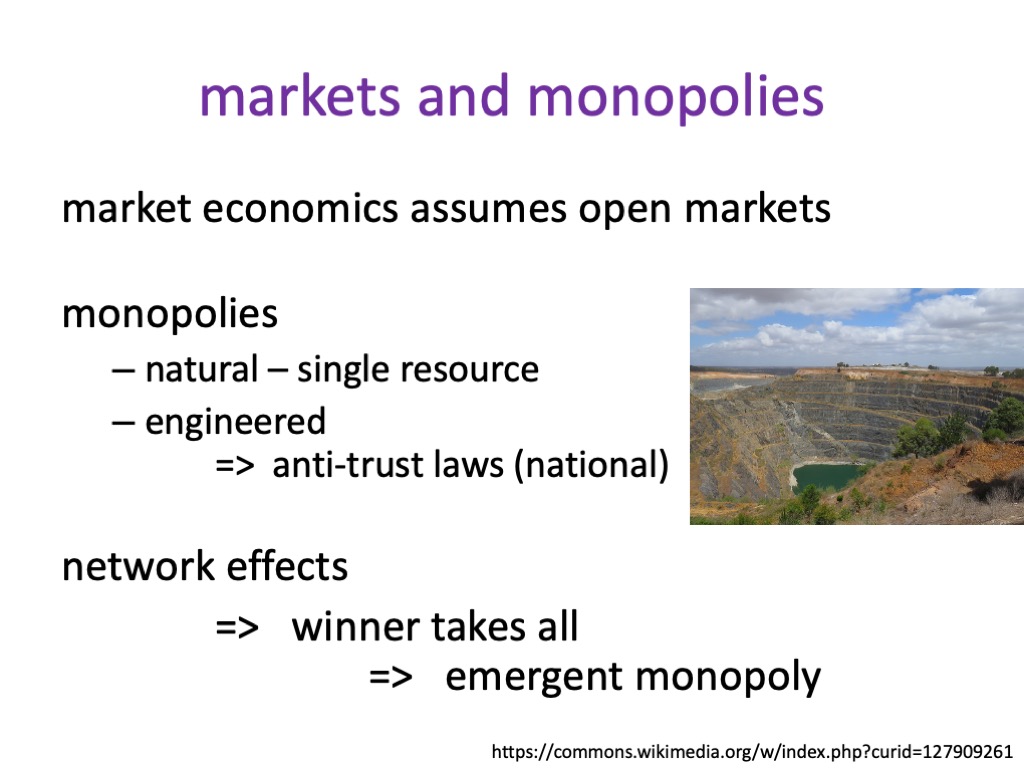
Image: By Calistemon – Own work, CC BY-SA 4.0, https://commons.wikimedia.org/w/index.php?curid=127909261
Now for a little bit of economics. Market economics assumes that markets are open; that is, it is possible for new businesses to start in an area and compete with existing ones, often leading to more efficient production. The arguments for why market economics work (to the extent they do, and there’s limits to that) are predicated on this openness. So, when monopolies happen, there are problems.
The most obvious kind of monopoly is a natural monopoly, where there is a single resource that is rare and only one or a small number of people control, just as many of the rare earths are found in China. This is a natural phenomenon but can still can cause problems, hence worries about finding alternative sources or alternative materials.
Sometimes monopolies are engineered when a group of people in a sector come together to agree to keep the price high, or restrict output. Most countries have antitrust laws or anti-monopoly laws, which try to ban this behaviour so that new players can come into a market and it doesn’t get controlled.
The trouble with network effects is that the positive feedback leads to a winner takes all situation. The issue first hit the digital headlines back in 2001 concerning Microsoft’s bundling of Internet Explorer [LM01], but applies to much other software. It is very hard to have even have two successful software products in an area, say Keynote and PowerPoint, let alone lots of different presentation software, because if one person uses it then it changes its value for everybody else. This is an emergent monopoly.
Note, this is not because the manufacturers get together and to something underhand. It is just a natural impact of digital technology, which you have to work hard to avoid. There are ways of doing this: you can ensure open standards, for example; the fact that PPTX format is an open format, means it’s possible for other products to use it and interoperate with PowerPoint.
So there are ways you can counter the worst effects, but the natural impact is often for digital goods to give rise to these emergent monopolies.
Coming next …
Part 5 – digital and AI breaks market economics
The very nature of digital technology and AI breaks free markets leading to runaway inequality, even with the best intentions of industry … but some tech companies further exploit these effects.
.
References
[LM01] Liebowitz, S., and Margolis, S. (2001). Network effects and the Microsoft case. Chapter 6 in Dynamic competition and public policy: Technology, innovation, and antitrust issues, J. Ellig (ed.), pp.160–192. https://personal.utdallas.edu/~liebowit/netwext/ellig%20paper/ellig.htm