TTW2 – the second Tiree Tech Wave is approaching

It is a little over a month (3-7 Nov)  until the next Tiree Tech Wave 🙂  However, as I’m going to be off-island most of the time until the end of October, it seems very close indeed!

The first registrations are in, including Clare flying straight here from the US ((In fact guided over the ocean by the ‘golf ball’ on Tiree, which is the North Atlantic civil radar.)) and Alessio coming from Madrid; mind you last time Azizah had come all the way from Malaysia, so still looking very parochial in comparison!

While I don’t expect we will be oversubscribed, do ‘book early’ (before Oct 10th) if you intend to come to help us plan things and make sure you get your preferred accommodation (the tent at the end of my garden is draughty in November) and travel.

If you want to take advantage of the island’s watersports, catch me in one place for more than a day, or simply hang out, do take a few extra days before or after the event.  One person has already booked to arrive a couple of days early and others maybe also.

To see what the Tech Wave will be like see the Interfaces report … although it is the people who make the event, so I’m waiting to be surprised again this time round 🙂

Looking forward to seeing you.

Cycling Cumbria to Northumbria for Miriam, Kenya and Cancer

In  just over a week I’m going to be cycling the coast-to-coast route, from Maryport on the west coast of Cumbria to Tynemouth on the east coast of Northumbria, 140 miles across the Pennines, the backbone of England.

The C2C ride is part of Miriam’s preparation for her 400km cycle ride in Kenya next February (see her blog “BICYCLE, BICYCLE, BICYCLE (I want to ride my…)“), organised by Women V Cancer, in support of several women’s cancer charities. During the Kenya ride Miriam will be doing a gruelling 50 miles a day in summer heat and on not-so-smooth roads, compared to just 35 miles a day on the C2C.  Janet Finlay, Rachel Cowgill and I are joining Miriam on the C2C, and Miriam, Janet and Rachel recently had their own pre-C2C training weekend down in the hills north of Cardiff, up near Aberfan (site of the 1966 disaster, which I posted about a few months ago).

In principle this should be a leisurely ride, we are doing it in four days, some people manage it in three or even two.  However, I’d not been on a bike for ten years before last summer, and since June have been travelling continuously and consequentially only stepped onto the bike four times — so not a lot of practice.  Furthermore, Tiree does not offer a lot of practice for cross-mountain cycling … the last time I cycled up a hill was 1994!  So, Alston Moor and the Pennines may be a bit of a challenge :-/

I’ll do a post when I finish and tweet (@alanjohndix) on the way (mobile signal allowing).

I’m not doing any sponsorship individually, but if you would like to support me and my sore bottom do add a few pounds on Miriam’s JustGiving page for Kenya and pop in the comments box that it is for me on the C2C.

Death by Satellite

The Upper Atmosphere Research Satellite (UARS) is on its way down after 20 years zipping by at 375 miles above our heads.  As the bus-sized satellite breaks up parts will reach earth and NASA reassuringly tell us that there is only a 1 in 3,200 chance that anyone will be hit.  Given being hit by a piece of satellite is likely to be painful and most likely terminal, I wonder if I should be worried.

With a world population of 6,963,070,029 ((World population of 6,963,070,029 at 5:14 UTC (EST+5) Sep 19, 2011 according to US Census Bureau World Population Clock )), that is around one in a trillion chance that I will die from UARS this year.  Given the annual risk from asteroid impact or shark attack is around one in in 2 billion ((Scientific American, “Competing Catastrophes: What’s the Bigger Menace, an Asteroid Impact or Climate Change?“, Robin Lloyd, March 31, 2010 )), that sounds quite good for UARS (but must buy that shark repellent from Boots).

Of course, it is a bit unfair comparing the UARS that has been up there for 20 years spinning round the world like frenzy, with more mundane day-to-day risks like crossing the road.  For air travel they take into account the distance travelled and aim for safety factors around 1 accident (but with a lot of people in the aeroplane) every hundred million flying miles and achieving a figure about 10 times better than that ((Wikipedia Air Safety page quotes different, but close numbers: 3 deaths per 10 billion passenger miles, one death in 20 billion passenger miles and 0.05 deaths per billion passenger kilometers.)).

At 375 miles the UARS will have been orbiting at 7.55978 km/s ((CalcTool Earth Orbit Calculator)), so travelled 2.9 billion miles in the last 20 years.  That means it is causing one death in 10 trillion miles travelled … five thousand times safer than air flight, 120 million times safer than car travel ((Based on UK figures of 3,431 deaths per year (US NHTSA) and 26.7 billion miles driven in the UK per year (Admiral Insurance).)), and around million times safer than bicycle ((Wikipedia Air Safety statistics)).  I must cancel my KLM ticket home and get one by satellite.

Private schools and open data

Just read short article “Private schools aren’t doing as well right-wingers like to think” by Rob Cowen @bobbiecowman ((Thanks to Laura Cowen @lauracowen for re-tweeting this.)).  Rob analyses the data on recent GCSE results and finds that independent schools have been falling behind comprehensive schools in the last couple of years.  He uses this to refute the belief that GCSE standards are dropping, although equally it calls into question David Cameron’s recent suggestion that independent schools such as Eton should be given public money to start ‘Free Schools’ ((See BBC News: Cameron: ‘Eton should set up a state school’)).

However, this is also a wonderful example of the way open data can be used to challenge unsupported views including official ones or ‘common knowledge’.  Of course, during the recent voting reform referendum, David Cameron expressed his disinterest in data and statistics compared with gut feelings, so the availability of data is only half the battle!

Graph shwoing comprehensive vs independent school performance

The Adelphi Liverpool

Last week I spent an evening in Liverpool watching the Lodestar Theatre Company production of Romeo and Juliet, part of the Liverpool Shakespeare Festival.  It was a wonderful performance, with evocative AV backdrops, rich music and an energetic cast, the high spot for me probably Juliet’s effervescent energy as she covered the stage with 14 year old tomboy-ish exuberance.

For the night, due to an overbooked hotel elsewhere, I ended up at the Adelphi Hotel, right in the heart of Liverpool, only a hundred yards from Lime Street Station and the St George’s Hall, where the performance was staged.

The Adelphi seems like an hotel from a different age, a huge Victorian edifice in the heart of Liverpool city centre.  The perhaps more imposing station hotel has been converted into student accommodation, so now the Adelphi stands alone in the centre jostling with the glass and neon Holiday Inn and Travelodge for station travellers, still representing tradition in an age of automatic check-in and Lego-kit furnishing.

Like an ageing aunt, remembering her dancing days, bright lipstick slightly awry, the Adelphi is clearly struggling to maintain its dignity assailed  by the recession and narrowing margins from without, crumbling masonry and cast-iron radiators within, and the occasional onslaught of amiable drunks passing on their way from pub to pub.

Sometimes it seems that, like the crooked lipstick, things slip: three times dragging my suitcase up and down to and from my sixth floor room until my keycard was properly programmed (yes electronic keys, signs of the 21st century), the water taps that only just work and never gave a hot shower, or the lifts that seemed to constantly deliver the same packed group of pensioners up to the sixth floor when they really wanted to get down to the ground. But, like the firmly grasped handbag, hat and Sunday gloves, signs of a different standard of service, vast veneer wooden wardrobe and dressing table, brocade-covered arm chairs, a real teapot and cup and saucers with the (electric) kettle, and of course a room-service menu that includes “roast of the day”.

At breakfast it feels like a post-apocalyptic science-fiction set where in the aftermath of 1950s atomic testing  all conception ceased and so now, from wall to wall, the room is filled with septuagenarians eating unending supplies of bacon, fried eggs and toasted crumpets, with the only under-60 faces the serving staff from Eastern Europe, which has evidently been spared the mass impotence of the West.

But, did you notice, in an age of croissants, yogurt and Danish pasties – crumpets, yes real crumpets for breakfast – a trace of the Empire still survives in Liverpool L1.

So like the ageing aunt, whose occasional quirks and impatience you forgive, overlooking her inexpert makeup, for the memory of war-time childhood and rock-and-roll romances, so with the Adelphi, I forgive its dodgy plumbing and erratic lift, for the glimpse of a style and a world that is past and will soon be gone for ever.

And in days to come, in some hotel room of plastic, steel and wine-bar-like sheen, I will dream of my night at the Adelphi.

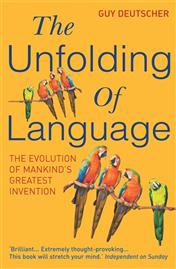
book: The Unfolding of Language, Deutscher

I have previously read Guy Deutscher‘s “Through the Language Glass“, and have now, topsy turvy, read his earlier book “The Unfolding of Language“.  Both are about language, “The Unfolding of Language” about the development of the complexity of language that we see today from simpler origins, and “Through the Language Glass” about the interaction between language and thought.  Both are full of sometimes witty and always fascinating examples drawn from languages around the world, from the Matses in the Amazon to Ancient Sumarian.

I recall my own interest in the origins of language began young, as a seven year old over breakfast one day, asking whether ‘night, was a contraction of ‘no light’.  While this was an etymological red herring, it is very much the kind of change that Deutscher documents in detail showing the way a word accretes beginnings and ending through juxtaposition of simpler words followed by erosion of hard to pronounce sounds.

One of my favourites examples was the French “aujourd’hui”.  The word ‘hui, was Old French for ‘today’, but was originally Latin “hoc die”, “(on) this day”. Because ‘hui’ is not very emphatic it became “au jour d’hui”, “on the day of this day” , which contracted to the current ‘aujourd’hui’. Except now to add emphasis some French speakers are starting to say “au jour aujourd’hui”, “on the day on the day of this day”!  This reminds me of Longsleddale in the Lake District (inspiration for Postman Pat‘s Greendale),  a contraction of “long sled dale”, which literally means “long valley valley” from Old English “slaed” meaning “valley” … although I once even saw something suggesting that ‘long’ itself in the name was also “valley” in a different language!

Deutscher gives many more prosaic examples where words meaning ‘I’, ‘you’, ‘she’ get accreted to verbs to create the verb endings found in languages such as French, and how prepositions (themselves metaphorically derived from words like ‘back’) were merged with nouns to create the complex case endings of Latin.

However, the most complex edifice, which Deutscher returns to repeatedly, is that of the Semitic languages with a template system of vowels around three-consonant roots, where the vowel templates change the meaning of the root.  To illustrate he uses the (fictional!) root ‘sng’ meaning ‘to snog’ and discusses how first simple templates such as ‘snug’ (“I snogged”) and then more complex constructions such as ‘hitsunnag’ (“he was made to snog himself”) all arose from simple processes of combination, shortening and generalisation.

“The Unfolding of Language” begins with the 19th century observation that all languages seem to be in a process of degeneration where more complex  forms such as the Latin case system or early English verb endings are progressively simplified and reduced. The linguists of the day saw all languages in a state of continuous decay from an early linguistic Golden Age. Indeed one linguist, August Schleicher, suggested that there was a process where language develops until it is complex enough to get things done, and only then recorded history starts, after which the effort spent on language is instead spent in making history.

As with geology, or biological evolution, the modern linguist rejects this staged view of the past, looking towards the Law of Uniformitarianism, things are as they have always been, so one can work out what must have happened in the pre-recorded past by what is happening now.  However, whilst generally finding this convincing, throughout the book I had a niggling feeling that there is a difference.  By definition, those languages for which we have written records are those of large developed civilisations, who moreover are based on writing. Furthermore I am aware that for biological evolution small isolated groups (e.g. on islands or cut off in valleys) are particularly important for introducing novelty into larger populations, and I assume the same would be true of languages, but somewhat stultified by mass communication.

Deutscher does deal with this briefly, but right at the very end in a short epilogue.  I feel there is a whole additional story about the interaction between culture and the grammatical development of language.  I recall in school a teacher explained how in Latin the feminine words tended to belong to the early period linked to agriculture and the land, masculine words for later interests in war and conquest, and neuter for the still later phase of civic and political development. There were many exceptions, but even this modicum of order helped me to make sense of what otherwise seemed an arbitrary distinction.

The epilogue also mentions that the sole exception to the ‘decline’ in linguistic complexity is Arabic with its complex template system, still preserved today.

While reading the chapters about the three letter roots, I was struck by the fact that both Hebrew an Arabic are written as consonants only with vowels interpolated by diacritical marks or simply remembered convention (although Deutscher does not mention this himself). I had always assumed that this was like English where t’s pssble t rd txt wth n vwls t ll. However, the vowels are far more critical for Semitic languages where the vowel-less words could make the difference between “he did it” and “it will be done to him”.  Did this difference in writing stem from the root+template system, or vice versa, or maybe they simply mutually reinforced each other?

The other factor regarding Arabic’s remarkable complexity must surely be the Quran. Whereas the Bible was read for a over a millennium in Latin, a non-spoken language, and later translated focused on the meaning; in contrast there is a great emphasis on the precise form of the Quran together with continuous lengthy recitation.  As the King James Bible has been argued to have been a significant influence on modern English since the 17th century, it seems likely the Quran has been a factor in preserving Arabic for the last 1500 years.

Early in “The Unfolding of Language” Deutscher dismisses attempts to look at the even earlier prehistoric roots of language as there is no direct evidence. I assume that this would include Mithin’s “The Singing Neanderthals“, which I posted about recently. There is of course a lot of truth in this criticism; certainly Mithin’s account included a lot of guesswork, albeit founded on paleontological evidence.  However, Deutscher’s own arguments include extrapolating to recent prehistory. These extrapolations are based on early written languages and subsequent recorded developments, but also include guesswork between the hard evidence, as does the whole family-tree of languages.  Deutscher was originally a Cambridge mathematician, like me, so, perhaps unsurprisingly, I found his style of argument convincing. However, given the foundations on Uniformitarianism, which, as noted above, is at best partial when moving from history to pre-history, there seems more of  a continuum rather than sharp distinction between the levels of interpretation and extrapolation in this book and Mithin’s.

Deutscher’s account seeks to fill in the gap between the deep prehistoric origins of protolanguage (what Deutscher’s calls ‘me Tarzan’ language) and its subsequent development in the era of media-society (starting 5000BC with extensive Sumerian writing). Rather than seeing these separately, I feel there is a rich account building across various authors, which will, in time, yield a more complete view of our current language and its past.

On Travelling and Stretched Souls

A few days ago I tweeted:

“Maybe people like car warranties have so many years or so many miles? Each flight a little death; 400 more miles on the clock. Better walk.”

This was half in jest, but set me thinking.

Each time I fly I feel thinner, more distant, like some bored executive’s rubber desktop toy overstretched. Now this may simply be age or ennui, but, naturally resisting such a simple explanation, I wonder about an alternative Pullman-esque world, not so different from our own, where, while our bodies move, some part of our soul, like a snail track or Theseus letting out Ariadne’s thread, is stretched behind, so that in the sky amongst the vapour trail of each passing plane, two hundred souls are also spread, vapourous, across the heavens.

It is not so far from the world we know where, with nostalgia and fond memory, it is clear some part of our heart is always left behind. If we move slowly, or rest still for periods, our souls regrow, regenerate, but, if we move too fast or too far, our body, Golem-like, continues to walk, yet our eyes increasingly blankly stare from an emptied heart, and our soul blows gossamer-like, spread thin across the empty seas.

book: The Singing Neanderthals, Mithin

One of my birthday presents was Steven Mithin’s “The Singing Neanderthals” and, having been on holiday, I have already read it! I read Mithin’s “The Prehistory of the Mind” some years ago and have referred to it repeatedly over the years ((See particularly my essay on the role of imagination in bringing together our different forms of ‘specialised intelligence’. “The Prehistory of the Mind” highlighted the importance of this ‘cognitive fluidity’, linking social, natural and technological thought, but lays this largely in the realm of language. I would suggest that imagination also has this role, creating a sort of ‘virtual world’ on which different specialised cognitive modules can act (see “imagination and rationality“).)), so was excited to receive this book, and it has not disappointed. I like his broad approach taking evidence from a variety of sources, as well as his own discipline of prehistory; in times when everyone claims to be cross-disciplinary, Mithin truly is.

“The Singing Neanderthal”, as its title suggests, is about the role of music in the evolutionary development of the modern human. We all seem to be born with an element of music in our heart, and Mithin seeks to understand why this is so, and how music is related to, and part of the development of, language. Mithin argues that elements of music developed in various later hominids as a form of primitive communication (( He calls this musical communication system Hmmmm in its early form – Holistic, Multiple-Modal, Manipulative and Musical, p138 – and later Hmmmmm – Holistic, Multiple-Modal, Manipulative, Musical and Mimetic, p221.)), but separated from language in homo sapiens when music became specialised to the communication of emotion and language to more precise actions and concepts.

The book ‘explains’ various known musical facts, including the universality of music across cultures and the fact that most of us do not have perfect pitch … even though young babies do (p77). The hard facts of how things were for humans or related species tens or hundreds of thousands of years ago are sparse, so there is inevitably an element of speculation in Mithin’s theories, but he shows how many, otherwise disparate pieces of evidence from palaeontology, psychology and musicology make sense given the centrality of music.

Whether or not you accept Mithin’s thesis, the first part of the book provides a wide ranging review of current knowledge about the human psychology of music. Coincidentally, while reading the book, there was an article in the Independent reporting on evidence for the importance of music therapy in dealing with depression and aiding the rehabilitation of stroke victims ((“NHS urged to pay for music therapy to cure depression“, Nina Lakhani, The Independent, Monday, 1 August 2011)), reinforcing messages from Mithin’s review.

The topic of “The Singing Neanderthal” is particularly close to my own heart as my first personal forays into evolutionary psychology (long before I knew the term, or discovered Cosmides and Tooby’s work), was in attempting to make sense of human limits to delays and rhythm.

Those who have been to my lectures on time since the mid 1990s will recall being asked to first clap in time and then swing their legs ever faster … sometimes until they fall over! The reason for this is to demonstrate the fact that we cannot keep beats much slower than one per second ((Professional conductors say 40 beats per minute is the slowest reliable beat without counting between beats.)), and then explain this in terms of our need for a mental ‘beat keeper’ for walking and running. The leg shaking is to show how our legs, as a simple pendulum, have a natural frequency of around 1Hz, hence determining our slowest walk and hence need for rhythm.

Mithin likewise points to walking and running as crucial in the development of rhythm, in particular the additional demands of bipedal motion (p150). Rhythm, he argues, is not just about music, but also a shared skill needed for turn-taking in conversation (p17), and for emotional bonding.

In just the last few weeks, at the HCI conference in Newcastle, I learnt that entrainment, when we keep time with others, is a rare skill amongst animals, almost uniquely human. Mithin also notes this (p206), with exceptions, in particular one species of frog, where the males gather in groups to sing/croak in synchrony. One suggested reason for this is that the louder sound can attract females from a larger distance. This cooperative behaviour of course acts against each frog’s own interest to ‘get the girl’ so they also seek to out-perform each other when a female frog arrives. Mithin imagines that similar pressures may have sparked early hominid music making. As well as the fact that synchrony makes the frogs louder and so easy to hear, I wonder whether the discerning female frogs also realise that if they go to a frog choir they get to chose amongst them, whereas if they follow a single frog croak they get stuck with the frog they find; a form of frog speed dating?

Mithin also suggests that the human ability to synchronise rhythm is about ‘boundary loss’ seeing oneself less as an individual and more as part of a group, important for early humans about to engage in risky collaborative hunting expeditions. He cites evidence of this from the psychology of music, anthropology, and it is part of many people’s personal experience, for example, in a football crowd, or Last Night at the Proms.

This reminds me of the experiments where a rubber hand is touched in time with touching a person’s real hand; after a while the subject starts to feel as if the rubber hand is his or her own hand. Effectively our brain assumes that this thing that correlates with feeling must be part of oneself ((See also my previous essay on “driving as a cyborg experience“.)). Maybe a similar thing happens in choral singing, I voluntarily make a sound and simultaneously everyone makes the sound, so it is as if the whole choir is an extension of my own body?

Part of the neurological evidence for the importance of group music making concerns the production of oxytocin. In experiments on female prairie voles that have had oxytocin production inhibited, they engage in sex as freely as normal voles, but fail to pair bond (p217). The implication is that oxytocin’s role in bonding applies equally to social groups. While this explains a mechanism by which collaborative rhythmic activities create ‘boundary loss’, it doesn’t explain why oxytocin is created through rhythmic activity in the first place. I wonder if this is perhaps to do with bipedalism and the need for synchronised movement during face-to-face copulation, which would explain why humans can do synchronised rhythms whereas apes cannot. That is, rhythmic movement and oxytocin production become associated for sexual reasons and then this generalises to the social domain. Think again of that chanting football crowd?

I should note that Mithin also discusses at length the use of music in bonding with infants, as anyone who has sung to a baby knows, so this offers an alternative route to rhythm & bonding … but not one that is particular to humans, so I will stick with my hypothesis 😉

Sexual selection is a strong theme in the book, the kind of runaway selection that leads to the peacock tail. Changing lifestyles of early humans, in particular longer periods looking after immature young, led to a greater degree of female control in the selection of partners. As human size came close to the physical limits of the environment (p185), Mithin suggests that other qualities had to be used by females to choose their mate, notably male singing and dance – prehistoric Saturday Night Fever.

As one evidence for female mate choice, Mithin points to the overly symmetric nature of hand axes and imagines hopeful males demonstrating their dexterity by knapping ever more perfect axes in front of admiring females (p188). However, this brings to mind Calvin’s “Ascent of Mind“, which argues that these symmetric, ovoid axes were used like a discus, thrown into the midst of a herd of prey to bring one down. The two theories for axe shape are not incompatible. Calvin suggests that the complex physical coordination required by axe throwing would have driven general brain development. In fact these forms of coordination, are not so far from those needed for musical movement, and indeed expert flint knapping, so maybe it was this skills that were demonstrated by the shaping of axes beyond that immediately necessary for purpose.

Mithin’s description of the musical nature of mother-child interactions also brought to mind Broomhall’s “Eternal Child“. Broomhall ‘s central thesis is that humans are effectively in a sort of arrested development with many features, not least our near nakedness, characteristic of infants. Although it was not one of the points Broomhall makes, his arguments made sense to me in terms of the mental flexibility that characterises childhood, and the way this is necessary for advanced human innovation; I am always encouraging students to think in a more childlike way. If Broomhall’s theories were correct, then this would help explain how some of the music making more characteristic of mother-infant interactions become generalised to adult social interactions.

I do notice an element of mutual debunking amongst those writing about richer cognitive aspects of early human and hominid development. I guess a common trait in disciplines when evidence is thin, and theories have to fill a lot of blanks. So maybe Mithin, Calvin and Broomhall would not welcome me bringing their respective contributions together! However, as in other areas where data is necessarily scant (such as sub-atomic physics), one does feel a developing level of methodological rigour, and the fact that these quite different theoretical approaches have points of connection, does suggest that a deeper understanding of early human cognition, while not yet definitive, is developing.

In summary, and as part of this wider unfolding story, “The Singing Neanderthal” is an engaging and entertaining book to read whether you are interested in the psychological and social impact of music itself, or the development of the human mind.

… and I have another of Mithin’s books in the birthday pile, so looking forward to that too!

Do teachers need a 2:2

Those in the UK will have seen recent news ((Hit headlines about a week ago in the UK, just catching up after holiday!)) that the Education Secretary Michael Grove is planning to remove remove funding for teacher training from those who do not achieve a 2:2 or better. A report on the proposals suggests this will reduce numbers of trainee science teachers by 25% and language teachers by a third.

An Independent article on this lists various high profile figures who got third class degrees (albeit all from prestigious universities), who would therefore not be eligible – including Carol Vorderman, who is the Conservative Party’s ‘maths guru’ ((“Reforms of teacher training will bring mass shortages, report finds“, Richard Garner, The Independent, Thursday, 11 August 2011, p14-15.)).

The proposed policy and the reporting of it raise three questions for me.

First is the perennial problem that the reporting only tells half the story.  Who are these one third of language trainees and one quarter of science trainees who currently do not have 2:2 degrees? Are they recent graduates who have simply not done well in their courses and treating teaching as an easy option? Are they those that maybe made poor choices in their selected courses, but nonetheless have broader talents after careful assessment by the teaching course admissions teams? Or are they mature students who did not do well in university, or maybe never went, but have been admitted based on their experience and achievements since (as we would do for any advanced degree, such as an MSc)?  If it were the first of these, then I think most parents and educators would agree with the government line, but I very much doubt this is the case.  However, with only part of the story how are we to know?  I guess I could read the full report, or maybe the THES has a more complete story, but how many parents reading about this are likely to do so?

Second is the implicit assumption that degree level study in a particular subject is likely to make you a good teacher in that subject.  Certainly in my own first subject, mathematics, many of the brightest mathematicians are unlikely to be good school teachers. In general in the sciences, I would far prefer a teacher who has a really deep understanding of GCSE and A level Physics to one who has a hazy (albeit sufficient to get 2:2 or even 2:1 degree) knowledge at degree-level. I certainly want teachers who have the interest and excitement in their topic to keep up-to-date beyond the minimum needed for their courses, but a broad ‘James Gleik’ style popular science, is probably more useful than third year courses in a Physics degree.

Finally the focus on degree classification, suggests that Michael Gove has a belief in a cross-discipline, cross-department, and cross-institutional absolute grading that appears risible to anyone working in Higher Education. Does he really believe that a 2:2 from Oxford is the same as a 2:2 at every UK institution? If so then I seriously doubt his ability to be hold the education portfolio in government.

To be fair this is a real problem in the Higher Education system as it is hard for those not ‘in the know’ to judge the meaning of grades, especially as it is not simply a matter of institution, often particular parts of an institution (notably music, arts and design schools) have a different profile to the institution as a whole. Indeed we have the same problem within the university system when judging grades from other countries. This has not been helped by gradual ‘grade inflation’ across the education sector from GCSE to degrees, driven in no small part by government targets and independent ‘league tables’ that use crude measures largely unrelated to real educational success. Institutions feel under constant pressure to create rules that meet various metrics to the detriment of real academic judgement ((In fact, I came very close to resigning earlier in the summer over this issue.)).

If the government is seriously worried about the standard of teachers entering the profession, then shift funding of courses towards measures of real success and motivation – perhaps percentage of students who subsequently obtain public-sector teaching jobs. If the funding moves the selection will follow suit!

… and maybe at the same time this should apply across the sector.  A few weeks ago I was at the graduation at LIPA, which is still managing near 100% graduate employment despite the recession and severe cuts across the arts.  Not that employment is the only measure of success, but if metrics are to be used, then at least make them real ones. Or better still drop the metrics, targets and league tables and let students both at school and university simply learn.

book: The Laws of Simplicty, Maeda

Yesterday I started to read John Maeda’s “The Laws of Simplicty” whilst  sitting by Fiona’s stall at the annual Tiree agricultural show, then finished before breakfast today.  Maeda describes his decision to cap at 100 pages ((In fact there are 108 pages in the main text, but 9 of these are full page ‘law/chapter’ frontispieces, so 99 real pages.  However, if you include the 8 page introduction that gives 107 … so even the 100 page cap is perhaps a more subtle concept than a strict count.)) as something that could be read during a lunch break. To be honest 30,000 words sounds like a very long lunch break or a very fast reader, but true to his third law, “savings in time feel like simplicity” ((See his full 10 laws of simplicity at lawsofsimplicity.com)), it is a short read.

The shortness is a boon that I wish many writers would follow (including me). As with so many single issue books (e.g. Blink), there is s slight tendency to over-sell the main argument, but this is forgiveable in a short delightful book, in a way that it isn’t in 350 pages of less graceful prose.

I know I have a tendency, which can be confusing or annoying, to give, paradoxically for fear of misunderstanding, the caveat before the main point. Still, despite knowing this, in the early chapters I did find myself occasionally bristling at Maeda’s occasional overstatement (although in accordance with simplicity, never hyperbole).

One that particularly caught my eye was Maeda’s contrast of the MIT engineer’s RFTM (Read The F*cking Manual) with the “designer’s approach” to:

marry function with form to create intuitive experiences that we understand immediately.

Although in principle I agree with the overall spirit, and am constantly chided by Fiona for not reading instructions ((My guess is that the MIT engineers didn’t read the manuals either.)), the misguided idea that everything ought to ‘pick up and use’ has bedeviled HCI and user interface design for at least the past 20 years. Indeed this is the core misconception about Heidegger’s hammer example that I argued against in a previous post “Struggling with Heidegger“. In my own reading notes, my comment is “simple or simplistic!” … and I meant here the statement not the resulting interfaces, although it could apply to both.

It has always been hard to get well written documentation, and the combination of single page ‘getting started’ guides with web-based help, which often disappears when the web site organisation changes, is an abrogation of responsibility by many designers. Not that I am good at this myself. Good documentation is hard work. It used to be the coders who failed to produce documentation, but now the designers also fall into this trap of laziness, which might be euphemistically labelled ‘simplicity’ ((Apple is a great — read poor — example here as it relies on keen technofreaks to tell others about the various hidden ways to do things — I guess creating a Gnostic air to the devices.)).

Personally, I have found that the discipline of documenting (in the few times I have observed it!) is in fact a great driver of simple design. Indeed I recall a colleague, maybe Harold Thimbleby ((Certainly Harold was a great proponent of ‘live’ documentation, both Knuth’s literate programming and also documentation that incorporated calculated input and output, rather like dexy, which I reported after last autumn’s Web Art/Science camp.)), once suggested that documentation ought to be written before any code is written, precisely to ensure simple use.

Some years ago I was reading a manual (for a Unix workstation, so quite a few years ago!) that described a potentially disastrous shortcoming of a the disk sync command (which could have corrupted the disk). Helpfully the manual page included a suggestion of how to wrap sync in scripts that prevented the problem. This seemed to add insult to injury; they knew there was a serious problem, they knew how to fix it … and they didn’t do it. Of course, the reason is that manuals are written by technical writers after the code is frozen.

In contrast, I was recently documenting an experimental API ((In fairness, the API had been thrown together in haste for my own use.)) so that a colleague could use it. As I wrote the documentation I found parts hard to explain. “It would be easier to change the code”, I thought, so I did so. The API, whilst still experimental, is now a lot cleaner and simpler.

Coming back to Maena after a somewhat long digression (what was that about simplicity and brevity?). While I prickled slightly at a few statements, in fact he very clearly says that the first few concrete ‘laws’ are the simpler (and if taken in their own simplistic), the later laws are far more nuanced and suggest deeper principles. This includes law 5 “differences: simplicity and complexity need each other”, which suggest that one should strive for a dynamic between simplicity and complexity. This echoes the emphasis on texture I often advocate when talking with students; whether in writing, presenting or in experience design it is often the changes in voice, visual appearance, or style which give life.

Unix command line prompt

the simplest interface?

I wasn’t convinced by Maeda’s early claim that simple designs were simpler and cheaper to construct.  Possibly true for physical prodcuts, but rarely so for digital interfaces, where more effort is typically needed in code to create simpler user interfaces.  However, again this was something that was revisited later, especially in the context of more computationally active systems (“law 8, in simplicity we trust”), where he contrasts “how much do you need to know about a system?” with “how much does the system know about you?”.  The former is the case of more traditional passive systems, whereas more ‘intelligent’ systems such as Amazon recommendations (or even Facebook news feed) favour the latter.  This is very similar to the principles for incidental and low-intention interaction that I have discussed in the past ((See ‘incidental interaction” and HCI book chapter 18.)).

Finally “The Laws of Simplicity” is beautifully designed in itself.  It includes  many gems not least those arising from Maeda’s roots in Japanese design culture, including aichaku, the “sense of attachment one can feel for an artefact” (p.69) and omakase meaning “I leave it to you”, which asks the sushi chef to create a meal especially for you (p.76).  I am perhaps too much of a controller to feel totally comfortable with the latter, but Maeda’s book certainly inspires the former.