running and talking

September saw two events on Tiree; both exciting but each very different: at the beginning of the month the first Tiree Ultramarathon organised by Will Wright our very own Tiree superhero and towards the end ‘Re-Thinking Architecturally‘, a workshop of the European Network of Excellence on Internet Science organised by Clare Hooper from Southampton University.    I was lucky enough to take part in both.

In addition, in a few weeks time (23-27 Oct) there will be the eighth Tiree Tech Wave, which will include participants from Canada, Scotland, Wales and England (but no-one from Ireland yet).  As well as the usual unstructured serendipity, we will have some tutorial workshops of 3D scanning, 3D printing and laser cutting … but more about that in another post.

The Tiree Ultra
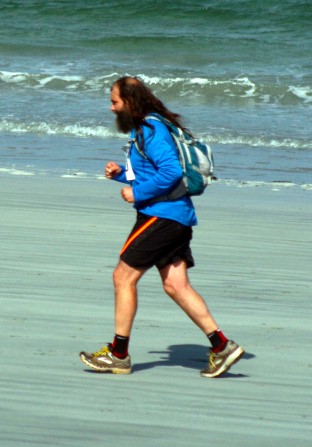
photo Rhoda Meek

I should first emphasise that I did not run all of the 35 mile ultra-marathon course around the coast of Tiree, but did about 50:50, walk/run.  I’d never done anything remotely like this before.  The longest I’d run was the Tiree half marathon back in May and the longest I’d walked during the Wales walk was a 29 mile day (although I did that over more than 12 hours).  I had as a schoolboy once done a 34 mile day hike up into the coal valleys above Cardiff, and one of the spurs to sign up for the Ultra was to beat my 17 year old self!

With my usual level of preparation it came to the beginning of August and I realised I’d not run at all, nor even taken a walk longer than to the beach and back, since the half-marathon in May.  Just before the event I found a couple of sites with training schedules for marathons, all of them were several months long and the ‘beginner’ level was “runs 15-25 miles  a week regularly” … what about zero miles a week?  Anyway my lengthy one month training schedule consisted mainly of short (2.5 mile) beach runs with the occasional 7.5 mile run to Hynish and towards the end a run of 8.5 miles along part of the route of the Ultra round the base of Ben Hynish.  I was aware I’d not done any really substantial runs and so, rather foolishly, on the Wednesday 4 days before the event I ran (and walked!) 21 miles around part of the route on the east end of the island and down to Hynish and back.  A good last run before the event, but one I should have done a week earlier.

Somehow or other, despite my foolish training schedule, I managed to get round without any serious injury.  My main problem was eating, or rather failing to eat. I found I could only mange food during walking stages, and then just a small amount of Kendal Mint Cake and few bananas, I guess overall I managed to burn around 4000 calories, but ate less than 1000, which really made the legs start to tire as I got to the latter parts of the course.  I’ve already entered for the 2015 Tiree Ultra next September (half the places are already gone and entries have only been open a week), but I will have to work out how to eat better before then.  Crucially I got round the course … and not even last.  The serious contenders managed times not much more than 4 1/2 hours whilst I got round in just over 8:20, but I was simply happy to get to the end.

Although it was further and faster than any day walking last year, it was in many ways a lot easier than the Wales walk.  About 2/3 of the way round the Tiree course my right ankle and calf started to stiffen, which was where I’d had Achilles ankle problems a couple of years ago.  Although I did try to ease a little I was not terribly worried; the worst would be that I’d be hobbling for a month or so after the run.  In contrast, last year I knew that I would be walking again the next day, and the next,and the one after that; with each ache I worried whether it would be the injury that did not get better, and stopped the walk. And, despite the worry of this, I had also learnt quite how resilient the body is, that most pains and strains did get better, albeit slowly, despite unrelenting exercise.

I was also reminded very much of the walk when I finished.  I took off my running shoes and socks, the latter sodden from beach and bog, and filled with fine layer of sand.  The soles of my feet, which had been subjected to 35 miles of damp sandpaper, felt like I was walking on coals and I hobbled about between van and Ceadhar where they laid on a post-walk pizza and party.  It was just like that so many days last year, I would get to where I was staying, ease off my boots, put on sandals, and then hobble out in search of food, wondering if I would get as far as the closest pub or cafe, let alone walk again the next day.

Re-thinking Architecturally

The Internet Science workshop was equally enjoyable, but a little less physically challenging!  It brought together economists, architects, lawyers, policy advisors, and some with more technical background from as far afield as Umea in northern Sweden. It was lovely being able to attend a technology workshop on Tiree that I hadn’t organised 🙂

Clare had been to one of the Tiree Tech Waves, and then, when she was organising a workshop for the European Network of Excellence on Internet Science, she thought of Tiree.  The logistics were not without problems, but after the event I’ve been getting together with the Tiree Trust to make an information pack for future organisers to make the process easier.  So if if you would like to organise an event on Tiree, get in touch!

The participants all seemed utterly taken with the venue, several brave souls even swimming in the mornings off the Hynish pier, in the words of one of the participants on the way back after the event “I’d rather be in Tiree!”.  Another said:

one great consequence of the week in Tiree was a kind of intellectual regeneration that let me set aside the stresses of the coming academic year and…think openly a bit.”
Alison Powell (London School of Economics)

In fact this is precisely the feedback I get from many who have been to Tiree Tech Wave.  It is hard to capture in words the way the open horizon and being at the wild-edge opens up the mind, especially when meeting with others equally committed to exploring new ideas freely and openly.

One of the memorable moments from the week was a debate of internet freedom and regulation.  We started off half on one side half the other and then part way through we all had to swop sides.  I can’t believe how passionate I got about both sides of the argument … and I managed to wheel in my school English teacher as authority on benevolent dictatorship1.
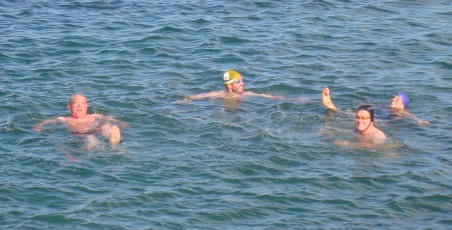
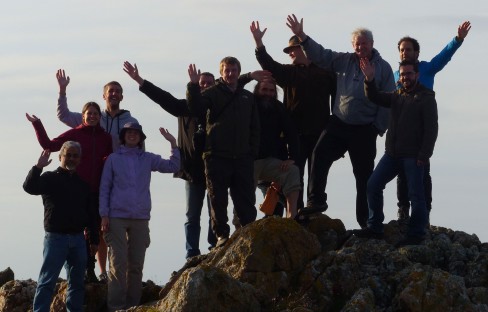
photo Parag Deshpande

photo Rory at Balevullin

People

While two very different events, a common story was the wonderful welcome of the people of Tiree.  During the Ulta-marathon, at every way-station there was a glorious array of tray bakes, chocolates, pre-sliced fruit, and above all smiling faces.  This was great for me seeing faces I knew, but clearly very special for the participants who came from afar being greeted as if they too were friends.  For the Re-thinking Architecturally workshop many people made it a success: the wonderful team at the Hynish Centre, especially Lesley who kept on smiling despite a seven hour wait for participants whose travel was disrupted, everyone at Ceadhar, Ring n Ride, and at the airport re-arranging travel across Europe when the Thursday plane was cancelled.

  1. I wrote what I thought to be a masterful mock O’level essay that asserted that Macbeth was actually a good king taking a ‘he made the trains run on time’ argument — my English teacher, Miss Griffiths, was not impressed.[back]
First version of Tiree Mobile Archive app goes live at Wave Classic

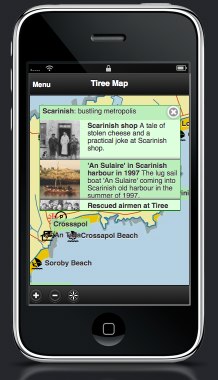
The first release version of the Tiree Mobile Archive app (see “Tiree Going Mobile“) is seeing real use this coming week at the Tiree Wave Classic. As well as historical information, and parts customised for the wind-surfers, it already embodies some interesting design features including the use of a local map  There’s a lot of work to do before the full launch next March, but it is an important step.

The mini-site for this Wave Classic version has a simulator, so you can see what it is like online, or download to your mobile … although GPS tracking only works when you are on Tiree 😉

Currently it still has only a small proportion of the archive material from An Iodhlann so still to come are some of the issues of volume that will surely emerge as more of the data comes into the app.

Of course those coming for the Wave Classic will be more interested in the sea than local history, so we have deliberately included features relevant to them, Twitter and news feeds from the Wave Classic site and also pertinent tourist info (beaches, campsites and places to eat … and drink!).  This will still be true for the final version of the app when it is released in the sprint — visitors come for a variety of reasons, so we need to offer a broad experience, without overlapping too much with a more tourism focused app that is due to be created for the island in another project.

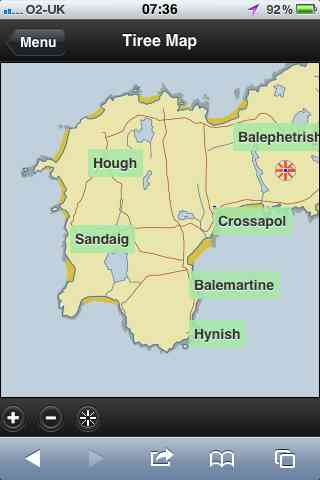
One crucial feature of the app is the use of local maps.  The booklet for the wave classic (below left) uses the Discover Tiree tourist map, designed by Colin Woodcock and used on the island community website and various island information leaflets.  The online map (below right) uses the same base layer.  The map deliberately uses this rather than the OS or Google maps (although final version will swop to OS for most detailed views) as this wll be familiar as they move between paper leaflets and the interactive map.


In “from place to PLACE“, a collection developed as part of Common Ground‘s ‘Parish Maps‘ project in the 1990s, Barbara Bender writes about the way:

“Post-Renaissance maps cover the surface of the world with an homogeneous Cartesian grip”

Local maps have their own logic not driven by satellite imagery, or military cartography1; they emphasise certain features, de-emphasise others, and are driven spatially less by the compass and ruler and more by the way things feel ‘on the ground’.  These issues of space and mapping have been an interest for many years2, so both here and in my walk around Wales next year I will be aiming to ‘reclaim the local map within technological space’.

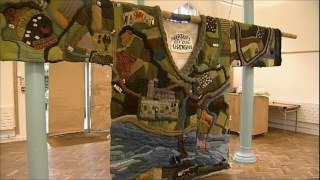
In fact, the Discover Tiree map, while stylised and deliberately not including roads that are not suitable for tourists, is very close to a ‘standard map’ in shape, albeit at a slightly different angle to OS maps as it is oriented3 to true North whereas OS maps are oriented to ‘Grid North’ (the problems of representing a round earth on flat sheets!).  In the future I’d like us to be able to deal with more interpretative maps, such as the mural map found on the outside of MacLeod’s shop. Or even the map of Cardigan knitted onto a Cardigan knitted as part of the 900 year anniversary of the town.


Technically this is put together as an HTML5 site to be cross-platform,, but … well let’s say some tweaks needed4.  Later on we’ll look to wrapping this in PhoneGap or one of the other HTML5-to-native frameworks, but for the time being once you have bookmarked to the home page on iOS looks pretty much like an app – on Android a little less so, but still easy access … and crucially works off-line — Tiree not known for high availability of mobile signal!

  1. The ‘ordnance‘ in ‘Ordnance Survey‘ was originally about things that go bang![back]
  2. For example, see “Welsh Mathematician walks in Cyberspace” and  “Paths and Patches – patterns of geognosy and gnosis”.[back]
  3. A lovely word, originally means to face East as early Mappa Mundi were all arranged with the East at the top.[back]
  4. There’s a story, going cross browser on mobile platform reminds me so much of desktop web design 10 years ago, on the whole iOS Safari behave pretty much like desktop ones, but Android is a law unto itself!.[back]

Death by design

Wonderful image and set of slides describing some of the reasons multitasking is a myth and how the interfaces we design may be literally killing people (during a mobile outage in Dubai cat accidents dropped by 20%).

Thanks to Ian Sommervile for sharing this on twitter.

“lost in hyperspace” – do we care?

I have rarely heard the phrase “lost in hyperspace” in the last 10 years, although it used to be a recurrent theme in hypertext and HCI literature.  For some time this has bothered me.  We don’t seem less lost, so maybe we are just more laid back about control, or maybe we are simply relinquishing it?

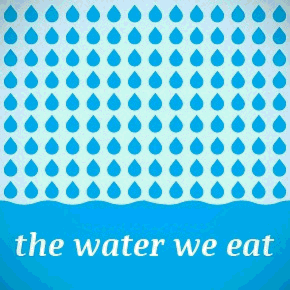
Recently Lisa Tweedie posted a Pintrest link on Facebook to Angela Morelli‘s dynamic infographic on water.  This is a lovely vertically scrolling page showing how the majority of the water we use is indirectly consumed via the food we eat … especially if you are a meat eater (1 kilo beef = 15,400 litres of water!).  The graphic was great, except it took me ages to actually get to it.  In fact the first time I found a single large graphic produced by Angela as a download, it was only when I returned to it that I found the full dynamic info graphic.

Every time I go to Pintrest I feel like I’ve been dropped into a random part of Hampton Court Maze, so hard to find the actual source … this is why a lot of artists get annoyed at Pintrest!  Now for Pintrest this is probably part of their design philosophy … after all they want people to stay on their site.  What is amazing is that this kind of design is so acceptable to users … Facebook is slightly less random, but still it takes me ages to find pages I’ve liked, each time I start the search through my profile afresh.

In the early days of hypertext everyone used to talk about the “lost in hyperspace” problem … now we are more lost … but don’t care anymore.  In the Mediaeval world you put your trust in your ‘betters’ lords, kings, and priests and assumed they knew best … now we put our trust in Pintrest and Facebook.

Walking Wales

As some of you already know, next year I will be walking all around Wales: from May to July covering just over 1000 miles in total.

Earlier this year the Welsh Government announced the opening of the Wales Coastal Path a new long distance footpath around the whole coast of Wales. There were several existing long distance paths covering parts of the coastline, as well as numerous stretches of public footpaths at or near the coast. However, these have now been linked, mapped and waymarked creating for the first time, a continuous single route. In addition, the existing Offa’s Dyke long distance path cuts very closely along the Welsh–English border, so that it is possible to make a complete circuit of Wales on the two paths combined.

As soon as I heard the announcement, I knew it was something I had to do, and gradually, as I discussed it with more and more people, the idea has become solid.

This will not be the first complete periplus along these paths; this summer there have been at least two sponsored walkers taking on the route. However, I will be doing the walk with a technology focus, which will, I believe, be unique.

The walk has four main aspects:

personal — I am Welsh, was born and brought up in Cardiff, but have not lived in Wales for over 30 years. The walk will be a form of homecoming, reconnecting with the land and its people that I have been away from for so long. The act of encircling can symbolically ‘encompass’ a thing, as if knowing the periphery one knows the whole. Of course life is not like this, the edge is just that, not the core, not the heart. As a long term ex-pat, a foreigner in my own land, maybe all I can hope to do is scratch the surface, nibble at the edges. However, also I always feel most comfortable as an outsider, as one at the margins, so in some ways I am going to the places where I most feel at home. I will blog, audio blog, tweet and generally share this experience to the extent the tenuous mobile signal allows, but also looking forward to periods of solitude between sea and mountain.

practical — As I walk I will be looking at the IT experience of the walker and also discuss with local communities the IT needs and problems for those at the edges, at the margins. Not least will be issues due to the paucity of network access both patchy mobile signal whilst walking and low-capacity ‘broadband’ at the limits of wind-beaten copper telephone wires — none of the mega-capacity fibre optic of the cities. This will not simply be fact-finding, but actively building prototypes and solutions, both myself (in evenings and ‘days off’) and with others who are part of the project remotely or joining me for legs of the journey1. Geolocation and mobile based applications will be a core part of this, particularly for the walkers experience, but local community needs likely to be far more diverse.

philosophical — Mixed with personal reflections will be an exploration of the meanings of place, of path, of walking, of nomadicity and of locality. Aristotle’s school of philosophy was called the Peripatetic School because discussion took place while walking; over two thousand years later Wordsworth’s poetry was nearly all composed while walking; and for time immemorial routes of pilgrimage have been a focus of both spiritual service and personal enlightenment. This will build on some of my own previous writings in particular past keynotes2 on human understanding of space, and also wider literature such as Rebecca Solnit’s wonderful “Wanderlust“.  This reflection will inform the personal blogging, and after I finish I will edit this into a book or account of the journey.

research3 — the practical outcomes will intersect with various personal research interests including social empowerment, interaction design and algorithmics4.  For the walker’s experience, I will be effectively doing a form of action research!.  This will certainly include how to incorporate local maps (such as tourists town plans) effectively into more large-scale experiences, how ‘crowdsourced’ route knowledge can augment more formal digital and paper resources, data synchonisation to deal with disconnection, and data integration between diverse sources.  In addition I am offering myself as a living lab so that others can use my trip as a place to try out their own sensors and instrumentation5, information systems, content authoring, ethnographic practices, community workshops, etc.  This may involve simply asking me to use things, coming for a single meeting or day, or joining me for parts of the walk.

If any of this interests you, do get in touch.  As well as research collaborations (living lab or supporting direct IT goals) any help in managing logistics, PR, or finding sources of funding/sponsorship for basic costs, most welcome.

I’ll get a dedicated website, Facebook page, twitter account, and charity sponsorship set up soon … watch this space!

  1. Coding whilst walking is something I have thought about (but not done!) for many years, but definitely inspired more recently by Nick the amazing cycling programmer who came to the Spring Tiree Tech Wave.[back]
  2. Welsh Mathematician Walks in Cyberspace“, and “Paths and Patches: patterns of geognosy and gnosis“.[back]
  3. I tried to think of a word beginning with ‘p’ for research, but failed![back]
  4. As I tagged this post I found I was using nearly all my my most common tags — I hadn’t realised quite how much this project cuts across so many areas of interest.[back]
  5. But with the “no blood rule”: if I get sensor sores, the sensors go in the bin 😉 [back]

Alt-HCI open reviews – please join in

Papers are online for the Alt-HCI trcak of British HCI conference in September.

These are papers that are trying in various ways to push the limits of HCI, and we would like as many people as possible to join in discussion around them … and this discussion will be part of process for deciding which papers are presented at the conference, and possibly how long we give them!

Here are the papers  — please visit the site, comment, discuss, Tweet/Facebook about them.

paper #154 — How good is this conference? Evaluating conference reviewing and selectivity
        do conference reviews get it right? is it possible to measure this?

paper #165 — Hackinars: tinkering with academic practice
        doing vs talking – would you swop seminars for hack days?

paper #170 — Deriving Global Navigation from Taxonomic Lexical Relations
        website design – can you find perfect words and structure for everyone?

paper #181 — User Experience Study of Multiple Photo Streams Visualization
        lots of photos, devices, people – how to see them all?

paper #186 — You Only Live Twice or The Years We Wasted Caring about Shoulder-Surfing
        are people peeking at your passwords? what’s the real security problem?

paper #191 — Constructing the Cool Wall: A Tool to Explore Teen Meanings of Cool
        do you want to make thing teens think cool?  find out how!

paper #201 — A computer for the mature: what might it look like, and can we get there from here?
        over 50s have 80% of wealth, do you design well for them?

paper #222 — Remediation of the wearable space at the intersection of wearable technologies and interactive architecture
        wearable technology meets interactive architecture

paper #223 — Designing Blended Spaces
        where real and digital worlds collide

open data: for all or the few?

On Twitter Jeni Tennison asked:

Question: aside from personally identifiable data, is there any data that *should not* be open?  @JenT 11:19 AM – 14 Jul 12

This sparked a Twitter discussion about limits to openness: exposure of undercover agents, information about critical services that could be exploited by terrorists, etc.   My own answer was:

maybe all data should be open when all have equal ability to use it & those who can (e.g. Google) make *all* processed data open too   @alanjohndix 11:34 AM – 14 Jul 12

That is, it is not clear that just because data is open to all, it can be used equally by everyone.  In particular it will tend to be the powerful (governments and global companies) who have the computational facilities and expertise to exploit openly available data.

In India statistics about the use of their own open government data1 showed that the majority of access to the data was by well-off males over the age of 50 (oops that may include me!) – hardly a cross section of society.  At  a global scale Google makes extensive use of open data (and in some cases such as orphaned works or screen-scraped sites seeks to make non-open works open), but, quite understandably for a profit-making company, Google regards the amalgamated resources as commercially sensitive, definitely not open.

Open data has great potential to empower communities and individuals and serve to strengthen democracy2.  However, we need to ensure that this potential is realised, to develop the tools and education that truly make this resource available to all3.  If not then open data, like unregulated open markets, will simply serve to strengthen the powerful and dis-empower the weak.

  1. I had a reference to this at one point, but can’t locate it, does anyone else have the source for this.[back]
  2. For example, see my post last year “Private schools and open data” about the way Rob Cowen @bobbiecowman used UK government data to refute the government’s own education claims.[back]
  3. In fact there are a variety of projects and activities that work in this area: hackathons, data analysis and visualisation websites such as IBM Many Eyes, data journalism such as Guardian Datablog and some government and international agencies go beyond simply publishing data and offer tools to help users interpret it (I recall Enrico Bertini, worked on this with one of the UN bodies some years go). Indeed there will be some interesting data for mashing at the next Tiree Tech Wave in the autumn.[back]

Status Code 451- and the burning of books

I was really pleased to see that Alessio Malizia has just started to blog.  An early entry is a link to a Guardian article about Tim Bray‘s suggestion for a new status code of 451 when a site is blocked for legal reasons.

Bray’s tongue-in-cheek suggestion is both honouring Ray Bradbury, the author of Faranheit 451, and also satirising the censorship implicit in IP blocking such as the UK High Court decision in April to force ISPs to block Pirate Bay.

However, I have a feeling that perhaps the satire could be seen, so to speak, as on the other foot.

Faranheit 451 is about a future where books are burnt because they have increasingly been regarded as meaningless by a public focused on quick fix entertainment and mindless media: censorship more the result than the cause of societal malaise.

Just as Huxley’s Brave New World seemed to sneak up upon us until science fiction was everyday life, maybe Bradbury’s world is here with the web itself not the least force in the dissolution of intellectual life.

Bradbury foresaw ‘firemen’ who burnt the forbidden books, following in a long history of biblioclasts from the destruction of the Royal Library of Ashurbanipal at Ninevah to Nazi book burnings in the 1930s.  However, today it is the availability of information on the internet which is often used as an excuse for the closure of libraries, and publishers foresee the end of paper publication in the next five years.

Paradoxically it is the rearguard actions of publishers (albeit largely to protect profit not principle) that is one of the drivers behind IP blocking and ‘censorship’ of copyright piracy sites.  If I were to assign roles from Faranheit 451 to the current day protagonists it would be hard to decide which is more like the book-burning firemen.

Maybe Faranheit 451 has happened and we never noticed.

Tiree going mobile

Tiree’s Historical Centre An Iodhlann has just been awarded funding by the Scottish Digital Research and Development Fund for Arts and Culture to make historic archive material available through a mobile application whilst ‘on the ground’ walking, cycling or driving around the island.

I’ve been involved in bigger projects, but I can’t recall being more excited than this one: I think partly because it brings together academic interests and local community.

the project

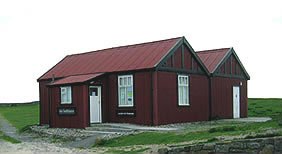
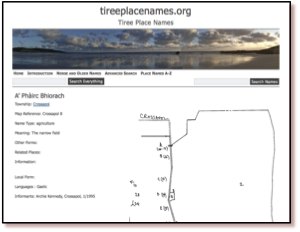
An Iodhlann (Gaelic for a stackyard) is the historical centre on the island of Tiree.  Tiree has a rich history from the Mesolithic period to the Second World war base. The archive was established in 1998, and its collection of old letters, emigrant lists, maps, photographs, stories and songs now extends to 12 000 items.  500 items are available online, but the rest of the primary data is only available at the centre itself.  A database of 3200 island place names collated by Dr Holliday, the chair of An Iodhlann, has recently been made available on the web at tireeplacenames.org.  Given the size of the island (~750 permanent residents) this is a remarkable asset.


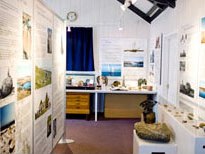
To date, the online access at An Iodhlann is mainly targeted at archival / historical use, although the centre itself has a more visitor-centred exhibition.  However, the existing digital content has the potential to be used for a wider range of applications, particularly to enhance the island experience for visitors.

Over the next nine months we will create a mobile application allowing visitors and local historians to access geographically pertinent information, including old photographs, and interpretative maps/diagrams, while actually at sites of interest.  This will largely use visitors’ own devices such as smart phones and tablets.  Maps will be central to the application, using both OS OpenData and bespoke local maps and sketches of historical sites.
As well as adding an extra service for those who already visit An Iodhlann, we hope that this will attract new users, especially younger tourists.  In addition a ‘data layer’ using elements of semantic web technology will mean that the raw geo-coded information is available for third parties to mash-up and for digital humanities research.

the mouse that roars

The Scottish Digital Research and Development Fund for Arts and Culture is run by Nesta, Creative Scotland and the Arts and Humanities Research Council (AHRC).

This was a highly competitive process with 52 applications of which just 6 were funded.  The other successful organisations are: The National Piping Centre, Lyceum Theatre Company and the Edinburgh Cultural Quarter, Dundee Contemporary Arts, National Galleries of Scotland, Glasgow Film Theatre and Edinburgh Filmhouse.  These are all big city organisations as were the projects funded by an earlier similar programme run by Nesta England.

As the only rural-based project, this is a great achievement for Tiree and a great challenge for us over the next nine months!

challenges

In areas of denser population or high overall tourist numbers, historical or natural sites attract sufficient visitors to justify full time (volunteer or paid) staff.  In more remote rural locations or small islands there are neither sufficient people for volunteers to cover all, or even a significant number, of sites, nor have they sufficient tourist volume to justify commercial visitor centres.

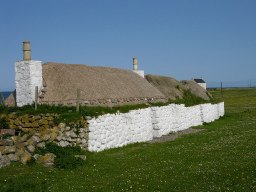
A recent example of this on Tiree is the closing of the Thatched Cottage Museum.  This is one of the few remaining thatched houses on the island, and housed a collection of everyday historical artefacts.  This was owned by the Hebridean Trust, and staffed by local volunteers, but was recently closed and the building sold, as it proved difficult to keep it staffed sufficiently given the visitor numbers.

At some remote sites such as the Tiree chapels, dating back to the 10th century, or Iron Age hill forts, there are simple information boards and at a few locations there are also fixed indoor displays, including at An Iodhlann itself.  However, there are practical and aesthetic limits on the amount of large-scale external signage and limits on the ongoing running and maintenance of indoor exhibits.  Furthermore, limited mobile signals mean that any mobile-based solutions cannot assume continuous access.
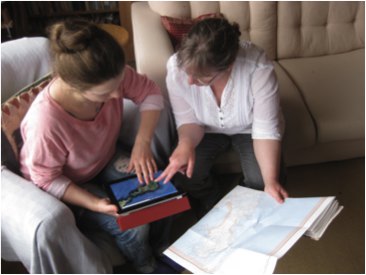
from challenge to experience

Providing information on visitors’ own phones or tablets will address some of the problems of lack of signage and human guides.  However, achieving this without effective mobile coverage means that simple web-based solutions will not work.

The application used whilst on the ground will need to be downloaded, but then this limits the total amount of information that is available whilst mobile; our first app will be built using HTML5 to ensure it will be available on the widest range of mobile devices (iOS, Android, Windows Mobile, ordinary laptops), but using HTML5  further reduces the local storage available1.

In order to deal with this, the on-the-ground experience will be combined with a web site allowing pre-trip planning and post-trip reminiscence.  This will also be map focused, allowing visitors to see where they have been or are about to go, access additional resources, such as photos and audio files that are too large to be available when on the ground (remembering poor mobile coverage). This may also offer an opportunity to view social content including comments or photographs of previous visitors and then to associate one’s own photographs taken during the day with the different sites and create a personal diary, which can be shared with others.

On reflection, this focus on preparation and reminiscence will create a richer and more extended experience than simply providing information on demand.  Rather than reading reams of on-screen text whilst looking at a  monument or attempting to hear an audio recording in the Tiree wind, instead visitors will have some information available in the field and more when they return to their holiday base, or home2.


  1. For some reason HTML5 applications are restricted to a maximum of 5Mb![back]
  2. This is another example of a lesson I have seen so many times before: the power of constraints to force more innovative and better designs. So many times I have heard people say about their own designs “I wanted to make X, but couldn’t for some reason so did Y instead” and almost every time it is the latter, the resource-constrained design, that is clearly so much better.[back]

September beckons: calls for Physicality and Alt-HCI

I’m co-chairing a couple of events, both with calls due in mid June: Physicality 2012, and Alt-HCI.   Both are associated with HCI 2012  in Birmingham in September, so you don’t have to chose!

Physicality 2012 – 4th International Workshop on Physicality

(Sept.11, co-located with HCI 2012)

Long awaited, the 4th in the Physicality workshop series exploring design challenges, theories and experiences in developing new forms of interactions that exploit human physical interaction with digital technology.

Position papers and research papers due 18th June.

see:

Alt-HCI

(track of HCI 2012, 12-15 Sept 2012)

A chance to present and engage with work that pushes the boundaries of HCI.  Do you investigate methods for inducing negative user experience, or for not getting things done (or is that Facebook?).  Maybe you would like to argue for the importance of Taylorism within HCI, or explore user interfaces for the neonate.

Papers due 15th June with an open review process in the weeks following.

see: HCI 2012 call for participation  (also HCI short papers and work-in-progress due 15th June: )