Back to Tiree – and being ‘half-time’

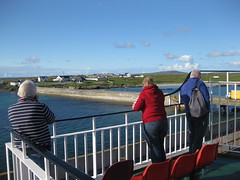
I’m on the ferry on the way back to Tiree. It’s been 2 months since I was home and then only one long weekend since the end of August, so it seems both familiar and strange sitting on the Calmac ferry again as it makes its way out of Oban.

Last autumn I had a similar long stay away, then mostly in the camper van near the University as I was still working full time at Lancaster. This year I am working half time at Lancaster, but also half-time for Talis and for the first three months at Talis spending half my time on site at the Talis offices in Birmingham. After that I’ll be doing my Talis job based from home, only going down more occasionally, so after Christmas will get more time at home.

Instead of my camper van I’ve been staying a lot at the ‘Talis house’, a house near Solihull for small off-site meetings and for those like me who live a long way away from Talis’ Birmingham offices (others live in France, Italy, and the USA). It was rather claustrophobic last autumn spending most of my weekends in my office at Lancaster, so having Talis house as a base has been good. However, I do miss that snug feeling in the back of the camper van hunkering under the bedclothes, with a take-away on my knees and watching a DVD, while the van rocked in time to the whistling wind outside.

Working half time for Talis has also imposed a discipline on my time working in my University role. Since last Christmas I have been formally working half time at Lancaster (certainly getting half pay!), but as those who work in the universities know, it is hard to put a limit on things. The idea was that this meant I would get half my time to do ‘my stuff’, research and writing. Of course I knew cutting my old 80-hour weeks down to 20 or even 40 would not happen, but I would at least get a little more time than I have become used to.

One of the half expected and half surprising things about the shift to half-time working for the University last January was the way other people dealt with it.

I guess for years I have implicitly ‘educated’ both fellow academics and students in their expectations; whenever there was something to be done, a report to read or write, I would say things like “ah this weekend I’ve already got this other task to do, but I’ll do it the next weekend” — basically assuming that weekends and evenings, strictly the unpaid times, were the times when things happened. After a bit students would get used to giving me things on Friday in the expectation that I would then have time to do it.

When I shifted to half time people would extend this notion and say “ah now you have more time you can do X”: reviews, reading student work, etc. As I said this was half expected, I had the feeling I would need to re-educate people. However, what surprised me was not that people acted this way, but that they said it, and even wrote it in emails. I would have thought that when they saw it explicitly in front of them they would think, “oh no Alan now has less time for these things”, but no; it is amazing how little we notice of what we say and do.

Anyway now things are different. Instead of it being ‘my time’ that my academic life intruded into, it is now Talis’ time and this is something others can respect more, and I guess I also respect more than my own time.

So how is it working — really being a half-time academic?

In fact of course, I still work most weekends and long days, so I have somewhat more than a full-time week of effort, so I am not yet down to 20 hours of university work, but certainly a lot less time then when I was simply trying to protect my own (unpaid!) time.

In January when I shifted to half-time, I said I’d do a day a week while at home effectively eating nearly half of my ‘half time’, meaning I was expecting to spend about 60 days a year away from home whether on site in Lancaster or travelling. In fact during this Autumn alone, by Christmas I will have spent 53 days either on site in Lancaster or travelling on University business, that is more than 2/3 of the formal 75 working days in the period and nearly all my annual ‘not at home’ Lancs working days! This doesn’t seem to add up given 1/2 time spent in B’ham, but of course the 53 days of Lancaster time includes many weekends away while travelling that I wasn’t used to counting when a ‘full time’ academic.

I clearly need to cut this down further! However, even now, being stricter than I was with ‘my time’, cracks are beginning to show. I can see students getting unhappy as it takes me longer to find time to read things they have written, and colleagues patiently realising that email to me is getting even less reliable. So much of the life of an academic depends on things done in ‘extra time’ whether weekends or evenings, or in my case earlier in the year unpaid time; when you cut back on that things simply do not happen.

From Christmas I will not have the imposed discipline of days at the offices at Talis, so will need to maintain this more for myself. However, the last few months have helped and I will certainly keep careful records to make sure Talis gets its fair share of my time and that the University does not consume so much of my ‘own’ time as rest is also part of working well.

Even though I have effectively ‘used up’ most of my university on-site/travelling days, I will of course not say “no more until next September’ (!), but will at least try to control it more. And I will also try to let some of the more balanced view of work and life I am learning at Talis influence my attitudes at the University.

And no, I won’t be reading email this evening.
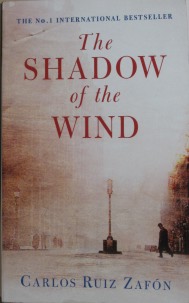
book: How Green Was My Valley

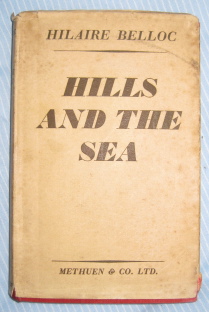
After too many years I eventually read Richard Llewellyn’s “How Green Was My Valley“, which tells the story of growing up in a South Wales valley at the end of the 19th century.  I vaguely recall seeing the film of the book on the TV one Sunday afternoon as a small child.

You can read the book as a social commentary of a time past, or as a coming of age novel set around with stories of strikes and singing, madness and joy, requited and unrequited loves.   But above all it is a book of poetry, not in the sense of verse, but that form of prose that raises goosebumps down your back:

“… and I raised my arms and drew tight the muscles of my body, and as the blood within me thudded through my singing veins, a goldness opened wide before me and I knew I had become of Men, a Man.” (Chap. 24)

“My Valley, O my Valley, within me, I will live in you eternally … for part of me is the memory of you in your greens and browns, with everything of life happy in your deeps and shades, when you gave sweet scents to us, and sent for spices for the pot, and flowers, and birds sang out for pleasure to be with you.” (Chap. 18)

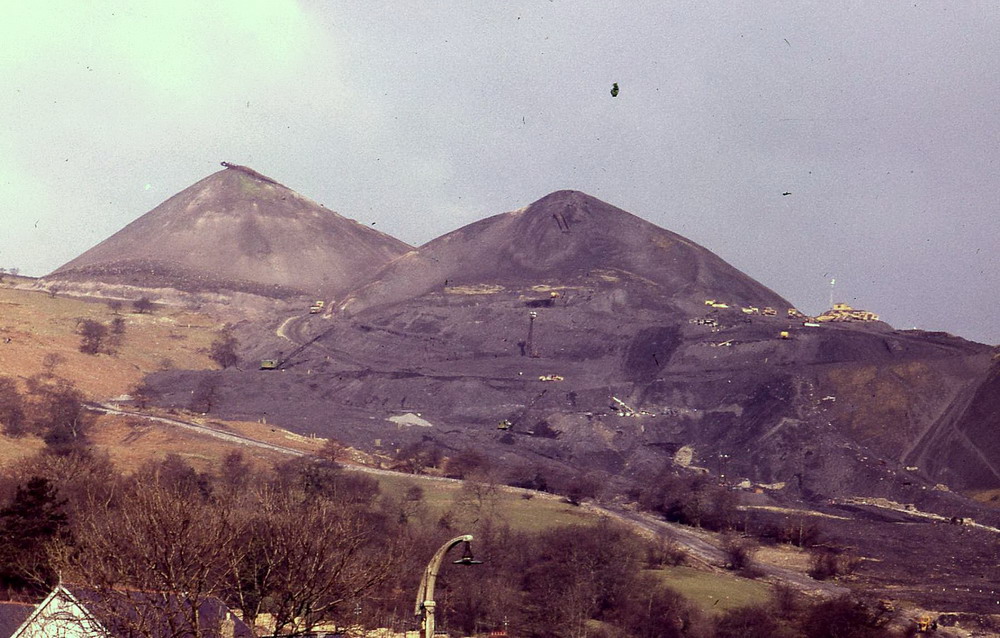
A recurrent theme through the novels is the gradual covering of that green, the burying of the valley sides and trees beneath the encroaching blackness of the slag, the coal tips, which as a child I recall still covering the valley sides north of Cardiff.  Indeed the novel is narrated by an old man thinking back over his childhood as he leaves his family home for the last time, a home itself now half buried as the slag spreads ever down the valley.

In the early days of coal mining the slag, the pieces of coal that were too small to burn, was left below the ground, rammed hard into the sides of the tunnels, strengthening and supporting them. But in the time of the book, and on throughout the 20th century, it proved cheaper and quicker to bring everything to the surface and separate there, the remains being spread upon the mountain sides in dark hills of their own, like welts upon a diseased landscape eaten underground by men.

“There is a patience in the Earth to allow us to go into her, and dig, and hurt with tunnels and shafts, and if we put back the flesh we have torn from her and so make good what we have weakened, she is content to let us bleed her. But when we take, and leave her weak where we have taken, she has a soreness, and an anger that we should be so cruel to her and thoughtless of her comfort. So she waits for us, and finding us, bears down, and bearing down, makes us a part of her, flesh of our flesh, with our clay in place of the clap we thoughtlessly have shovelled away.” (Chap. 42)

These are the thoughts of the elderly Huw looking back at the moment when he sat with his father part buried and dying after a roof fall.  Prescient today when we are at last beginning to realise how much we have taken from the earth and how little given back.

But, while the narrator is thinking of the toll taken on the miners underground by the thoughtless drive for profit and cheap coal, those brooding slag heaps remind me more of the dark repayment taken above.

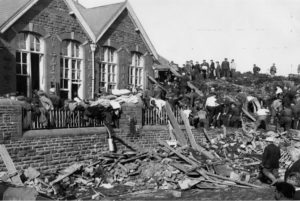
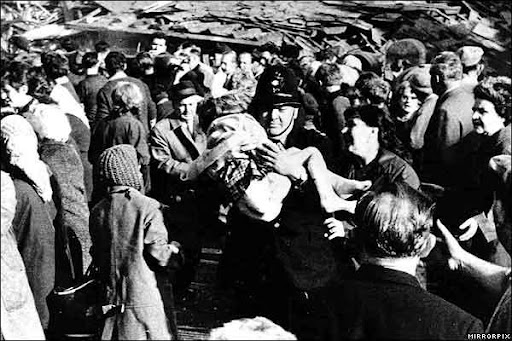
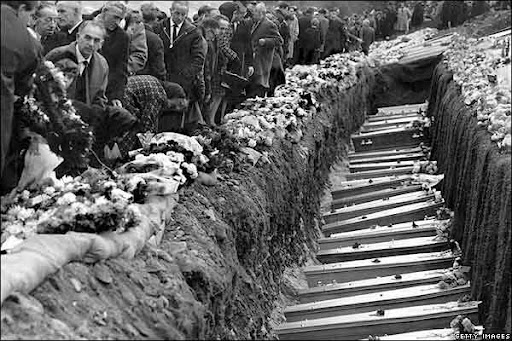
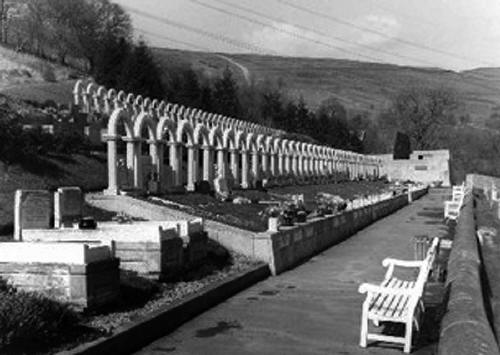
One of the defining moments of my own childhood, was when, a few months after the Aberfan disaster, we drove up to Brecon along the valley road, and looked across the valley to a field of white crosses, like the images of Flanders on Armistice day, only no red poppies among the white graves, just white against green a ghastly mirror of the black upon green of the coal tip that rolled down the valley-side burying the school of Aberfan and taking the lives of  whole generation of children.


Qualification vs unlimited education

In “Adrift in Caledonia“, Nick Thorpe is in the Shetland Isles speaking to Stuart Hill (aka ‘Captain Calamity’).  Stuart says:

“What does qualification mean? … Grammatically, a qualification limits the meaning of a sentence. And that’s what qualifications seem to do to people. When you become a lawyer it becomes impossible to think of yourself outside that definition. The whole of the education system is designed to fit people into employment, into the system. It’s not designed to realise their full creativity.”

Now Stuart may be being slightly cynical and maybe the ‘whole of education system’ is not like that, but sadly the general thrust often seems so.

Indeed I recently tweeted a link to @fmeawad‘s post “Don’t be Shy to #fail” as it echoed my own long standing worries (see “abject failures“) that we have a system that encourages students to make early, virtually unchangeable, choices about academic or career choices, and then systematically tell them how badly they do at it. Instead the whole purpose of education should be to enable people to discover their strengths and their purposes and help them to excel in those things, which are close to their heart and build on their abilities.  And this may involve ‘failures’ along the way and may mean shifting areas and directions.

At a university level the very idea behind the name ‘university’ was the bringing together of disparate scholars.  In “The Rise and Progress of  Universities” (Chapter 2. What is a University?, 1854) John Henry Newman (Cardinal Newman, recently beatified) wrote:

“IF I were asked to describe as briefly and popularly as I could, what a University was, I should draw my answer from its ancient designation of a Studium Generale, or “School of Universal Learning.” This description implies the assemblage of strangers from all parts in one spot;—from all parts; else, how will you find professors and students for every department of knowledge? and in one spot; else, how can there be any school at all? Accordingly, in its simple and rudimental form, it is a school of knowledge of every kind, consisting of teachers and learners from every quarter. Many things are requisite to complete and satisfy the idea embodied in this description; but such as this a University seems to be in its essence, a place for the communication and circulation of thought, by means of personal intercourse, through a wide extent of country.”

Note the emphasis on having representatives of many fields of knowledge ‘in one spot’: the meeting and exchange, the flow across disciplines, and yet is this the experience of many students?  In the Scottish university system, students are encouraged to study a range of subjects early on, and then specialise later; however, this is as part of a four year undergraduate programme that starts at 17.  At Lancaster there is an element of this with students studying three subjects in their first year, but the three year degree programmes (normally starting at 18) means that for computing courses we now encourage students to take 2/3 of that first year in computing in order to lay sufficient ground to cover material in the rest of their course.  In most UK Universities there is less choice.

However, to be fair, the fault here is not simply that of university teaching and curricula; students seem less and less willing to take a wider view of their studies, indeed unwilling to consider anything that is not going to be marked for final assessment.  A five year old is not like this, and I assume this student resistance is the result of so many years in school, assessed and assessed since they are tiny; one of the reasons Fiona and I opted to home educate our own children (a right that seems often under threat, see “home education – let parents alone!“).  In fact, in the past there was greater degree of cross-curricula activity in British schools, but this was made far more difficult by the combination of the National Curriculum prescribing content,  SATs used for ‘ranking’ schools, and increasingly intrusive ‘quality’ and targets bureaucracy introduced from the 1980s onwards.

Paradoxically, once a student has chosen a particular discipline, we often then force a particular form of breadth within it.  Sometimes this is driven by external bodies, such as the BPA, which largely determines the curriculum in psychology courses across the UK.  However, we also do it within university departments as we determine what for us is considered a suitable spread of studies, and then forcing students into it no matter what their leanings and inclinations, and despite the fact that similar institutions may have completely different curricula.  So, when a student ‘fails’ a module they must retake the topic on which they are clearly struggling in order to scrape a pass or else ‘fail’ the entire course.  Instead surely we should use this this as an indication of aptitude and maybe instead allow students to take alternative modules in areas of strength.

Several colleagues at Talis are very interested in the Peer 2 Peer University (P2PU), which is attempting to create a much more student-led experience. I would guess that Stuart Hill might have greater sympathy with this endeavour, than with the traditional education system.  Personally, I have my doubts as to whether being virtually / digitally ‘in one spot‘ is the same as actually being co-present (but the OU manage), and whether being totally student-led looses the essence of scholarship, teaching1 and mentoring, which seems the essence of what a university should be. However, P2PU and similar forms of open education (such as the Khan Academy)  pose a serious intellectual challenge to the current academic system: Can we switch the balance back from assessment to education?  Can we enable students to find their true potential wherever it lies?

  1. Although ‘teaching’ is almost a dirty word now-a-days, perhaps I should write ‘facilitating learning’![back]

Paris dawn

Dawn in Paris from the 29th floor of Hôtel Concorde La Fayette, looking north-east towards Sacre Cœur.  End of a few days as external expert for the INRIA Evaluation Seminar on “Interaction and Visualisation”.

I was also in Paris last September and changed my view of the city (hitherto rather poor).  I started a post about that then “Paris and the redemption of the French restaurant“, but never uploaded it at the time; however, I have now done so (post dated to Sept 2009).  Also on Flickr are more photos of dawn over Sacre Cœur and also I am uploading my photos from the previous Paris trip last Sept.

cracks in the ceiling, windows on childhood

This bedroom.  Where she knew the pattern of cracks in the ceiling better than any other fact of her life.
Shipping News, p.54

Reading this, I realised I also remember the patterns on the ceiling above Mum and Dad’s bed in the big bedroom in Bangor Street, where my sister and I also slept in bunk beds.  As I lay, falling asleep with monkey held close, the pattern above seemed like the face and shoulders of some giant that had slept in the attic and left his impression in the plaster like the smaller dent in the sheets when I got up in the morning.

I had forgotten it, but I can see it now, patterns upon light green woodchip ceiling paper, as clear as the sky and grass before me where I am sitting now, and mornings with tea from the Goblin Teasmade and Dad bringing up marmalade-laden toast cut in triangles before, workman-fashion, he sipped hot tea from the saucer.

beyond books and blood

With most others, I was sickened by Pastor Terry Jones’ threat to burn copies of the Qur’an; it is directly counter to the Christian message and basic human decency.  Happily, this now seems to have been abandoned. However, while this was provocative and insensitive and may be used as an excuse for violence across the world, there seems to be a subtle and worrying shift as many have suggested that he will be responsible for any violence or even deaths.

However vile Jones’ threat was, the responsibility for violence lies with the perpetrators.

We seem to have lost the plot somehow when the burning of a book claims more news time and more  condemnation than those persecuting, maiming and killing people.

I am sure both true Muslims and Christians know that God’s dignity is not diminished one iota by the desecration of any book or building (including Ground Zero), even though our own feelings, dignity or pride may suffer. And I am certain they also know that God’s love extends to victims whatever their beliefs.

Let’s set our attention on the important things and leave those like Pastor Jones to the obscurity they deserve.

Across Ireland to Limerick: Stepping Out of Time

Early last week I had  a few days external examining the iMedia course at Limerick.  A wonderful course I was impressed again at the Dawn 2010 show pieces produced by the students who come predominantly from arts or design backgrounds and many of whom have never touched code or soldering iron before starting the course.

As it was Bank Holiday weekend, flying would have meant spending 24 hours in an airport between flights and airport hotels in each direction, or alternatively driving south to an airport.  It seemed more sensible and more fun to drive south through Ireland itself, and in the process satisfy a little my itinerant spirit.

I didn’t manage to write as I went along, but have retrospectively made a number of post-dated photo-blogs:

Roads of the Sea — Tiree to Larne

Into the West — Larne to Westport

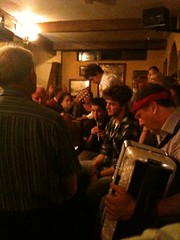
Serendipity and Song — Westport to Doolin

Last Day — Doolin to Limerick

Full set of photos at my Limerick-Aug-2010 Flickr photo set

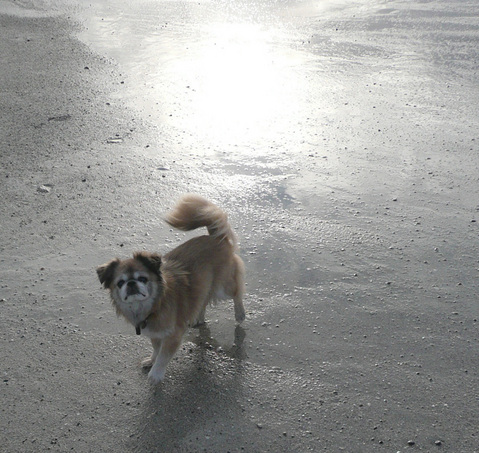
Said goodbye to our little dog Tansy over weekend.  I am not one of nature’s dog lovers, but it is amazing how one gets attached to a small bundle of fur, I just wish I had been at home in Tiree with Fiona at the time.  At nearly 17 she was very old in doggy years, seemed to be happy to the end and certainly gave a lot of happiness to others, which is a pretty good epitaph for anyone.

Last Day — Doolin to Limerick

From Doolin’s harbour side you can see the ferries that ply back and forth to the Aran Islands.  The rock is limestone, like the Burren, and the land beneath cut through with caves including the world’s largest stalactite and the submerged ‘Green Holes’, only discovered in the 1980s.

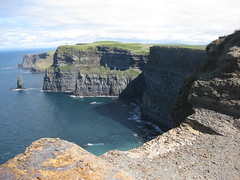
While the Aran Islands stretch across the sea to the North West, to the South West rise the Cliffs of Moher, 200 metres from the sea, shortlisted alongside Kilimanjaro, the Great Barrier Reef and the Grand Canyon to be one of the new seven wonders of nature.  There is no beach, no sand or shingle, just sea and shear rock, but surfers travel there to ride the 35 foot wave at its feet.

The Moher visitor centre is dug and buried into the hillside with curved windows cut through the turf; Hobbit Town meets HiTech,  The paved, stepped, and wheelchair-access routed area with its viewing points and wall of wave-patterned Burran limestone slabs, ends at widely ignored signs threatening danger to life and limb if one proceeds.  You can see why the signs are there; it is not so much the lack of fence or wall between the cliff top path and precipitous edge, but the rock itself.  The limestone of the Burran, Doolin coast and Aran Isles has ended and this is younger, softer alluvial rock, at the cliff top often little more than flakes of shale in hardened mud.  The tourists peeking over the edge may be secure in footing, but the soft cliff edge itself might shrug them off to fly for a moment amongst the nesting gulls before hitting the water 600 feet below.

And out on the grass beside the forbidden cliff path, an Italian couple set up a video camera looking out towards the rocky headland, and sit in front of it to exchange rings.

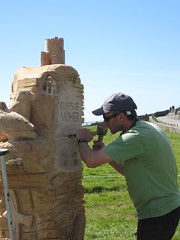
Back at the visitor centre a sculptor was hard at work with chisel, angle grinder and chain saw, capturing the spirit of Maher from surfer to sea birds.  Shane Gilmore‘s sculptures are found across Western Ireland, and he was commissioned to make this one in situ during the Clare Heritage Week.  At Shane’s feet lay a collection of reference books; he explained that if he got some detail wrong, gave a bird the head of a gull and the body of a gannet, someone would be sure to notice.

It is only a short way from Doolin and Maher, and slightly longer of you cut back north to travel across the Burren, but worth it, for its near lunar yet surprisingly fertile landscape.   Few roads cut across the limestone countryside but far beneath the ground are subterranean rivers and networks of caves left from past water courses, treacherous as they too can flood rapidly when rain falls and drains through sinkholes and caverns.

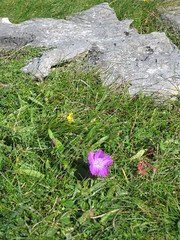
At a distance the Burren landscape appears barren, but between the clints, giant paving slabs of grey stone, the cracks, or grykes, are rich with wild flowers and lush grasses that supported communities from Neolithic times, who in turn left their traces in fire circles and ring forts.  And near every parking place, each clint is topped with a tiny cairn or sculpture as visitors today still want to leave some trace of their being here, or maybe token of their hoped-for return.