Runaway growth of AI is not painless – opportunity costs of investment and human costs of lost jobs. Gains may be transitory – buy-now-pay-later tech risk tying users into spiralling costs.
This is the sixth of a series of blogs based on my keynote “The abomination of AI” at ICoSCI 2026. Each has an accompanying segment of the video and slides from the talk as well as detailed notes and references. Section numbers refer to the full report which will be released in the final blog. The slide thumbnails in the text correspond to the slides in the navigation panel below. The presentation can be played below, or opened full screen. The full length video, complete slides and further information can be found at: https://alandix.com/academic/talks/ICOSCI-2026-abomination-of-AI/
Previously …
§1. Every industry is driven by profits and power, but there is something about the nature of AI itself, which interacts with the nature of market forces in the world that is problematic and is different from other technologies.
§2. Can any technology be neutral? AI can be used for good purposes, such as advances in healthcare. It can also have bad outcomes such as bias in the criminal justice system or online exploitative pornography. Perhaps most often it is creating the frivolous or even ugly.
§3. The obvious impact of AI is in the things it does directly. Some technologies also change the very nature of society, affecting even those who do not use them. Cars are an obvious example. AI is also such a technology.
§4. Doomsayers worry about the point when AI becomes sentient, outgrowing its creators. The real danger is more insidious: the massive financial and human impacts of AI seem almost obscene.
§5 . Network externalities, the way one person’s use of AI and digital tech changes its value for others, creates positive feedback loops, leading to runaway growth and emergent monopolies, the nemesis of free markets. This the very nature of digital technology and AI breaks free markets leading to runaway inequality, even with the best intentions of industry … but some tech companies further exploit these effects.
6. Should we worry?
6.1 Jobs and power
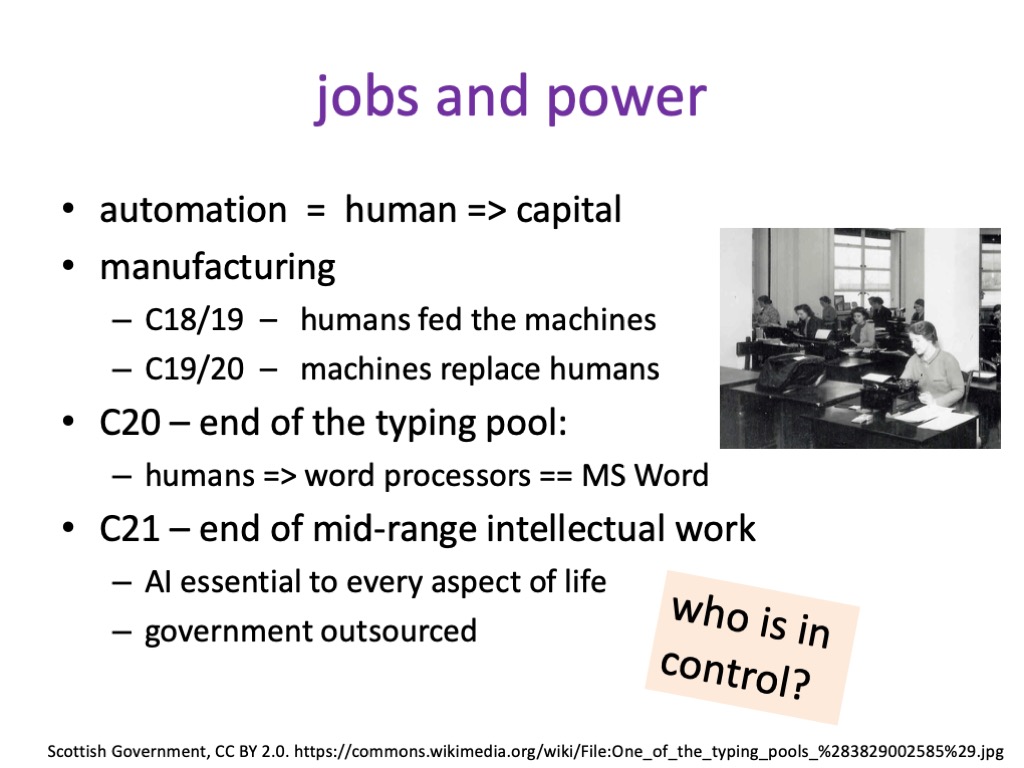
Image: Scottish Government, CC BY 2.0. https://commons.wikimedia.org/wiki/File:One_of_the_typing_pools_%283829002585%29.jpg
Does this matter? So what if a small number of companies have notional multi-trillion balance sheets and are engaged in runaway development in the digital realm, so long as it doesn’t affect the real world. But, of course, it does; the digital domain is leaking into the physical domain.
Of course, technology and automation have long had massive impact on society, with a gradual shift from human expertise to financial capital. This certainly dates back to the 19th century or late 18th century with the rise of the industrial revolution. Of course, at that time, humans were still needed, but they went from being the expert weavers and spinners, to the those (including young children) who merely tended the machines, monitoring and knotting broken threads, and occasionally losing arms in the moving parts. So it wasn’t that the humans were unnecessary, but they merely fed the machines.
Moving into the 20th century, machines replaced humans more completely with fully automated production lines and industrial robots, although of course still with humans cleaning up between them. In many parts of the global north skilled manual work has all but disappeared, with a combination of automation and out-sourcing.
To some extent the impact of automation initially hit traditional male jobs, but in the latter half of 20th century, from about the early seventies on this also hit clerical roles. Until then every big organisation would have had a typing pool. My own mother was for many years a typist at first in the War Department throughout the Second World War, and then the Inland Revenue. These typing pools, consisted of ranks of people, usually women, typing sometimes from dictation and shorthand, and sometimes other forms of handwriting. Word processors basically destroyed the typing pool. Whereas previously, managers would dictate letters and reports to a secretary who would then type it up, with the word processor, despite initial resistance, they would type directly themselves. Of course, after initial diversity, Microsoft Word soon became dominant – another emergent monopoly, although now matched by Google Workspace, with about 90% world share between them.
So, in general, skilled working class jobs have been destroyed by automation leaving a growing underclass with minimum wage jobs and gig work.
What we’re seeing now is that the mid-range intellectual work is starting to be eaten by AI [BSI25,].
You may have seen the MIT report that found that while many companies were investing heavily in AI, around 95% of the projects were considered to be failing or underperforming [CP25]. So, effective job substitution is not yet universal, but in some areas such as computing many of the lower range of the roles, typical graduate first jobs, are being replaced by AI. Until recently the expert developer would have several junior developers who do the grunt work; now this is done by AI. Similar pictures are emerging in advertising, aspects of finance, and some of the large management consultancies [Ko25,Sw26,IPA26,KM26,Pa26]. In the UK, and even more so in other parts of the world, there are strong pushes to use AI more extensively within government, not least on the assumption that it will improve efficiency [GUK25,Dx26].
There’s a critical issue about who’s in control. Think about the road network. In the UK there are some private roads and also some toll roads, but the majority of roads, including almost all in urban areas, are owned by the local authority or central government. That is, the vast majority of the road network is local in terms of its maintenance and control. Imagine if the road network was instead owned by two or three major companies based in the west coast of America. Imagine if every road in Malaysia, every road in Indonesia, as well as every road in UK was owned by those two or three companies half the world away. If there’s a pothole in the road, it is those companies to whom you have to complain. Perhaps they decide to charge you to use the road outside your house or decide to remove the roads entirely if they’re in dispute with you or your government.
That’s exactly the direction we are moving with AI and public services. Even assuming the best intention of the big AI players, this does feel worrying. And, of course, this isn’t a choice you can make or not. Just like cars and roads, once AI is embedded into public service everything orients around it.
Returning to the changes in employment, once we lose the entry stage jobs, there’s a clear problem for the people who would have had them. All the graduates from our universities, who would have been going into those jobs, are being hit, and, in many countries, on top of large student loans [DoE25,Pa25,Pa26]. This is creating a class of people who are underemployed, inexperienced, and quite likely disaffected with society. Think of this in the light of the rise of extremism across the world. Often this is dismissed as a problem of the uneducated, but here we are adding a vast number of highly educated people, who are disaffected in society, further spreading those extreme messages.
6.2 Locked into AI
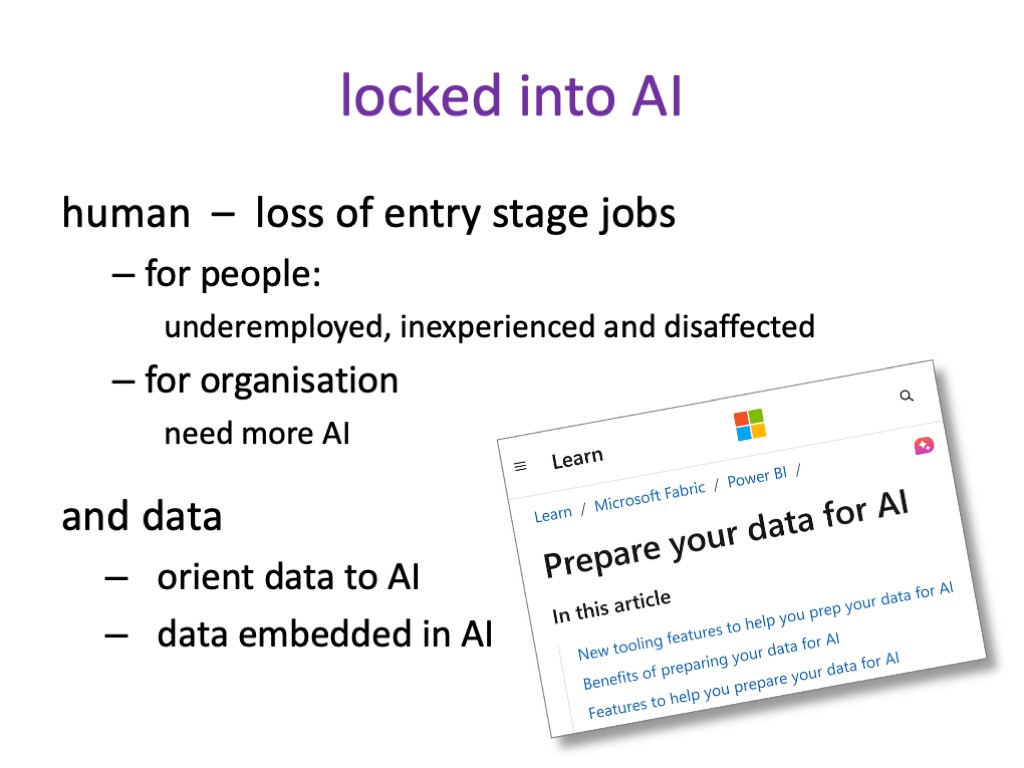
This is also a problem within an organization. If you are not employing those early career people, what happens in five or ten years’ time as your more experienced employees want to move up the organization? How do you fill in those gaps if you haven’t been training people?
This might be something we need to address as universities, training people effectively to higher and higher levels so that they can jump in at that point.
Or the organisation can simply find they need more AI – what they certainly can’t do is just turn off the AI because they haven’t got the people with the experience in order to do the jobs anymore. They have become locked in as a company to the use of AI.
This is also true of data. Microsoft have a guide entitled, “Prepare your data for AI” [Ms26]. The use of AI is not coming for free, but needs a rearrangement of data for it. One does wonder if the same effort making data ready for AI could be better spent making it ready for simpler statistical algorithms.
However, let’s assume you have put effort into reorienting your whole data around AI. Your systems rapidly become AI dependent – your recent information and new data has become deeply embedded into the AI itself in ways that are often opaque.
Once you have bought into an AI system, you can’t just say, “well, let’s just swap to something else”. It’s difficult even to swap vendors once it is that embedded.
6.3 Buy now … pay later
If you have a loan with interest, you know you have to pay for it eventually, but things can be less obvious. When I was little, my mum had a Kays catalogue, a sort of the 1960s equivalent of internet selling [WA17]. Its pages were full of big colour pictures of clothes, white goods, toys, etc. …it was usually the toys I was looking at. You could buy things from the catalogue and could pay over 20 weeks with no interest, but of course the things cost more than if you had the ready cash buy them at a shop. So effectively you were paying extra.
AI currently is in that ‘buy now pay later’ mode, both globally and locally for individuals. AI growth is funded by massive investment (as we discussed absolutely huge) possibly more than ever before except perhaps the South Sea Bubble. However, the income doesn’t in any way cover the costs, and the ratio between expected income and investment is way out of kilter for what you’d expect even for a digital company, let alone for a physical one.
So how do the books add up?
If you’re an accountant in the company or if you’re an investment manager, what are you thinking about as, as you see these figures? Why don’t you sound the alarm? The reason is you are thinking that in the future you will have more money from that stream. In early digital companies, like Amazon, you did that because you assumed you were going have a bigger market, the number of people who would use it would grow.
But AI already has lots of users, so instead you have two options. The first is to find ways to make what you produce more cheaply, which is happening to some extent already. However, you don’t want it to get too cheap otherwise competitors can enter the market. The alternative, and your only real option, to recoup your investment by charging more or getting the same customers to use more. Either way, it is the customer who pays in the end!
This is no secret. Fortune magazine said that OpenAI’s business plan relies on “what amounts to a bet on dominance” [Sm25]. That is, in putting in all that investment, what investors are hoping is that the company will become the AI company in an area that everybody is tied into. And then of course they can charge pretty much what they like: a buy now – pay later world. We’re using AI now, but the cost is going to come later on.
Coming next …
Part 7 – what can we do?
It all seems too big, requiring national and international responses. But we can make a difference using appropriately chosen small AI (including none). Plus, this good use of AI is good for business too.
Update.
Since the talk, I read about a woman who had developed a close relationship with a chatbot hosted on a version of ChatGPT that is due to be retired [He26]. While she could probably export her chat history and use that to reinitialise the new version of the software, it would not be the same. We will soon start to hear similar stories for business and public systems as tech companies have not had a good record of backward compatibility, and this is all but impossible with current LLMs.
Also, in late January, OpenClaw was released [OC26]. This highlighted the way current payment models do not reflect the actual cost of use. OpenClaw (originally called Clawdbot) is an open-source GitHub project that used the Claude API to create an automated assistant coordinating web and desktop resources. Within days of the launch Anthropic enforced a long-standing, but unenforced, restriction on third-party use of its API and blocked OpenClaw for most user accounts including its $200 Max account. This was because these accounts come with monthly usage limits, and OpenClawd encouraged full use of those limits. However, the business model of even premium accounts depends on users NOT using their monthly allowances. OpenClawd encouraged full use of those limits, thus exposing.the true cost of the full use vastly exceeded the subscriptions [Ba26] .
References
[Ba26] Novy Baf (2026). Anthropic Pushed Its Most Loyal Developers Straight Into OpenAI’s arms. OpenAI Didn’t Even Have to Ask. The Nov TEch, 2nd Mar 2026. https://www.thenovtech.com/p/anthropic-pushed-its-most-loyal-developers
[BSI25] British Standards Institution (2025). Evolving Together: AI, automation and building the skilled workforce of the future. https://www.bsigroup.com/en-GB/insights-and-media/insights/whitepapers/evolving-together-flourishing-in-the-ai-workforce/
[Dx26] A. Dix. (2026). Beyond the Algorithm: Designing Human-Centric Public Service with AI. Talk at Service Design for Public Sector Spotlight Seminar series of challenges and opportunities between Design Cultures and Public Sector, Sapienza, University of Rome + Online, 4th February 2026. https://alandix.com/academic/talks/Rome-Seminar-Feb-2026/
[DoE25] Department of Education (2025). The impact of AI on UK jobs and training. November 2023. https://www.gov.uk/government/publications/the-impact-of-ai-on-uk-jobs-and-training
[CP25] Aditya Challapally, Chris Pease, Ramesh Raskar, Pradyumna Chari (2025). The GenAI Divide: State of AI in Business 2025. MIT NANDA, July 2025. https://mlq.ai/media/quarterly_decks/v0.1_State_of_AI_in_Business_2025_Report.pdf
[GUK25] Gov.UK (2025). AI to power national renewal as government announces billions of additional investment and new plans to boost UK businesses, jobs and innovation. Press release from Department for Science, Innovation and Technology, HM Treasury, Wales Office, The Rt Hon Liz Kendall MP, The Rt Hon Rachel Reeves MP and The Rt Hon Jo Stevens MP. 20 November 2025. https://www.gov.uk/government/news/ai-to-power-national-renewal-as-government-announces-billions-of-additional-investment-and-new-plans-to-boost-uk-businesses-jobs-and-innovation
[He26] Stephanie Hegarty (2026). Rae fell for a chatbot called Barry, but their love might die when ChatGPT-4o is switched off. BBC News, 14 February 2026. https://www.bbc.co.uk/news/articles/crl43dxwwy9o
[IPA26] IPA (2026). IPA Agency Census 2025 shows workforce declines while diversity improves. Institute of Practitioners in Advertising. 11 February 2026. https://ipa.co.uk/news/agency-census-2025/
[KM26] Lucy Knight and Sumaiya Motara (2026). The big AI job swap: why white-collar workers are ditching their careers. The Guardian, 11 Feb 2026. https://www.theguardian.com/technology/2026/feb/11/big-ai-job-swap-white-collar-workers-ditching-their-careers
[Ko25] Saskia Koopman (2025). Big Four slash graduate jobs as AI takes on entry level work. City AM, 23 June 2025. https://www.cityam.com/big-four-slash-graduate-jobs-as-ai-takes-on-entry-level-work/
[Ms26] Microsoft (2026). Prepare your data for AI. Dated 20/1/2026. https://learn.microsoft.com/en-gb/power-bi/create-reports/copilot-prepare-data-ai
[OC26] OpenClaw (2026). OpenClaw — Personal AI Assistant. https://github.com/openclaw/openclaw
[Pa25] Joanna Partridge (2025). Gen Z faces ‘job-pocalypse’ as global firms prioritise AI over new hires, report says. The Guardian, 9 Oct 2025. https://www.theguardian.com/money/2025/oct/09/gen-z-face-job-pocalypse-as-global-firms-prioritise-ai-over-new-hires-report-says
[Pa26] Joanna Partridge (2026). More than a quarter of Britons say they fear losing jobs to AI in next five years. The Guardian, 25 Jan 2026. https://www.theguardian.com/business/2026/jan/25/more-than-quarter-britons-fear-losing-jobs-ai-next-five-years
[Sm25] Dave Smith (2025). OpenAI says it plans to report stunning annual losses through 2028—and then turn wildly profitable just two years later . Fortune, November 12, 2025. https://fortune.com/2025/11/12/openai-cash-burn-rate-annual-losses-2028-profitable-2030-financial-documents/
[Sw26] Mark Sweney (2026). UK ad agencies undergo their biggest exodus of staff as AI threatens industry. The Guardian, 13 Feb 2026. https://www.theguardian.com/media/2026/feb/13/uk-ad-agencies-biggest-annual-exodus-of-staff-ai-threatens-industry
[WA17] Worcestershire Archive and Archaeology Service (2017). Christmas and Kays. Explore the Past. 19th December 2017. https://www.explorethepast.co.uk/2017/12/christmas-and-kays/