The war in the west

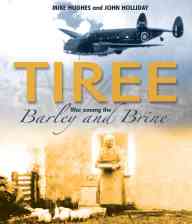
Just got back from the book launch for “Tiree: War among the Barley and Brine“.  Organised by An Iodhlann and the Islands Book Trust.

Mike Hughes, one of the authors, gave a talk and there were ex-service men connected with Tiree and their families present.  One man was the son of the pilot of one of the two Halifaxes which crashed into each other over the airfield on a cloudy day – a father he had never met as his mother was only 4 months pregnant at the time.

I hadn’t realised that it was from Tiree that the weather reports came in that set the timetable for D-Day.  The meteorological squadrons are unsung heroes of the war, flying far out into the Atlantic, in conditions where all other planes were grounded, to get the long-range weather data that is so easy to gather now-a-days from satellites.  Sadly the airman who had made the crucial weather observations for D-Day did not survive the war dying in that same Halifax accident over Tiree.

Neither had I known that Tiree was to be the staging post for the withdrawal of Winston Churchill and the Royal Family had the worst happened and the the German’s invaded Britain.  So, before it withdrew to a government in exile in Saskatchewan, the last outpost of British sovereignty would have been … Tiree.

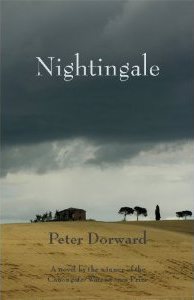
book: Nightingale, Peter Dorward

Peter Dorward’s Nightingale is a truly beautiful tale, both in language and story.  Not beautiful in a pink ribbons sense, but with a harsh, sometimes almost brutal directness.  Dorward is a Scot, so perhaps the image of whisky is pertinent.  Certainly not a liquor like limoncello, strong beneath but covered over with sweetness, like aspects of the Italy Dorward portrays, but like a South-East Islay Malt, a smoke-tar flavour that almost makes you gag and yet all the richer for its lack of compromise.

Nightingale, takes us into Italy’s “Years of Lead” (Anni di piombo), the period of political terrorism from left and right that left  thousands dead, and in particular the 1980 railway station bombing in Bologna, which killed eighty five one hot holiday morning.  This is hardly an easy topic to deal with.  The jacket describes the novel as a ‘literary thriller’, but it is at heart about people: the almost comic, but bloody, naivete of political extremism, and the tenuous glory of love.

Although, the central character in the novel is Scottish, and the protagonists include a German Baader-Meinhoff acolyte and an Egyptian bartender, Italians and Italy form not just the backdrop, but permeate the pages of Nightingale. Dorward describes Italy with sensitivity and straightforwardness, and I think loves the country and the people in the same way I have come to; yet aware of the dark undercurrents that often underlie the Formica-tabled pizzeria and high fashion boutiques.

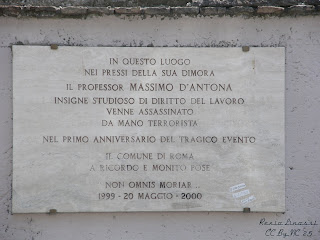
I recall a  few years ago seeing flowers around a plaque on the wall, just opposite the entrance to the University of Rome “La Sapienza” in via Salaria.  I had been visiting occasionally for several years, but not noticed the plaque before.  I was told it was to commemorate a Professor of the University, Massimo D’Antona, who had been assassinated some years earlier (1999) for serving on a government committee looking into the reform of labour law.  In the UK it sometimes seems we have lost our passion, that politics and life end up in a lassitude and compromise, that we need some of the passion of the south.  And yet, this passion comes at a cost.

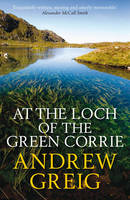
I came to Nightingale through reading Andrew Greig’s At the Loch of the Green Corrie.  The central part of Greig’s semi-biographical, semi-autobiographical book is his journey to fish at the loch of the title, accompanied with two close friends, brothers, one of which was Peter. One evening, camping beside another loch, in conversation oiled with whisky drunk from camping mugs, Peter shares his early ideas for a story.  He is a GP in London at the time, and dabbling in writing, but yet to write a full novel.

I was captivated by this real story, of the man and his desires, and instantly reached for the internet to find him.  It was with so much joy that I saw he had written the novel, and was now an award-winning author (and still a doctor, but now in Scotland). Greig’s account had opened up such an intimacy with these brothers, so wonderful to see those nascent ideas, on that midge-plagued, peat-mattressed shoreline, bear fruit.

roots – how do we see ourselves spatially

I was just reading the chapter on Benedict Anderson in “Key Thinkers on Space and Place1.  Anderson forged the concept of a national imagination, the way nations are as much, or more, a construct of socio-cultural imaginings than physical topography or legal/political sovereignty.

However, this made me wonder whether this conception itself was very culturally specific, to what extent do people relate to nation as opposed to other areas.

I was reminded particularly of a conversation with, the much missed, Pierro Mussio. He explained to me the distinct nature of Italian cultural identity, which tends to focus on regional and local identity before national identity, partly because Italy itself is quite young as a nation state (a mere 150 years in a country which sees itself in terms of millennia). There is even a word “campanilismo”, which is literally relating to the “bell tower” (campanile) in a town, meaning one’s primary loyalties lie to that bell tower, that town, that community.

How do you see yourself?  Are you British or Geordie, French or Parisian, American or New Yorker?

I know I see myself as ‘Welsh’.  Wales is part of Britain, but my Britishness is secondary to Welshness.  I was born and brought up in Bangor Street, Roath Park, Cardiff, but again while the street, area and city are foci of nostalgia, it is the Welshness which seems central.  For Fiona she is Cumbrian (rather than Wetheral, English or British), Steve who is visiting is British, but says his brother would say Scottish, despite both having spent equal amounts of time in Scotland whilst growing up and since.

I asked people on Twitter and got a variety of answers2, most quite broad:

“I always think English rather than British but I don’t have a more specific area to identify with.”

“I think I primarily think of myself as both “Brit” & “northerner”. Lancastrian when differentiating myself from Yorkshire lot!”

“in decreasing granularity I’m a Devoner (south, of course!), west country-er, English, British, European, World-ean.”

Some less clear:

“I’m confused specially. I am Coloradan and American by birth, but feel more at home in England, and miss Scotland.”

“ooh, complicated. I’m British but not English. that’s as specific as I get.”

The last perhaps particularly interesting in its focus on what he is not!

Obviously the way we see ourselves varies.

The choice of a ‘level of granularity’ for location reminds me a little of the way in which we have some sort of typical level in a classification hierarchy (I think Lakoff writes about this); for example you can say “look at that bird”, but not “look at that mammal”, you have to say “look at that dog” or “look at that cat”.  This also varies culturally including subcultures such as dog breeders – saying “look at that dog” in Crufts would hardy sound natural.

Some cities have specific words to refer to their natives: Glaswegian, Geordie, Londoner; others do not – I was brought up in Cardiff, but Cardiffian sounds odd.  Does the presence of a word (Cumbrian, Welsh) make you more likely to see yourselves in those terms, or is it more that it is that, where cities have forged a strong sense of belonging, words naturally emerge … I sense a Sapir-Whorf moment!

Now-a-days this is even more contested as loyalties and identities can be part of networked communities that cut across national and topographical boundaries.  In some way these new patterns of connection reinforce those focusing on human relations rather than physical space as defining countries and communities, but of course in far newer ways.

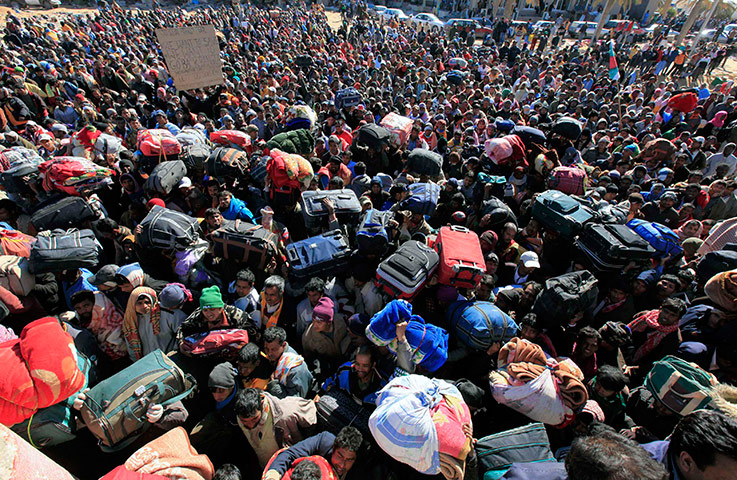
However, it also made me think of those parts of the world where there are large numbers of people with problematic statehood.  There is how we see ourselves and how states see us.  We tend to define democracy in terms of citizenship, and laud attempts, such as the Arab Spring, that give power to the people … but where ‘people’ means citizens.  In Bahrain the Shite majority are citizens and therefore their views should be considered in terms of democracy, whereas the migrant workers in Libya fleeing the rebels in the early days of the recent Libyan war, or the Palestinians in Kuwait during the first Gulf War were not citizens and therefore marginalised.

Defining citizenship then becomes one of the most powerful methods of control.  This has been used to powerful effect in Estonia leaving some who had lived the country for fifty years effectively stateless, and, while not leaving people stateless, in the UK new rules for electoral registration could leave up to 10 million, principally the young and the poor, voteless.

In the days of the nation state those with loyalties not tied to geography have always been problematic: Gypsies, Jews before the establishment of Israel, the various Saharan nomad trades.  Many of these have been persecuted and continue to suffer across the world, and yet paradoxically in a networked world it seems possible that pan-national identity may one day become the norm.


  1. I’ve got 1st edition, but 2nd edition recently come out. [back]
  2. Many thanks for those who Tweeted responses. [back]

book: The Unfolding of Language, Deutscher

I have previously read Guy Deutscher‘s “Through the Language Glass“, and have now, topsy turvy, read his earlier book “The Unfolding of Language“.  Both are about language, “The Unfolding of Language” about the development of the complexity of language that we see today from simpler origins, and “Through the Language Glass” about the interaction between language and thought.  Both are full of sometimes witty and always fascinating examples drawn from languages around the world, from the Matses in the Amazon to Ancient Sumarian.

I recall my own interest in the origins of language began young, as a seven year old over breakfast one day, asking whether ‘night, was a contraction of ‘no light’.  While this was an etymological red herring, it is very much the kind of change that Deutscher documents in detail showing the way a word accretes beginnings and ending through juxtaposition of simpler words followed by erosion of hard to pronounce sounds.

One of my favourites examples was the French “aujourd’hui”.  The word ‘hui, was Old French for ‘today’, but was originally Latin “hoc die”, “(on) this day”. Because ‘hui’ is not very emphatic it became “au jour d’hui”, “on the day of this day” , which contracted to the current ‘aujourd’hui’. Except now to add emphasis some French speakers are starting to say “au jour aujourd’hui”, “on the day on the day of this day”!  This reminds me of Longsleddale in the Lake District (inspiration for Postman Pat‘s Greendale),  a contraction of “long sled dale”, which literally means “long valley valley” from Old English “slaed” meaning “valley” … although I once even saw something suggesting that ‘long’ itself in the name was also “valley” in a different language!

Deutscher gives many more prosaic examples where words meaning ‘I’, ‘you’, ‘she’ get accreted to verbs to create the verb endings found in languages such as French, and how prepositions (themselves metaphorically derived from words like ‘back’) were merged with nouns to create the complex case endings of Latin.

However, the most complex edifice, which Deutscher returns to repeatedly, is that of the Semitic languages with a template system of vowels around three-consonant roots, where the vowel templates change the meaning of the root.  To illustrate he uses the (fictional!) root ‘sng’ meaning ‘to snog’ and discusses how first simple templates such as ‘snug’ (“I snogged”) and then more complex constructions such as ‘hitsunnag’ (“he was made to snog himself”) all arose from simple processes of combination, shortening and generalisation.

“The Unfolding of Language” begins with the 19th century observation that all languages seem to be in a process of degeneration where more complex  forms such as the Latin case system or early English verb endings are progressively simplified and reduced. The linguists of the day saw all languages in a state of continuous decay from an early linguistic Golden Age. Indeed one linguist, August Schleicher, suggested that there was a process where language develops until it is complex enough to get things done, and only then recorded history starts, after which the effort spent on language is instead spent in making history.

As with geology, or biological evolution, the modern linguist rejects this staged view of the past, looking towards the Law of Uniformitarianism, things are as they have always been, so one can work out what must have happened in the pre-recorded past by what is happening now.  However, whilst generally finding this convincing, throughout the book I had a niggling feeling that there is a difference.  By definition, those languages for which we have written records are those of large developed civilisations, who moreover are based on writing. Furthermore I am aware that for biological evolution small isolated groups (e.g. on islands or cut off in valleys) are particularly important for introducing novelty into larger populations, and I assume the same would be true of languages, but somewhat stultified by mass communication.

Deutscher does deal with this briefly, but right at the very end in a short epilogue.  I feel there is a whole additional story about the interaction between culture and the grammatical development of language.  I recall in school a teacher explained how in Latin the feminine words tended to belong to the early period linked to agriculture and the land, masculine words for later interests in war and conquest, and neuter for the still later phase of civic and political development. There were many exceptions, but even this modicum of order helped me to make sense of what otherwise seemed an arbitrary distinction.

The epilogue also mentions that the sole exception to the ‘decline’ in linguistic complexity is Arabic with its complex template system, still preserved today.

While reading the chapters about the three letter roots, I was struck by the fact that both Hebrew an Arabic are written as consonants only with vowels interpolated by diacritical marks or simply remembered convention (although Deutscher does not mention this himself). I had always assumed that this was like English where t’s pssble t rd txt wth n vwls t ll. However, the vowels are far more critical for Semitic languages where the vowel-less words could make the difference between “he did it” and “it will be done to him”.  Did this difference in writing stem from the root+template system, or vice versa, or maybe they simply mutually reinforced each other?

The other factor regarding Arabic’s remarkable complexity must surely be the Quran. Whereas the Bible was read for a over a millennium in Latin, a non-spoken language, and later translated focused on the meaning; in contrast there is a great emphasis on the precise form of the Quran together with continuous lengthy recitation.  As the King James Bible has been argued to have been a significant influence on modern English since the 17th century, it seems likely the Quran has been a factor in preserving Arabic for the last 1500 years.

Early in “The Unfolding of Language” Deutscher dismisses attempts to look at the even earlier prehistoric roots of language as there is no direct evidence. I assume that this would include Mithin’s “The Singing Neanderthals“, which I posted about recently. There is of course a lot of truth in this criticism; certainly Mithin’s account included a lot of guesswork, albeit founded on paleontological evidence.  However, Deutscher’s own arguments include extrapolating to recent prehistory. These extrapolations are based on early written languages and subsequent recorded developments, but also include guesswork between the hard evidence, as does the whole family-tree of languages.  Deutscher was originally a Cambridge mathematician, like me, so, perhaps unsurprisingly, I found his style of argument convincing. However, given the foundations on Uniformitarianism, which, as noted above, is at best partial when moving from history to pre-history, there seems more of  a continuum rather than sharp distinction between the levels of interpretation and extrapolation in this book and Mithin’s.

Deutscher’s account seeks to fill in the gap between the deep prehistoric origins of protolanguage (what Deutscher’s calls ‘me Tarzan’ language) and its subsequent development in the era of media-society (starting 5000BC with extensive Sumerian writing). Rather than seeing these separately, I feel there is a rich account building across various authors, which will, in time, yield a more complete view of our current language and its past.

book: The Singing Neanderthals, Mithin

One of my birthday presents was Steven Mithin’s “The Singing Neanderthals” and, having been on holiday, I have already read it! I read Mithin’s “The Prehistory of the Mind” some years ago and have referred to it repeatedly over the years1, so was excited to receive this book, and it has not disappointed. I like his broad approach taking evidence from a variety of sources, as well as his own discipline of prehistory; in times when everyone claims to be cross-disciplinary, Mithin truly is.

“The Singing Neanderthal”, as its title suggests, is about the role of music in the evolutionary development of the modern human. We all seem to be born with an element of music in our heart, and Mithin seeks to understand why this is so, and how music is related to, and part of the development of, language. Mithin argues that elements of music developed in various later hominids as a form of primitive communication2, but separated from language in homo sapiens when music became specialised to the communication of emotion and language to more precise actions and concepts.

The book ‘explains’ various known musical facts, including the universality of music across cultures and the fact that most of us do not have perfect pitch … even though young babies do (p77). The hard facts of how things were for humans or related species tens or hundreds of thousands of years ago are sparse, so there is inevitably an element of speculation in Mithin’s theories, but he shows how many, otherwise disparate pieces of evidence from palaeontology, psychology and musicology make sense given the centrality of music.

Whether or not you accept Mithin’s thesis, the first part of the book provides a wide ranging review of current knowledge about the human psychology of music. Coincidentally, while reading the book, there was an article in the Independent reporting on evidence for the importance of music therapy in dealing with depression and aiding the rehabilitation of stroke victims3, reinforcing messages from Mithin’s review.

The topic of “The Singing Neanderthal” is particularly close to my own heart as my first personal forays into evolutionary psychology (long before I knew the term, or discovered Cosmides and Tooby’s work), was in attempting to make sense of human limits to delays and rhythm.

Those who have been to my lectures on time since the mid 1990s will recall being asked to first clap in time and then swing their legs ever faster … sometimes until they fall over! The reason for this is to demonstrate the fact that we cannot keep beats much slower than one per second4, and then explain this in terms of our need for a mental ‘beat keeper’ for walking and running. The leg shaking is to show how our legs, as a simple pendulum, have a natural frequency of around 1Hz, hence determining our slowest walk and hence need for rhythm.

Mithin likewise points to walking and running as crucial in the development of rhythm, in particular the additional demands of bipedal motion (p150). Rhythm, he argues, is not just about music, but also a shared skill needed for turn-taking in conversation (p17), and for emotional bonding.

In just the last few weeks, at the HCI conference in Newcastle, I learnt that entrainment, when we keep time with others, is a rare skill amongst animals, almost uniquely human. Mithin also notes this (p206), with exceptions, in particular one species of frog, where the males gather in groups to sing/croak in synchrony. One suggested reason for this is that the louder sound can attract females from a larger distance. This cooperative behaviour of course acts against each frog’s own interest to ‘get the girl’ so they also seek to out-perform each other when a female frog arrives. Mithin imagines that similar pressures may have sparked early hominid music making. As well as the fact that synchrony makes the frogs louder and so easy to hear, I wonder whether the discerning female frogs also realise that if they go to a frog choir they get to chose amongst them, whereas if they follow a single frog croak they get stuck with the frog they find; a form of frog speed dating?

Mithin also suggests that the human ability to synchronise rhythm is about ‘boundary loss’ seeing oneself less as an individual and more as part of a group, important for early humans about to engage in risky collaborative hunting expeditions. He cites evidence of this from the psychology of music, anthropology, and it is part of many people’s personal experience, for example, in a football crowd, or Last Night at the Proms.

This reminds me of the experiments where a rubber hand is touched in time with touching a person’s real hand; after a while the subject starts to feel as if the rubber hand is his or her own hand. Effectively our brain assumes that this thing that correlates with feeling must be part of oneself5. Maybe a similar thing happens in choral singing, I voluntarily make a sound and simultaneously everyone makes the sound, so it is as if the whole choir is an extension of my own body?

Part of the neurological evidence for the importance of group music making concerns the production of oxytocin. In experiments on female prairie voles that have had oxytocin production inhibited, they engage in sex as freely as normal voles, but fail to pair bond (p217). The implication is that oxytocin’s role in bonding applies equally to social groups. While this explains a mechanism by which collaborative rhythmic activities create ‘boundary loss’, it doesn’t explain why oxytocin is created through rhythmic activity in the first place. I wonder if this is perhaps to do with bipedalism and the need for synchronised movement during face-to-face copulation, which would explain why humans can do synchronised rhythms whereas apes cannot. That is, rhythmic movement and oxytocin production become associated for sexual reasons and then this generalises to the social domain. Think again of that chanting football crowd?

I should note that Mithin also discusses at length the use of music in bonding with infants, as anyone who has sung to a baby knows, so this offers an alternative route to rhythm & bonding … but not one that is particular to humans, so I will stick with my hypothesis ;-)

Sexual selection is a strong theme in the book, the kind of runaway selection that leads to the peacock tail. Changing lifestyles of early humans, in particular longer periods looking after immature young, led to a greater degree of female control in the selection of partners. As human size came close to the physical limits of the environment (p185), Mithin suggests that other qualities had to be used by females to choose their mate, notably male singing and dance – prehistoric Saturday Night Fever.

As one evidence for female mate choice, Mithin points to the overly symmetric nature of hand axes and imagines hopeful males demonstrating their dexterity by knapping ever more perfect axes in front of admiring females (p188). However, this brings to mind Calvin’s “Ascent of Mind“, which argues that these symmetric, ovoid axes were used like a discus, thrown into the midst of a herd of prey to bring one down. The two theories for axe shape are not incompatible. Calvin suggests that the complex physical coordination required by axe throwing would have driven general brain development. In fact these forms of coordination, are not so far from those needed for musical movement, and indeed expert flint knapping, so maybe it was this skills that were demonstrated by the shaping of axes beyond that immediately necessary for purpose.

Mithin’s description of the musical nature of mother-child interactions also brought to mind Broomhall’s “Eternal Child“. Broomhall ‘s central thesis is that humans are effectively in a sort of arrested development with many features, not least our near nakedness, characteristic of infants. Although it was not one of the points Broomhall makes, his arguments made sense to me in terms of the mental flexibility that characterises childhood, and the way this is necessary for advanced human innovation; I am always encouraging students to think in a more childlike way. If Broomhall’s theories were correct, then this would help explain how some of the music making more characteristic of mother-infant interactions become generalised to adult social interactions.

I do notice an element of mutual debunking amongst those writing about richer cognitive aspects of early human and hominid development. I guess a common trait in disciplines when evidence is thin, and theories have to fill a lot of blanks. So maybe Mithin, Calvin and Broomhall would not welcome me bringing their respective contributions together! However, as in other areas where data is necessarily scant (such as sub-atomic physics), one does feel a developing level of methodological rigour, and the fact that these quite different theoretical approaches have points of connection, does suggest that a deeper understanding of early human cognition, while not yet definitive, is developing.

In summary, and as part of this wider unfolding story, “The Singing Neanderthal” is an engaging and entertaining book to read whether you are interested in the psychological and social impact of music itself, or the development of the human mind.

… and I have another of Mithin’s books in the birthday pile, so looking forward to that too!


  1. See particularly my essay on the role of imagination in bringing together our different forms of ‘specialised intelligence’. “The Prehistory of the Mind” highlighted the importance of this ‘cognitive fluidity’, linking social, natural and technological thought, but lays this largely in the realm of language. I would suggest that imagination also has this role, creating a sort of ‘virtual world’ on which different specialised cognitive modules can act (see “imagination and rationality“). [back]
  2. He calls this musical communication system Hmmmm in its early form – Holistic, Multiple-Modal, Manipulative and Musical, p138 – and later Hmmmmm – Holistic, Multiple-Modal, Manipulative, Musical and Mimetic, p221. [back]
  3. NHS urged to pay for music therapy to cure depression“, Nina Lakhani, The Independent, Monday, 1 August 2011 [back]
  4. Professional conductors say 40 beats per minute is the slowest reliable beat without counting between beats. [back]
  5. See also my previous essay on “driving as a cyborg experience“. [back]

book: The Laws of Simplicty, Maeda

Yesterday I started to read John Maeda’s “The Laws of Simplicty” whilst  sitting by Fiona’s stall at the annual Tiree agricultural show, then finished before breakfast today.  Maeda describes his decision to cap at 100 pages1 as something that could be read during a lunch break. To be honest 30,000 words sounds like a very long lunch break or a very fast reader, but true to his third law, “savings in time feel like simplicity”2, it is a short read.

The shortness is a boon that I wish many writers would follow (including me). As with so many single issue books (e.g. Blink), there is s slight tendency to over-sell the main argument, but this is forgiveable in a short delightful book, in a way that it isn’t in 350 pages of less graceful prose.

I know I have a tendency, which can be confusing or annoying, to give, paradoxically for fear of misunderstanding, the caveat before the main point. Still, despite knowing this, in the early chapters I did find myself occasionally bristling at Maeda’s occasional overstatement (although in accordance with simplicity, never hyperbole).

One that particularly caught my eye was Maeda’s contrast of the MIT engineer’s RFTM (Read The F*cking Manual) with the “designer’s approach” to:

marry function with form to create intuitive experiences that we understand immediately.

Although in principle I agree with the overall spirit, and am constantly chided by Fiona for not reading instructions3, the misguided idea that everything ought to ‘pick up and use’ has bedeviled HCI and user interface design for at least the past 20 years. Indeed this is the core misconception about Heidegger’s hammer example that I argued against in a previous post “Struggling with Heidegger“. In my own reading notes, my comment is “simple or simplistic!” … and I meant here the statement not the resulting interfaces, although it could apply to both.

It has always been hard to get well written documentation, and the combination of single page ‘getting started’ guides with web-based help, which often disappears when the web site organisation changes, is an abrogation of responsibility by many designers. Not that I am good at this myself. Good documentation is hard work. It used to be the coders who failed to produce documentation, but now the designers also fall into this trap of laziness, which might be euphemistically labelled ‘simplicity’4.

Personally, I have found that the discipline of documenting (in the few times I have observed it!) is in fact a great driver of simple design. Indeed I recall a colleague, maybe Harold Thimbleby5, once suggested that documentation ought to be written before any code is written, precisely to ensure simple use.

Some years ago I was reading a manual (for a Unix workstation, so quite a few years ago!) that described a potentially disastrous shortcoming of a the disk sync command (which could have corrupted the disk). Helpfully the manual page included a suggestion of how to wrap sync in scripts that prevented the problem. This seemed to add insult to injury; they knew there was a serious problem, they knew how to fix it … and they didn’t do it. Of course, the reason is that manuals are written by technical writers after the code is frozen.

In contrast, I was recently documenting an experimental API6 so that a colleague could use it. As I wrote the documentation I found parts hard to explain. “It would be easier to change the code”, I thought, so I did so. The API, whilst still experimental, is now a lot cleaner and simpler.

Coming back to Maena after a somewhat long digression (what was that about simplicity and brevity?). While I prickled slightly at a few statements, in fact he very clearly says that the first few concrete ‘laws’ are the simpler (and if taken in their own simplistic), the later laws are far more nuanced and suggest deeper principles. This includes law 5 “differences: simplicity and complexity need each other”, which suggest that one should strive for a dynamic between simplicity and complexity. This echoes the emphasis on texture I often advocate when talking with students; whether in writing, presenting or in experience design it is often the changes in voice, visual appearance, or style which give life.

Unix command line prompt

the simplest interface?

I wasn’t convinced by Maeda’s early claim that simple designs were simpler and cheaper to construct.  Possibly true for physical prodcuts, but rarely so for digital interfaces, where more effort is typically needed in code to create simpler user interfaces.  However, again this was something that was revisited later, especially in the context of more computationally active systems (“law 8, in simplicity we trust”), where he contrasts “how much do you need to know about a system?” with “how much does the system know about you?”.  The former is the case of more traditional passive systems, whereas more ‘intelligent’ systems such as Amazon recommendations (or even Facebook news feed) favour the latter.  This is very similar to the principles for incidental and low-intention interaction that I have discussed in the past7.

Finally “The Laws of Simplicity” is beautifully designed in itself.  It includes  many gems not least those arising from Maeda’s roots in Japanese design culture, including aichaku, the “sense of attachment one can feel for an artefact” (p.69) and omakase meaning “I leave it to you”, which asks the sushi chef to create a meal especially for you (p.76).  I am perhaps too much of a controller to feel totally comfortable with the latter, but Maeda’s book certainly inspires the former.


  1. In fact there are 108 pages in the main text, but 9 of these are full page ‘law/chapter’ frontispieces, so 99 real pages.  However, if you include the 8 page introduction that gives 107 … so even the 100 page cap is perhaps a more subtle concept than a strict count. [back]
  2. See his full 10 laws of simplicity at lawsofsimplicity.com [back]
  3. My guess is that the MIT engineers didn’t read the manuals either. [back]
  4. Apple is a great — read poor — example here as it relies on keen technofreaks to tell others about the various hidden ways to do things — I guess creating a Gnostic air to the devices. [back]
  5. Certainly Harold was a great proponent of ‘live’ documentation, both Knuth’s literate programming and also documentation that incorporated calculated input and output, rather like dexy, which I reported after last autumn’s Web Art/Science camp. [back]
  6. In fairness, the API had been thrown together in haste for my own use. [back]
  7. See ‘incidental interaction” and HCI book chapter 18. [back]

Or … is Amazon becoming the publishing Industry?

A recent Blog Kindle post asked “Is Amazon’s Kindle Destroying the Publishing Industry?“.  The post defends Kindle seeing the traditional publishers as reactionaries, whose business model depended on paper publishing and, effectively. keeping authors from their public.

However, as an author myself (albeit academic) this seems to completely miss the reasons for the publishing industry.  The printing of physical volumes has long been a minimal part of the value, indeed traditional publishers have made good use of the changes in physical print industry to outsource actual production.  The core value for the author are the things around this: marketing, distribution and payment management.

Of these, distribution is of course much easier now with the web, whether delivering electronic copies, or physical copies via print-on demand services.  However, the other core values persist – at their best publishers do not ring fence the public from the author, but on the contrary connect the two.

I recall as a child being in the Puffin Club and receiving the monthly magazine.  I could not afford many books at the time, but since have read many of the books described in its pages and recall the excitement of reading those reviews.  A friend has a collection of the early Puffins (1-200) in their original covers; although some stories age, some are better, some worse, still just being a Puffin Book was a pretty good indication it was worth reading.

The myth we are being peddled is of a dis-intermediated networked world where customers connect directly to suppliers, authors to readers1, musicians to fans.  For me, this has some truth, I am well enough known and well enough connected to distribute effectively.  However for most that ‘direct’ connection is mediated by one of a small number of global sites … and smaller number of companies: YouTube, Twitter, Google, iTunes, eBay, not to forget Amazon.

For publishing as in other areas, what matters is not physical production, the paper, but the route, the connection, the channel.

And crucially Kindle is not just the device, but the channel.

The issue is not whether Kindle kills the publishing industry, but whether Amazon becomes the publishing industry.  Furthermore, if Amazon’s standard markdown and distribution deals for small publishers are anything to go by, Amazon is hardly going to be a cuddly home for future authors.

To some extent this is an apparently inexorable path that has happened in the traditional industries, with a few large publishing conglomerates buying up the smaller publishing houses, and on the high street a few large bookstore chains such as Waterstones, Barnes & Noble squeezing out the small bookshops (remember “You’ve Got Mail“), and it is hard to have sympathy with Waterstones recent financial problems given this history.

Philip Jones of the Bookseller recently blogged about these changes, noting that it is in fact book selling, not publishing that is struggling with profits … even Amazon – no wonder Amazon want more of the publishing action.  However, while Jones notes that the “digital will lead to smaller book chains, stocking fewer titles” in fact “It wasn’t digital that drove this, but it is about to deliver the coup de grâce.”

Which does seem a depressing vision both as author and reader.


  1. Maybe unbound.co.uk is actually doing this – see Guardian article, although it sounds more useful to the already successful writer than the new author. [back]

Books and books about books

A combination of things (several rail journeys and flights including two long haul, waits at airports due to snow, an unexpected 2 day diversion to a hotel outside Istanbul again due to snow,  a few days illness after Christmas, and a power cut lasting a whole morning) have all meant that I have spent more time reading than usual.  Now it is not that I do not want to read, and it has always been one of my chief pleasures, but as an academic, paradoxically, for many years my reading has narrowed to the next report, thesis or paper to review shutting out not just reading for pleasure, but any academic book or article that was not immediately necessary for the next deadline.

However, I have been wonderfully forced by circumstances back to the page.

I have already written about one of these “The Shadow of the Wind” while I was travelling, itself a book about books, and while travelling I also read Kathryn Harrison’s “A Thousand Orange Trees” (an eye opening but unrelentingly depressing vision of women’s life during the Spanish inquisition), Frank McCourt’s “Angela’s Ashes” (a sometimes depressing, but also glorious account of a hard Irish childhood), Jodi Picoult’s “Change of Heart” (on the death penalty and religion) and Elizabeth Gaskell’s “Ruth” (a wonderful book about the small mindedness and great generosity of the human spirit, especially remarkable when seen against its time).

… and then I had some new books for Christmas …

At first Keith Gray’s “Ostrich Boys” seems like a classic boy’s book with three friends ‘kidnapping’ the ashes of their friend Ross in order to give him a proper send off at Ross in Scotland.   Like all journey stories, a mixture of going on against the odds and self discovery, not in the league of Cynthia Voigt’s “Homecoming“, but more likely to be read by boys wanting a good adventure and being stretched in the process.

Mal Peet’s “Tamar” is clearly for ‘young adults’, a claustrophobic tale of war time resistance in 1945 cut through with a ‘modern day’ tale.  This parallel tale is a hard genre, and, like Joan Lingard “Natasha’s Will“, I felt Peet managed the 1945 tale better than the current day one1. Although Peet is writing for an older audience, I was reminded of the way Nina Bawden manages to get me to identify, however unwillingly at times, with the flawed characters in her children’s novels.

Susan Hill’s “Howards End is on the Landing” is, like “The Shadow of the Wind“, a book about books, but whereas Zafon’s Novel is set against a fictional library, Susan Hill tells us about her own bookshelves, which seem to coat and fill, like windblown snow, every wall and nook in her house.  She decides to spend a year reading only the books she already has on her shelves, a decision that coincides with a resolution to minimise use of the internet:

Too much internet usage fragments the brain and dissipates concentration so that after a while, one’s ability to spend long, focused hours immersed in a single subject becomes blunted.  Information comes pre-digested in small pieces, one grazes on endless ready-meals and snacks of the mind, and the result is mental malnutrition. (p.2)

This reminds me a little of Andrew Keen’s “The Cult of the Amateur” except Susan Hill says it more succinctly and elegantly.

Hill’s reading is both eclectic and catholic, encompassing Ian Flemming along with Trollope and Chaucer.  She takes Enid Blyton and J.K. Rowling seriously for their contribution to literacy (although unlike me does not re-read the former), and is happy to say that she never feels comfortable with Austin.  As she describes the titles she finds, sometimes lost between unlikely bedfellows, I am inspired to read them all and also to look to my own shelves:

A book which is left on a shelf for a decade is a dead thing, but it is also a chrysalis, packed with the potential to burst into new life. (p.2)

Susan Hill’s knowledge is amazing and the book is filled with anecdotes about authors she has met, known and corresponded with, giving hints of the inside story of many 20th century writers.  Sometimes I am surprised at her choices or rather not what she chooses, but more what she rejects.  In her list of books she has not read she includes:

Buddenbrooks. Thomas Mann

I want to read this . I mean to read this. I really do.

but also:

Romola. George Elliot

I do understand how I can have not read it.  (p.70)

Why?  Does she mean she can understand why it has not crossed her path, or that she does not want to read it? It is a book I have re-read several times, although always wishing the ending could be different.  I know she does not like “A Tale of Two Cities” feeling that Dickens is at his best when dealing with (for him) the contemporary; maybe she fears the same is true of Elliot?

However, Hill never assumes that her tastes are her readers’ tastes, she does not select the ‘good’ books, but the books she wants to read.

Sadly she does not supply a list of all the books she read during the year, but at the end she gives a ‘top 40′ list, with some I know well such as “The Mayor of Casterbridge“, some I know of but have never read, such as “A Passage to India“, and some I have never heard of such as “Flaubert’s Parrot“.  An instant Amazon Wish List!

Top of her top 40 are the Book of Common Prayer and the Bible (King James Version) — in the text (p173/174) deliberately in that order, but for some reason in the list at the end the Bible comes first, did she rethink after writing, or is it an editorial decision to make the list look neater?

This reminds me that I need to retrieve my battered school bible from underneath the pew where I left it after the Christmas morning service.  Also, the last of my Christmas reading (helped enormously by the enforced internet blackout due to the power cut), a book of Fiona’s “Whose Bible Is It?” by a biblical scholar and champion of inter-faith relations Joroslav Pelikan.  It is a book about a book, or rather a book about books, as Pelikan reminds us that the word “Bible” strictly means “little books”. I know some of the history of the forming of the modern Bible, but Pelikan’s encyclopaedic and detailed knowledge shines through.  I had not realised that it was the Greek Septuagint rather than the Hebrew Tanakh (Old Testament) that is quoted by the New Testament writers, making odd the decision of the early Protestants to excise the ‘Apocrypha’ (the writings in the Septuagint but not in the Hebrew).

It is a short and very readable book, but at times I found myself wanting to know a little more on some points.  When discussing the dates of the Gospels Pelikan notes that Mark is usually dated at 70CE, but doesn’t explain why.  Previously I’ve seen the same date quoted with the reason being that the Gospel appears to predict the fall of Jerusalem which happened in 70AD and therefore must have been written after.  This argument seems to presuppose that prediction is impossible and by analogy would inevitably lead to future historians excising or re-dating  several of Vince Cable’s statements prior to the 2008 financial crash. Maybe there is a better reason, or maybe, like other academic disciplines, biblical scholarship is a servant of its assumptions.

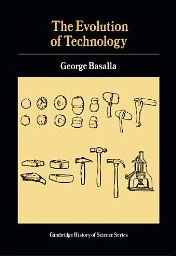
And now … no more power cuts and the internet is flawless, but trying not loose momentum with Sheila Stewart’s “Pilgrims of the Mist“, Mike Parker’s “Map Addict” and George Basalla’s “The Evolution of Technology” all on the go … maybe another post in a couple of weeks.


  1. Try also Susan Cooper’s “Victory” for a story that blends past and current narrative with equal conviction. [back]

book: The Shadow of the Wind, Zafon

I’ve been reading “The Shadow of the Wind” by Carlos Zafon.  It is actually a gift from Sinterklaas as I had the joy a few weeks ago to be with Mari-Carmen, Theo and Andrea in Utrecht at ‘Sinterklaas‘ (5th December, St Nicholas Day), the day when Santa delivers presents in Holland (maybe his dry run each year to get into shape ready for the big run on Christmas Eve).  I hadn’t expected Santa to remember me in Utrecht as he will be visiting Tiree this week.  However, to my joy I also had gifts including this book1.

What can be more enchanting than a book about books, a book that starts with the finding of a book, where the protagonist is brought up in a bookshop, has parents who met in a bookshop and who falls in love during the reading of a book.

Zafon creates an entangled plot where the characters in the book and the characters in the book that is in the book sometimes seem to almost merge into one another; a whodunnit ranged around dusty bookshelves, tattered undelivered letters, the lonely, the haunted and the deranged, all set in the rain-soaked streets of post-war Barcelona.

The Shadows of the Wind is full of wonderful phrases, often wry or ribald, but always perceptive, which cry out to be quoted:

On Latin: “There’s no such thing as a dead language, only dormant minds

On the impact of TV: “Humans will return to living in caves, to medieval savagery, and to the general state of imbecility that slugs overcame back in the Pleistocene era.

On courtship and gender: “you’re the man, and must take the lead … One has to pay some price for being able to pee standing up.

On the sound of teachers: “Years of teaching had left him with that firm didactic tone of someone used to being heard, but not certain of being listened to.

On action: “destiny does not do home visits. You have to go for it yourself.

Just as The Shadows of the Wind starts with a book and a secret, so it ends with a book and a secret, stories repeat, but sometimes get rewritten.


  1. I strongly suspect that Mari-Carmen helped Sinterklaas by advising a good choice of book. [back]

book: How Green Was My Valley

After too many years I eventually read Richard Llewellyn’s “How Green Was My Valley“, which tells the story of growing up in a South Wales valley at the end of the 19th century.  I vaguely recall seeing the film of the book on the TV one Sunday afternoon as a small child.

You can read the book as a social commentary of a time past, or as a coming of age novel set around with stories of strikes and singing, madness and joy, requited and unrequited loves.   But above all it is a book of poetry, not in the sense of verse, but that form of prose that raises goosebumps down your back:

“… and I raised my arms and drew tight the muscles of my body, and as the blood within me thudded through my singing veins, a goldness opened wide before me and I knew I had become of Men, a Man.” (Chap. 24)

“My Valley, O my Valley, within me, I will live in you eternally … for part of me is the memory of you in your greens and browns, with everything of life happy in your deeps and shades, when you gave sweet scents to us, and sent for spices for the pot, and flowers, and birds sang out for pleasure to be with you.” (Chap. 18)

A recurrent theme through the novels is the gradual covering of that green, the burying of the valley sides and trees beneath the encroaching blackness of the slag, the coal tips, which as a child I recall still covering the valley sides north of Cardiff.  Indeed the novel is narrated by an old man thinking back over his childhood as he leaves his family home for the last time, a home itself now half buried as the slag spreads ever down the valley.

In the early days of coal mining the slag, the pieces of coal that were too small to burn, was left below the ground, rammed hard into the sides of the tunnels, strengthening and supporting them. But in the time of the book, and on throughout the 20th century, it proved cheaper and quicker to bring everything to the surface and separate there, the remains being spread upon the mountain sides in dark hills of their own, like welts upon a diseased landscape eaten underground by men.

“There is a patience in the Earth to allow us to go into her, and dig, and hurt with tunnels and shafts, and if we put back the flesh we have torn from her and so make good what we have weakened, she is content to let us bleed her. But when we take, and leave her weak where we have taken, she has a soreness, and an anger that we should be so cruel to her and thoughtless of her comfort. So she waits for us, and finding us, bears down, and bearing down, makes us a part of her, flesh of our flesh, with our clay in place of the clap we thoughtlessly have shovelled away.” (Chap. 42)

These are the thoughts of the elderly Huw looking back at the moment when he sat with his father part buried and dying after a roof fall.  Prescient today when we are at last beginning to realise how much we have taken from the earth and how little given back.

But, while the narrator is thinking of the toll taken on the miners underground by the thoughtless drive for profit and cheap coal, those brooding slag heaps remind me more of the dark repayment taken above.

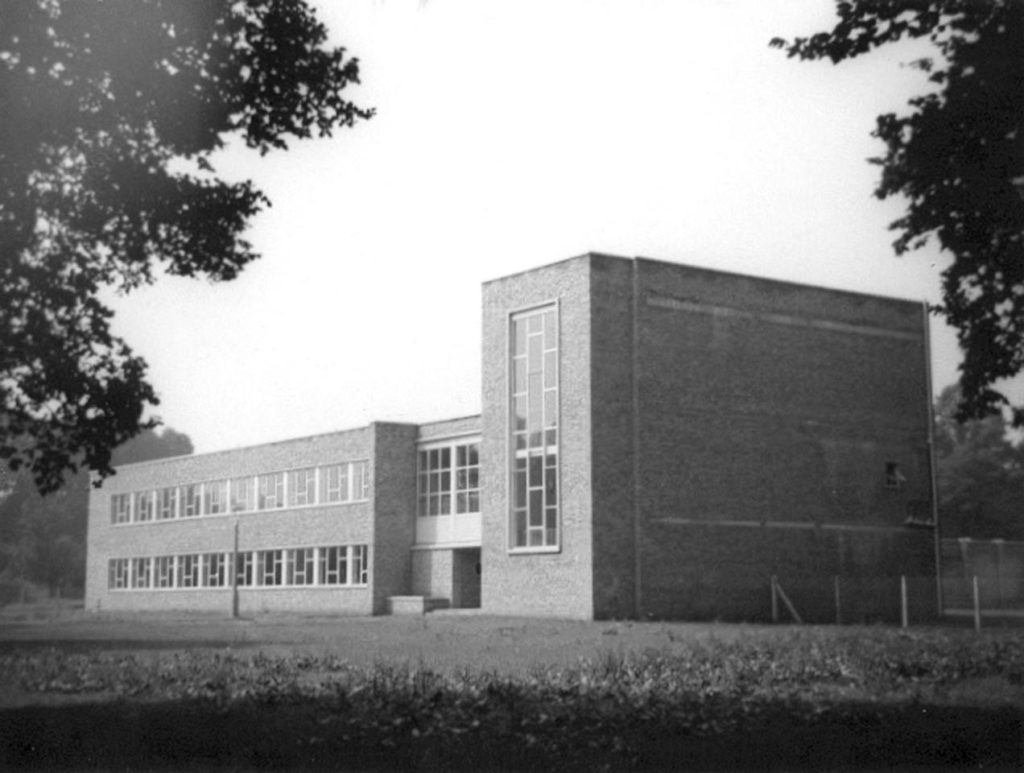
One of the defining moments of my own childhood, was when, a few months after the Aberfan disaster, we drove up to Brecon along the valley road, and looked across the valley to a field of white crosses, like the images of Flanders on Armistice day, only no red poppies among the white graves, just white against green a ghastly mirror of the black upon green of the coal tip that rolled down the valley-side burying the school of Aberfan and taking the lives of  whole generation of children.